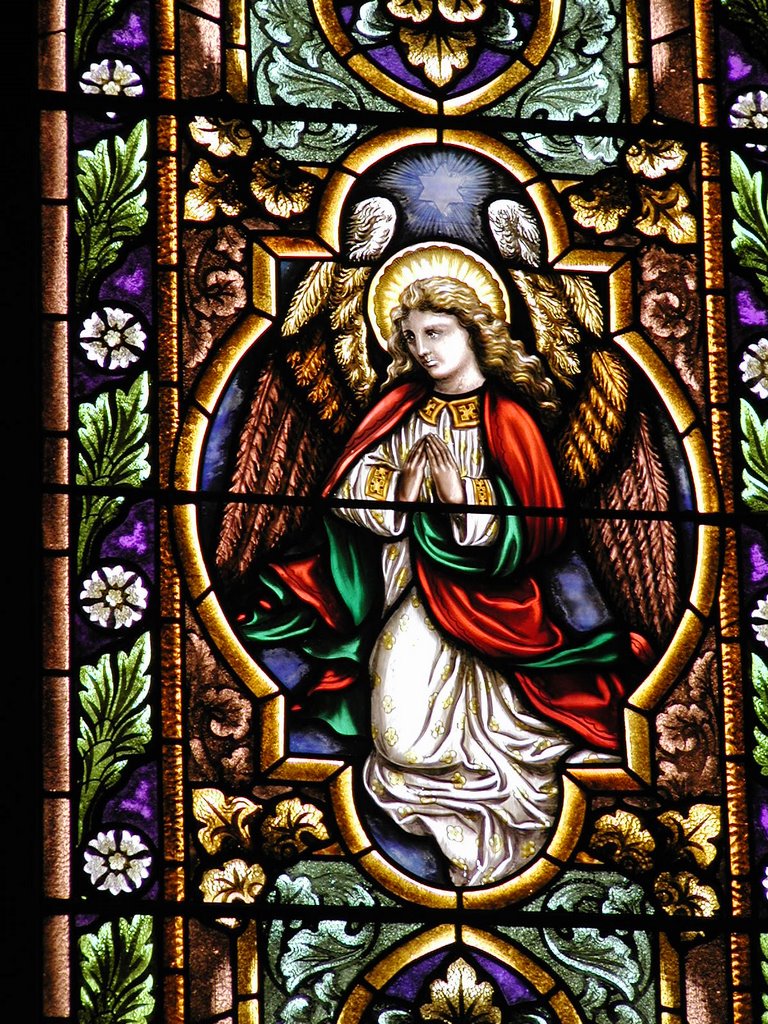
Saturday, September 23, 2006

Bet you can't have this on YOUR courthouse!

On our recent vacation down California's central coast, we spent a couple of days in Santa Barbara. We noticed that the AAA Tour Book had bestowed one of its infrequent "Gem" ratings on the Santa Barbara county courthouse, so in our wanderings through town, we stopped there, curious why a courthouse should have earned such high marks.

What a place it turned out to be -- the kind of public building that everyone could agree upon not so long ago, but which now would be impossible get past the censors from the ACLU and People for the American Way. Built in gorgeous Spanish-colonial style in the 1920's, it's full of exquisite craftsmanship, yet it's not a museum piece; it's still very much a fully functional courthouse. The murals, metalwork, tilework and paintings are a constant and unabashed celebration of the brief history of the region -- all of it, not just the part that's politically correct to recall.

For instance, here in California, it's not fashionable to celebrate Blessed Fr. Serra's tremendous accomplishment in founding the California missions. Since white people and their influence are considered baneful here right now, the padres are seen as foreign invaders who ruined the idyllic lives of the indigenous tribes, enslaving them and infecting them with smallpox, probably on purpose, of course. So it was a refreshing surprise to see this on their courthouse doors:
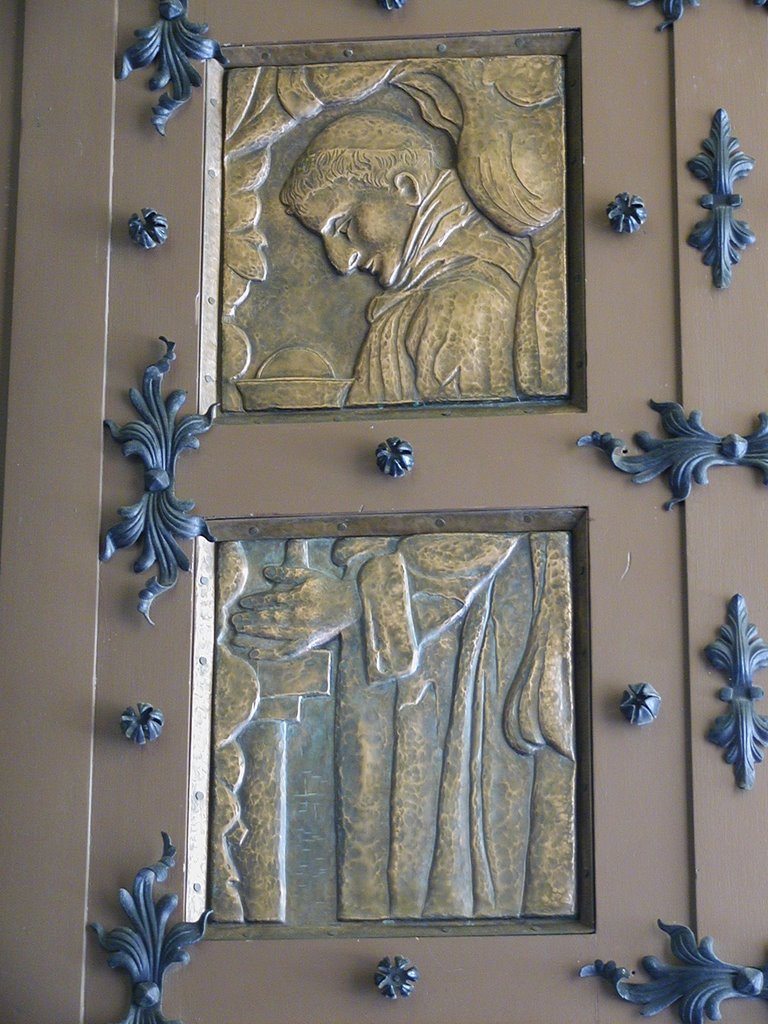


which appears to be a priest with the chalice and host; or this:


which is Fr. Serra gazing at the Santa Barbara mission -- holding a cross.

PAW and ACLU members, step away from your speed dials. Touch these artworks, and it's war.

And then there's the City Council chamber, adorned with enormous murals on three walls, showing the founding of Mission Santa Barbara, mission life, and the coming of the Americans in 1846. Each group -- Indians, the padres, the Spanish settlers, and the Americans -- is depicted with dignity. I should add that the murals are done in the style of that great American illustrator of the early 20th century, N. C. Wyeth (though not, alas, by the man himself). Wish I could show you pictures, but mine were disappointing. You'll have to see the paintings for yourself.

And then there's this motto, sitting prominently above the main entrance (and repeated in Spanish nearby):


"God gave us the country; the skill of man hath built the town." (Varro, A.D. 50).

So, come to think of it, all of this together means that Santa Barbara's courthouse has more overtly Catholic imagery and more references to God than a certain pretend cathedral down the road in L.A.


Friday, September 22, 2006

The "M" word

I hate how the word "martyr" is getting co-opted by those who are blowing other people up in the name of Allah, or the Palestinian people, or who knows what, and killing themselves in the process.

For centuries, "martyr" in the West has denoted a person who is put to death because of his witness to the Christian faith (the word itself derives from the ancient Greek legal term for a witness in court -- who, I presume, did not then blow up the court). Though the Christian might enter a dangerous situation expecting or even hoping for death, he did no harm to those around him. Death was inflicted on him, and his very defenselessness lent additional power to his witness for Christ.

Then along came the suicide bombers of Islam, and the perverse habit of translating the Arabic "shahid" as "martyr". So now what used to be a word for honorable self-sacrifice while doing no harm is being expanded to encompass killing yourself while doing others the ultimate harm. And consequently we have to read about such things as the Al-Aqsa "Martyrs" Brigade. What evil nonsense.

Followers of Muhammad, there's a better "M" word for what you're doing: Murder.

Ah, yes. The Al-Aqsa Murderers Brigade. That's better.

Sunday, September 17, 2006

This Sunday at St. Thomas

Most of the St. Ann Choir is singing on a tour in eastern Europe this week, but the "saving remnant" left behind still managed to produce these three Renaissance gems at the noon mass today:

Josquin d'Ascanio, In Te, Domine, Speravi
Martin de Rivaflecha, Anima Mea Liquefacta Est
Thomas Tallis, If Ye Love Me

Tuesday, September 12, 2006

Some common sense at last

The Salt Lake City Tribune quotes a gutsy priest about the U.S. response to 9/11:
Rev. Erik J. Richtsteig, pastor of St. James Catholic Church in Ogden, says the U.S. had every right to strike back after it was attacked on Sept. 11. "If someone is pulling a gun out of their holster, you don't wait for them to pull the trigger before you do something about it."
Fr. Richsteig's blog provides a link to the whole article.

I haven't heard such moral clarity from any representative of my Church since the whole shootin' match began.

Living as a Catholic in the San Francisco Bay area (which I'm hoping is good for at least 300 days' indulgence just by itself) I've much more often heard the following kind of thing, also from the same article:
The war in Iraq is not just, said Dee Rowland, director of government relations for the Salt Lake Catholic Diocese. "It was too soon and the danger was not imminent," she said. "But always, there is support for those who serve."
Too soon? The danger not imminent? One can only shake one's head at the sheer blind folly of it.

As you might expect, The Tribune gave Ms. Rowland a flattering photo, and added this revoltingly fawning caption:
Dee Rowland was arrested three times for world peace. The 1999 YWCA Outstanding Woman of the Year is still fighting for a safer world through her work with the Catholic Diocese Peace and Justice Commission by lobbying Congress.
Poor Fr. Richsteig's comments, in contrast, were stuck way at the article's end. No photo. No fawning caption.

But maybe the truth doesn't always need those to prevail.

Monday, September 11, 2006

This Sunday at St. Thomas

Sung by the St. Ann Choir at today's noon Mass at St. Thomas Aquinas:

di Lassus, Adoramus Te, Christe
Palestrina, Super Flumina Babylonis

Saturday, September 09, 2006

On the folly of taking no action

From Jean Anouilh's 1960 play Becket:

KING HENRY: Life is one long web of difficulties. The secret of it ... is to give them no importance whatever. In the end one difficulty swallows up the other and you find yourself ten years later still alive with no harm done. Things always work out.

BECKET: Yes. But badly. My prince, when you play tennis, do you simply sit back and let things work out? Do you wait for the ball to hit your racket and say "It's bound to come this way eventually"?

Thursday, September 07, 2006

What "diversity" will always become

Joseph Bottum, writing about the banning of evangelical groups from Georgetown University:

There’s an obvious irony here—employed too often to be surprising—in which people begin by protesting in the name of diversity against centralized authority, and later discover, once they’re in charge, how useful those old forms of authority can be in controlling diversity.

Those of us who were at college in the 1960's certainly have seen that happen before. At my alma mater, Pomona College, the conservative values the school espoused when I got there have now been completely replaced by the usual dreary soft-leftist orthodoxies, and heaven help you if you dissent. But back to Georgetown:

But it also represents a tactic we’re likely to see more of: claims of old-fashioned Catholicism, used by people who are far from old-fashioned Catholics, to maintain control of officially Catholic institutions and to ban the people whose political opinions they don’t like. Watch for it at Boston College, and Marquette, and Notre Dame, and Loyola Marymount, and on and on.

The trouble for these institutions is that sooner or later, people catch on, and they take their money elsewhere, where it will actually support what people think is worth preserving. Though we still send a little money annually to Pomona, mostly for old times' sake, we send as much or more now to Thomas Aquinas College.

Eventually, maybe money will talk.

Sunday, September 03, 2006

This Sunday at St. Thomas

Sung by the St. Ann Choir at St. Thomas Aquinas church in Palo Alto, at today's Gregorian mass:

Josquin des Prez, Tu Pauperum Refugium
Lodovico Viadana, Exsultate Justi

Wednesday, August 23, 2006

Next time you're in California...


... you absolutely have to visit this mission if you can. Because unlike most of the California missions, this one is a time machine.

This is Mission San Antonio de Padua, in the remote hills of central California, maybe 100 miles south of San Jose. The Spanish missions were connected by a road called El Camino Real (i.e. The Royal Road), and today's Highway 101 -- one of the main north-south routes in the state -- usually follows its path. So most of the missions are right along the busy interstate, or surrounded by the towns that grew up around most of them. Well restored in most cases, but when you're there you have no doubt you're still in the 21st century.

Not San Antonio. It's in the middle of nowhere, because when Hwy. 101 was laid out, it took a different, easier route, about 15 miles farther inland. To get there, you take Jolon Road from near King City, which follows the old route of El Camino, winding past a few lonely ranches and seeing very very few other cars. It's a beautiful, quiet drive.

The mission is all the more isolated because it's on the grounds of Fort Hunter Liggett, an Army training base which is mostly just open, untouched land. So to actually get to it, you have to show your driver's license, registration, and insurance card to the courteous but obviously armed guard at the gate, who takes those things, goes back into his hut and (I sure hope) makes certain you haven't been sending money to Hezbollah lately, and then comes back with your pass.

The base headquarters disappears behind you, and a little farther down the road, you come to the mission. You pull up in front, switch off the ignition, get out and shut the door. And then you hear it:

Nothing.

Not a sound of the modern world. Probably not another visitor, either. Just you and the padres' pride and joy, baking there in the afternoon sun with that glorious California summer scent of hot dry grass and oaks and evergreens. Look around you, and all you'll see is the same golden brown hills they saw. You'll have a sense of the immense sacrifice they made to come to this wilderness and bring the Faith with them.

Close your eyes just a little, and it's 1780.

If there's a caretaker, he's not in evidence, yet everything is wide open, reminiscent of those days, only yesterday, when pretty much everyone left their doors unlocked.

You might wander into the dim and peaceful sanctuary:


or maybe pause at this luminous side chapel:


but when you leave, you'll know you've been in not just another place, but in a little private hidden corner where another time is still there to be savored.

Tuesday, August 22, 2006

Too familiar

Most of the rank and file were devout, self-denying, and upright, but a crust of politically covetous, worldly, and cynical prelates had weakened and degraded the dignity and influence of organised Christianity.
Thus Winston Churchill, in his History of the English-Speaking Peoples, on the state of the Catholic Church in France on the eve of the Revolution.

But it's also a pretty good description of the Catholic Church in America, don't you think? Though much demoralized and often misled, the laity are still often surprisingly devout; but the Weaklands and Lynches and Laws and Mahonys and Gumbletons have indeed weakened and degraded the influence that the Catholic Church might have brought to bear on the rotten culture around us.

Sunday, August 20, 2006

The (mis)information highway

Something made me think of a quotation I'd heard years ago, and so, like any good netizen, of course I googled what I could recall of it. I duly was presented with a few hundred hits, but in reading the summaries I noticed that part of the quotation as cited in the majority of hits was strangely different from what I remembered. And so I got a useful reminder of how risky it can be to rely on that first screen of Google hits.

Here's the correct quotation:

Truth lies within a little and certain compass, but error is immense.

It's by Henry St. John, 1st Viscount Bolingbroke, writing ca. 1716. The first time I read it, many years ago, I loved it for the way it just sticks it to relativism. Hey, bub, there aren't many dissimilar truths about a thing; there is one, and it's closely circumscribed, and you can know what it is if you try hard enough. The vast remainder of what else you might say about the thing are not other truths, or "true for you but not for me"; they're just wrong.

Go get 'em, Henry!

But a funny thing happened to this fine sentence on its way to the web; on website after website that I checked out, it had turned into:

Truth lies within a little uncertain compass, but error is immense.

Just a few letters of difference, but what a change. Now the compass in which truth is to be found is no longer certain; gone is the author's confident assurance that we can know that compass, and the limits of what is true about a thing. We're still told that error is immense, but we can't be sure just where the truth is.

How did this change happen, so that it could be strewn all over the web? I think I can guess.

I suspect that whoever first goofed it up only heard the quotation, and never read it. And the speaker he was listening to slurred the "and" into the sloppy " 'n' " you hear all the time. My imagined listener parsed the " 'n' certain " he had heard into "uncertain", then wrote it down feverishly into his notebook or PDA or laptop, and without checking, or even reading his corrupt version carefully and realizing that it doesn't really make sense with the change, threw it up onto his website. And as things do on the web, it was picked up by one person after another who never checked it, and just trustingly repeated it -- also without noticing that it really didn't make sense.

So the search for truth hasn't really changed much. Centuries ago, when news traveled largely by word of mouth, you knew you couldn't trust everyone, and you honed the skills by which you could tell a reliable person from a rumor-mongering halfwit.

Now, after enormous technological change and the invention of the greatest information-gathering tool ever known, we're still right where we always were: trying to tell the reliable witness from the halfwit, and keep our inheritance of wisdom from morphing into gibberish.

Thursday, August 17, 2006

New cathedral in Arizona


From the architects of the new cathedral in Phoenix:

"This distinctive shape has two iconic relationships -- one to the Native American mandala form, ... and two to the barrel cactus form that is indigenous to the area."

OK, I'm lying. This is the new stadium of the Arizona Cardinals football team.

But given some of the absurd Catholic churches that have been built in the past thirty years, wasn't it believable for just a second that this structure was indeed a new cathedral? And weren't the architects' comments above reminiscent of the pretentious cant that we've often had to endure as money was wasted on yet another monstrosity?

Friday, August 04, 2006

Even better

After twenty-two years of marriage, you'd think I'd have learned to ask my wife about things. Perhaps this is why I'm in the casa del perro so often.

I knew that she had spent six months living with a Catalan family in Castellon de la Plana back in our college days, but did I think of asking her first whether she had ever heard the valediction "May no new thing arise" (que no hayan novedades) when she was there? No.

Turns out she had not. I suppose that if that fine little phrase is genuine at all (which I'm quite uncertain about at this point, though I'm sure hoping it is), it may have simply fallen out of fashion -- perhaps just as the once-universal complimentary close "your humble and obedient servant" disappeared from English letters by the late 1800's. Or maybe it was always more of a Castilian than a Catalan thing.

Interestingly, though, she also told me that novedades, which is translated "new thing" in the O'Brian novels, is more properly translated as "novelties." You know, as in "new and improved." So the valediction really means something more like "May no New Coke* arise."

Now that's a wish I can wholeheartedly agree with.


* For those who are too young to remember, about 25 years ago the Coca-Cola folks tried to replace their flagship time-tested favorite soda with some glop their marketeers dreamed up, which they called New Coke. Disaster ensued. It lasted only a few weeks, until they shamefacedly brought back the formula everyone loved, as Classic Coke. As far as I can tell, New Coke was taken out back and shot, probably together with the marketeers.

Wednesday, August 02, 2006

"May no new thing arise"

That wish (scroll down if you follow the link) -- used throughout Patrick O'Brian's seafaring novels by his Irish-Catalan ship's surgeon, Stephen Maturin, and purportedly a traditional Spanish (or perhaps Catalan) parting remark, much as we might say "see you later" -- sums up my attitude much of the time.

I'm not a Luddite or a complete traditionalist. There's my iPod right here on my desk, to prove it. But the world is awash in stuff that claims to be new and improved but so often is really just different, and worse. That certainly goes for my Catholic Church, where so much of the change of the past forty years has been sheer careless novelty.

The next time I hear someone piously say, "The only constant is change," there's going to be trouble. The only reason change may sometimes seem constant is that too few people say "you got another thing comin', bub." Or if I'm unexpectedly touched by grace, maybe I'll just say...

Que no hayan novedades.

Saturday, July 29, 2006

How authority works

Quite a few American bishops seem to be clueless when it comes to the way authority and obedience work in the real world. They feel free to ignore anything coming out of Rome that they don't like, and then are surprised and indignant when their priests and administrators follow their example and decide to ignore what they say.

Now, I'd love to send the guys who need some instruction in this (and thank God there are now many who don't, like Chaput and Vasa) to a big-ticket week-long workshop with a trendy management guru and plenty of breakout sessions, in, say, Aspen or Honolulu. But I just don't think that would be right, given the cash-strapped condition of many of their dioceses, after the umpteenth settlement for the priestly pederasty they've been ignoring.

No, I think I'll just suggest they zip over to the public library and borrow Patrick O'Brian's Master and Commander, where the secret is revealed in two sentences, for free:

A commander is obeyed by his officers because he himself is obeying; the thing is not in its essence personal; and so down. If he does not obey, the chain weakens.

Thanks for coming, your excellencies. Have a safe trip home.

Tuesday, July 25, 2006

Not by scripture alone

One of the things that drove me away from Protestantism and back to the RCC was the Protestant insistence on sola scriptura, the exclusive reliance upon the Bible for Christian truth (and therefore a rejection of the authority of the teaching tradition of the Church). It did seem odd, once I finally thought about it, that so vital a doctrine as sola scriptura isn't actually in the scriptura. Then I read this, in Survivals and New Arrivals by the English convert Hilaire Belloc:

Since the authority of the Church was denied, some other authority had to be accepted. The parallel authority of Holy Scripture was put forward. Then came the obvious difficulty, that, since there was no external authoritative Church, there was no one to tell you what Holy Scripture meant, and you were thrown back on the interpretation which each individual might make of any passage in the Bible, or its general sense. For instance (to take the leading example) the individual had to decide for himself what was meant by the words of Consecration. But the modern extension of the thing has gone far beyond such comparatively orthodox limits as trusting to the authority of Holy Scripture, even under private interpretation. It has taken the form of basing religion upon individual feelings. Men and women say: "This is true, because it is true to me. I have felt this, and therefore I know it to be true."

Come to think of it, if you want a religion that's really big on sola scriptura today, you probably want Islam. Where the Koran (but only in Arabic!) is the equivalent of Christ to Christians. Or so wrote Newsweek's religion editor, when he explained why last year's riots over allegedly flushed Korans (which turned out not to have been flushed) were perfectly reasonable, because the Koran is so much more important to Muslims than the Bible is to Christians.

Which shows how things can go fatally wrong when people start thinking a book, not God, deserves the honor due to God alone.

Saturday, July 22, 2006

Darn.

A few posts ago I revealed that I didn't have a clue who the eminent architect Henry Hardinge Menzies is. His profile is here. His fine article God in a Box is here.

Friday, July 21, 2006

Why we need beauty in our churches


This world in which we live needs beauty in order not to sink into despair.

This, from John Paul II's Letter to Artists, in which he recalled what the Fathers said at the end of Vatican II, quoted in this article.

Ten myths that deserve a good whack

For those who want to see beautiful new Catholic churches built, and beautiful old ones kept that way, I'd strongly recommend Duncan Stroik's article Ten Myths of Contemporary Church Architecture. It was originally published in Mr. Stroik's periodical Sacred Architecture, but is conveniently available online here.

A few excerpts:

[Myth] 1. The Second Vatican Council requires us to reject traditional church architecture and design new churches in a Modernist style.

This myth is based more on what Roman Catholics have built during the past thirty years than on what the Church has taught. Even by professional accounts, the church architecture of the past decade has been an unmitigated disaster. However, actions often speak louder than words, and the faithful have been led to believe that the Church requires buildings to be functional abstractions, because that is what we have been building. Nothing could be farther from the intentions of the Council fathers who clearly intended the historic excellence of Catholic architecture to continue. It is most important to keep in mind that "there must be no innovations unless the good of the Church genuinely and certainly requires them, and care must be taken that any new forms adopted should in some way grow organically from forms already existing." (Sacrosanctum Concilium) ...

[Myth] 2. New churches must be designed in accordance with the document Environment and Art in Catholic Worship, published by the Bishop's Committee on Liturgy in 1977.

Due to the lack of any alternative, this pamphlet has become the veritable bible for many new and renovated churches. This document, which was never voted on by the American Bishop's conference and holds no canonical weight, is based more on the principles of Modernist architecture than on Roman Catholic teaching, or her patrimony of sacred architecture. Among its weaknesses is an overemphasis on a congregational view of the Church, an antagonism towards history and tradition, and a strident iconoclasm. Because of the controversial nature of the document, the Bishop's Committee on the Liturgy is presently drafting a new and hopefully improved version.

[Myth] 6. The fan shape, in which everyone can see the assembly and be close to the altar, is the most appropriate form for expressing the full, active and conscious participation of the body of Christ.

This myth comes out of the extreme view that the assembly is the primary symbol of the church. While the fan shape is a wonderful shape for theater, for lectures, even for representative government - it is not an appropriate shape for the liturgy. Ironically, the reason often stated for using the fan shape is to encourage participation, yet the semicircular shape is derived from a room for entertainment. The fan shape does not derive from the writings of the Second Vatican Council, it derives from the Greek or Roman theater. Up until recently, it was never used as a model for Catholic churches. In fact, the first theater churches were 19th century Protestant auditoriums designed so as to focus on the preacher.

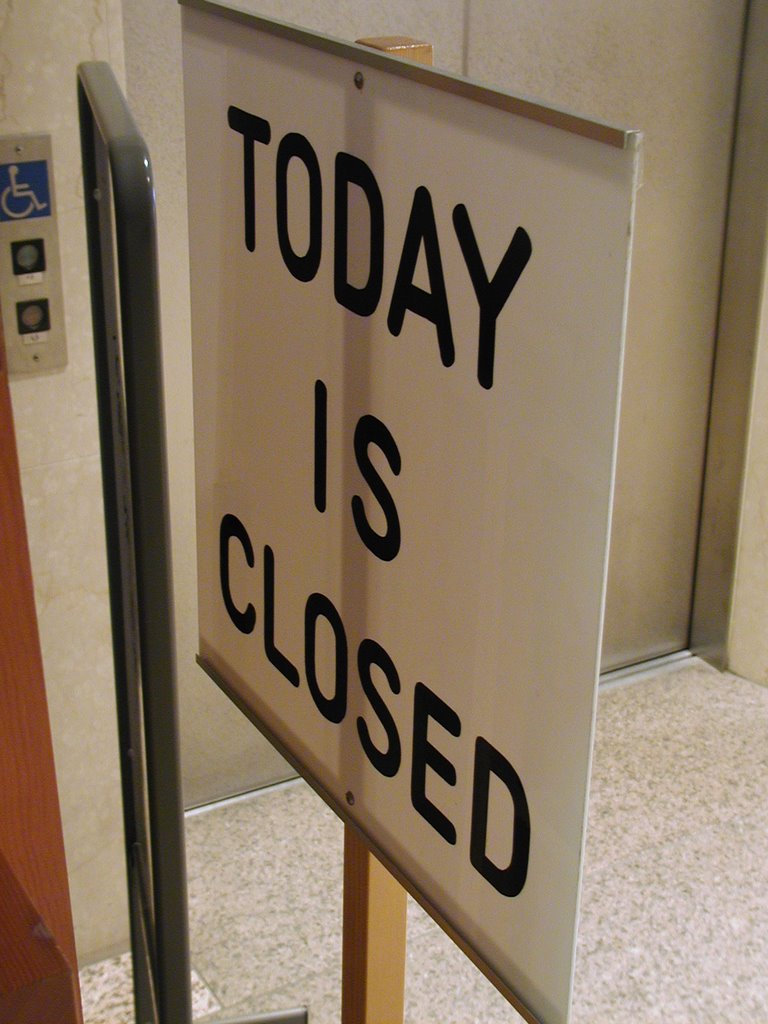
Some days are just like this


I don't know about you, but there are days when I long to put out this sign.

(Seen at the Fukugawa Edo museum in Tokyo, during our 2004 vacation. Actually, they were open.)

Thursday, July 20, 2006

A sight for sore eyes


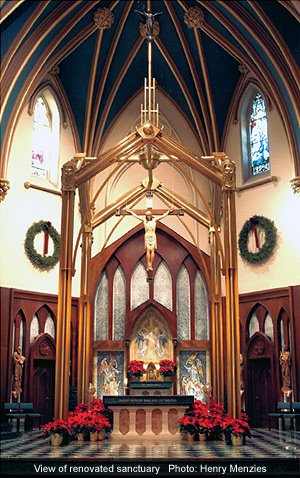
If, like me, your heart just breaks to see the many new Catholic cathedrals and churches that look more like airport lounges, concert halls, or clean rooms; or to see fine old cathedrals and churches get the sacred renovated completely out of them; then you should definitely spend some time at The Institute for Sacred Architecture. You'll feel better, I promise!

Take a look, for instance, at the renovation of the Cathedral of St. Augustine in Bridgeport, Connecticut, featured on the homepage. I hadn't heard of the architect, Henry Menzies, but I'm sure going to keep an eye on him now. Look at the baldacchino over the altar in the photo -- a very traditional element interpreted in a thoroughly contemporary way, beautifully and respectfully done.

I like the sound of this:

The centerpiece of Mr. Menzies’ design is the altar, which is, without a doubt, the crowning aspect of the project. The altar is the focus of the church, and the eye is invariably drawn to it from almost any point in the cathedral. The color scheme and floor patterns chosen by Mr. Menzies accentuate the altar’s importance and help to focus the eye. The color scheme inside consists of very pale walls and columns, highlighted by gold capitals. The eye is drawn from the capitals along the ribs of the nave ceiling. The ceiling is painted blue, reminiscent of color schemes of the Renaissance. The ceiling represents heaven, often painted blue to portray the heavens within the structure of the church. The attention is then gathered at more highly colorful areas of the church, such as the altar and side chapels.

The centerpiece is the altar -- AND it's in its proper place. The whole atmosphere is one of quiet, beauty, and reverence. I love the colors.

You could really get excited about going to Heaven in a place like that.

A typhoon rosary

Yikes! I just realized that I'm on my thirteenth Patrick O'Brian novel today (The Nutmeg of Consolation), having started the series only a few weeks ago. This has turned into a serious addiction. It's going to be hard when I get to that unfinished 21st volume.

I remarked a few posts back about the passage in which Stephen Maturin, the Irish-Catalan ship's doctor, seeks out a Mass in Boston in 1812. In the novel I just finished, The Thirteen Gun Salute, there's another fine Catholic moment. He and his friend Captain Aubrey are sitting in the dark on a desolate island as a spectacular typhoon batters their ship to matchwood just offshore. In one of the enormous lightning flashes, Aubrey looks over -- and sees Stephen praying the Rosary.

It's very interesting, the way Maturin's character has been developed to this point in the series. He's the consummate scientist and man of reason, but he's also clearly a passionate Catholic, one who can take consolation in a moment of crisis from the Rosary that is so much out of vogue in many Catholic parishes today.

I guess I have another reason to note this episode: in announcing the approach of the typhoon, with its unearthly seas and weird copper-violet skies, Stephen quotes lines from one of my favorite bits of verse, Dryden's Ode for St. Cecelia's Day:

So when the last and dreadful hour
This crumbling pageant shall devour,
The trumpet shall be heard on high,
The dead shall live, the living die,
And music shall untune the sky.

Wednesday, July 19, 2006

Echoes

What we do in life echoes in eternity.

That was the tag line of one of my favorite movies of the last ten years: Gladiator.

It's a terrifying thought, that. All that we do in each instant of time is a word that echoes not for a year, or an age, but for eternity. The good words, and the bad we cannot erase, but can only beg to be forgiven for. It will form the music we must listen to in saecula saeculorum.

And not only in eternity. Each moment's choice of virtue or vice, justice or injustice, courage or cowardice, alters the music of time, as well. Each choice makes certain things possible, and dictates that other things will never happen unto the world's end.

What colossal responsibilities even a day's worth of human life contains!

Sunday, July 09, 2006

The old ways were better, chapter 347

Sometimes, the old ways just worked better. Not so obviously at first. But sooner or later, the benefits of the old ways come out in unexpected ways. Just like the benefits of virtue.

Lately, there's been a good deal of attention paid to the potential of a bird flu epidemic. This has even stimulated some discussion about modifying certain modern practices in the distribution of the Eucharist if an epidemic really get going, to prevent the spread of contagion.

Let's review how Communion is often done today. The priest consecrates the bread and wine. The bread is handed to the communicant, who puts the bread into his own mouth with his hand, then also drinks from a common cup or chalice, whose rim is wiped with a cloth after each person drinks.

Contrast this with the bad old days we're taught to despise by many bishops and diocesan personnel. The priest would consecrate the bread and wine, but would bring only the bread to the communicants; he would then place the Host on the tongue of each person. No wine would be offered at all.

Add to these differences that before Vatican II, there was no such thing as shaking hands at the Peace, before Communion.

So let's look at all these changes from the standpoint of preventing the spread of disease -- many diseases, not just bird flu.

Under the new customs, everyone shakes hands with several other people a few minutes before Communion. News flash: shaking hands is a nifty way to transfer germs from one person to another. Then people go up for Communion, take their consecrated bread in their own now-contaminated hands, and put it in their mouth. Next, they drink a sip of wine from the same cup as several hundred other people, the rim of which has been ineffectually wiped with a cloth which itself is just collecting germs as it goes along.

Under the old customs, only one person ever touched the Host before it arrived directly on your tongue: the priest. The priest who publicly washed his hands at the beginning of the Offertory. I know, it was a ceremonial washing. I served Mass back then, and knew that some priests wanted only a few drops on the their fingertips, while others wanted a veritable flood. But either way, I never saw a priest approach either the side of the altar to wash his hands, or the altar rail to distribute Communion, with anything but scrupulously clean hands.

I hope it's pretty clear to everyone, whether liberal or conservative, that the old customs were simply less likely to transmit sickness among the congregation.

But we added the germ-spreading handshakes, and the taking of the Eucharist in the germy hand, and the drinking from the germy common cup, so we could be -- I don't know what. Trendier. Up with the times. Just different from the past. More like the Protestants.

What we got was sicker. In more ways than one.

Monday, July 03, 2006

Nine hundred years and counting

Nine-hundred and thirty-five years ago, at Manzikert in eastern Anatolia, the Islamic conquest of what we today call Turkey began its final phase, with a crushing victory over the army of the Byzantine Empire. It continues today, not with armies -- the need for such effort has long passed -- but with the solitary knife and pistol. From Catholic News Service:

A French missionary priest survived a knife attack on July 1, but Church leaders in Turkey are worried by a rising tide of anti-Christian violence in the months leading up to a visit by Pope Benedict XVI.

Father Pierre Brunissen was badly wounded when he was stabbed twice by a man who was promptly taken into police custody. Authorities said that the priest's assailant appeared mentally unbalanced.

The AsiaNews service reports, however, that Father Brunissen had received a number of threats in recent weeks, and the parish church he served in the town of Samsun had been vandalized. The violence and intimidation had increased, AsiaNews said, after the murder of an Italian missionary, Father Andrea Santoro, in the Turkish town of Trabzon, in February. The young man charged with killing Father Santoro, who was also described as unbalanced, shouted an Islamic slogan after shooting the priest.

Bishop Luigi Padovese, the apostolic nuncio in Turkey, told the Associated Press that he would like to believe officials' assurances that the assault on Father Brunissen "has nothing to do with Islamic fundamentalism." But he said that hostility toward the Church has increased significantly in recent months, with an apparent campaign against Christian influence, and "it is the Catholic priests who are being targeted."

Bishop Padovese seems to know the score. The "unbalanced" assailants of Frs. Brunissen and Santoro are no more than the undisciplined vanguard of the assault of the real Islam upon all things outside it -- including any brand of moderate Islam inclined to accommodate Western or Christian influences -- that will soon engulf Turkey. Not even the gentlest, most peaceful Christian presence, exemplified by these two priests, can be tolerated by the real Islam. A generation ago, there were still sizable religious minorities in Turkey. They are dwindling today, and soon there will be none.

What is utterly galling in this is that every square foot of what we now call "Turkey" -- and accept as naturally and natively Muslim -- was once the heartland of Christianity. Its churches at Ephesus and in Galatia were the recipients of letters from St. Paul. Its plains once fed the whole Byzantine Empire. Its sturdy Christian peasantry filled the ranks of the Empire's army, which alone fought off every pagan and Muslim challenger for centuries. Until Manzikert.

Saturday, June 24, 2006

Stephen Maturin's Mass

I've gotten hooked on the Aubrey-Maturin novels of Patrick O'Brian, which partly accounts for my last week's silence. But today I ran across something interesting from a contemporary Catholic viewpoint in the sixth novel, Fortune of War.

Stephen Maturin, the ship's surgeon and naturalist, Catalan and Irish by birth, and Catholic, has been taken prisoner with Jack Aubrey during the War of 1812, and goes hunting for somewhere to hear Mass during his captivity in Boston.

... the priest was already at the altar by the time they reached the obscure chapel in a side-alley, and crept into the enormously evocative smell of old incense. There followed an interval on a completely different plane of being: with the familiar ancient words around him, always the same, in whatever country he had ever been (though now uttered in a broad Munster Latin), he lived free of time or geography, and he might have walked out, a boy, into the streets of Barcelona white in the sun, or into those of Dublin under the soft rain. He prayed, as he had prayed so long, for Diana, but even before the priest dismissed them, the changed nature of his inner words brought him back to the immediate present and to Boston, and if he had been a weeping man it would have brought tears coursing down his face.

Lucky Stephen. He lived in a world where, indeed, a Catholic could voyage 'round the world and take solace in the same Mass in each land he visited. The world Catholics had had for a thousand years, and which we had until such a short time ago. May that world come again, and soon.

Sunday, June 18, 2006

Verdi Requiem

Recently, my brother was given tickets to a performance of the Verdi Requiem at San Francisco's Davies Hall, and kindly invited us to come along. I've heard it performed before, but this was something special. Fabulous soloists, 170-plus voices in the SF Symphony Chorus, great brass players in the SF Symphony Orchestra.

You'd think that in San Francisco, where nine-tenths of the people seem fundamentally opposed to most of what the Catholic Church stands for, a Mass setting would be treated with some disdain. Not so on that night. The audience was sternly warned on their way in by large placards proclaiming that there would be no intermission in the 100-minute performance, and that no one leaving their seat would be re-admitted to the hall. Not only did the audience treat the music with reverence, minding their manners by not applauding between movements, but the conductor (James Conlon) held the silence after the last plaintive Libera me for a full ten seconds -- and not the slightest sound was heard throughout the enormous hall. Then, of course, the place erupted for seven or eight minutes of cheering.

Of course, it was reverence for Verdi's music, not for the Church or even for God, that animated most patrons that night. But here's the great thing about Christian art of all kinds: it penetrates the soul even in the face of stark unbelief. No human being can escape unchanged from the hurricane of Verdi's treatment of the Dies Irae, all the more so when it returns by surprise near the end, when you've been lulled by several minutes of soft pleas for mercy. There in the program were the Latin and English side by side, and I wonder how many hearts were troubled -- rightly so -- by the unfamiliar sentiments, or by these disturbing lines alone:

Lacrymosa dies illa
Qui resurget ex favilla
Judicandus homo reus.

(Lamentable is the day
on which the guilty shall arise
from the ashes to be judged.)

And I wonder how many felt drawn by this wish:

Sed signifer Sanctus Michael
repraesentet eas in lucem sanctam,
Quam olim Abrahae promisisti
et semini eius.

But let Saint Michael, the standard-bearer,
bring them forth into the holy light,
which you once promised
to Abraham and his seed.

Corpus Christi at St. Thomas

Today there was a procession of the Blessed Sacrament in connection with Corpus Christi Sunday, at my little home parish of St. Thomas Aquinas, accompanied by:

Josquin des Prez, Missa Pange Lingua

sung by the St. Ann Choir.

Sunday, June 11, 2006

Lies > opinion > substance

Darn, that Francis Bacon just keeps on delivering up good ones!

And in these and the like kinds, it often falls out, that something is produced of nothing; for lies are sufficient to breed opinion, and opinion brings on substance.

And that insight explains why, for example, we have to continue to debunk Dan Brown, even though his book is claptrap, no one with any sense will believe it, etc., etc. We have to continue because the lies are out there -- powerfully out there -- and they are already breeding opinion. If that opinion brings on substance, watch out.

Not alone

It's nice to know one's not alone in certain sentiments, so I was encouraged to run across this, from Sir Francis Bacon:

A man's nature runs either to herbs or weeds: therefore let him seasonably water the one, and destroy the other.

Trinity Sunday at St. Thomas

From the St. Ann Choir at St. Thomas Aquinas today:

Josquin d'Ascano, In Te, Domine, Speravi
Antoine de Fevin, Sancta Trinitas

Wednesday, June 07, 2006

Womenpriests right down the street

Given what a wacky place the Bay Area is, I guess I shouldn't have been surprised that we're home to yet another wackiness: women declaring that they are now priests of the Roman Catholic Church. And only a convenient 20-minute drive from my front door!

To say the least, I'm not too impressed with the response of the diocese. Here's the entire acknowledgement of the situation from the current issue of the diocesan newspaper:

Recent news reports of “Roman Catholic Woman Priest” Victoria Rue leading celebrations of the Mass on the campus of San Jose State University require the Diocese of San Jose to issue the following statement: Victoria Rue is not a validly ordained priest of the Roman Catholic Church. Members of the Roman Catholic Church should not participate in celebrations of the sacraments that are conducted by Victoria Rue, as those celebrations are not in union with the local or universal Church.

That's it. Note that although this has been going on for some time, it's "recent news reports" that led the diocese to do something, finally. And there's to be no punishment for anyone -- no excommunication of the "priestesses", no warning of grave sin attaching to attendance at these "celebrations of the sacraments". And what a wishy-washy way of putting the reason for not attending: the bogus masses are "not in union with the local or universal church." Come to think of it, why was it necessary to mention the "local" church at all?

At least they put "Roman Catholic Woman Priest" in quotes.

According to a May 28 story in the San Jose Mercury News, the diocesan spokeswoman, Roberta Ward, believes that

most of the services are so small... there's no point in drawing attention to them.

How many times have we seen that attitude before. Let's not say anything about the evil in our midst. It's small now. Maybe it'll just go away. Subtext: think of how inconvenient and uncomfortable it might become to actually stand up for our Faith.

The diocese's grand strategy has been to try to avoid giving the group publicity. And what happens? The Mercury News, circulation 300,000+, runs a fawning 1,200 word front-page story with three attractive photos, a full schedule of when and where you can attend these false masses, and the group's website.

Well, that idea sure worked great.

Monday, June 05, 2006

This Sunday at St. Thomas

Since this Sunday was Pentecost, the St. Ann Choir performed a full Renaissance mass, Missa Osculetur Me by Orlando de Lassus, along with the Gregorian sequence Veni, Sancte Spiritus.

No Rainbow sashers, thank God.

There was one little girl making her First Communion, very charming in her white dress and veil, the only one of her group of 170 in this three-church parish to learn all the required prayers in Latin! And so she wanted to have her First Communion at St. Thomas, where Latin is used and honored.

There's hope!

Sunday, June 04, 2006

Weed 'n' feed

A friend once explained to me why his (non-denominational) pastor didn't talk much about sin and evil: one should just talk about the "good news" of the Gospels, not the "bad news" of evil, lest one become fascinated, even fixated, on the latter.

Quite aside from the danger of making a kind of "happy talk" Christianity, it just isn't honest to ignore evil. To do so gives an incomplete picture of the world, and begs the question of what we needed to be saved from in the first place. There is good in the world, and there is evil. Deal with both.

Anyone who has ever successfully tended a garden knows about celebrating Good while confronting Evil. How's that? Well, what happens if you just plant nice flowers in your garden, but never pull any weeds? The weeds take over. What happens if you weed like mad but never plant any flowers? You get a barren patch of ground. But if you both weed and plant, then you get a garden.

Not all that is high is holy

From Thomas á Kempis, The Imitation of Christ

I do not desire consolation that robs me of contrition, nor do I care for contemplation that leads to pride, for not all that is high is holy, nor is all that is sweet good, nor every desire pure, nor all that is dear to us pleasing to God.

Monday, May 29, 2006

Something else to remember today


Today is Memorial Day, and we're rightly remembering the many who have given their lives for our country.

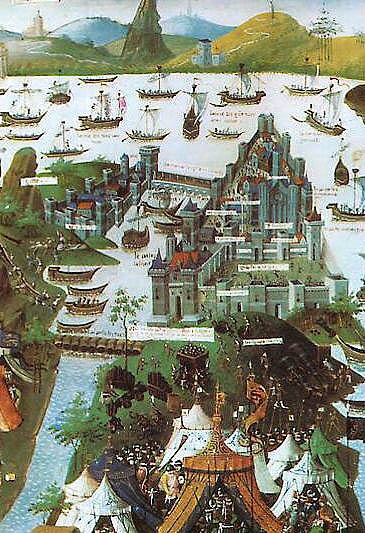
But there are others whom we should be recalling on this May 29: the thousands who died on the walls of Constantinople, 553 years ago on this day, in hopeless defense of their city and their faith against Muslim conquest.

Muslim armies had first tried to storm Constantinople over 800 years earlier, and over the centuries since then, had steadily torn away piece after piece of the Byzantine Empire. The pressure was sometimes greater, sometimes less, but the Religion of Peace never gave up its dream of bringing the great Christian empire to its infidel knees. It knew what it wanted, and it was willing to wait.

By the time Mehmet II brought his Ottoman siege guns up to the walls in spring 1453, everyone knew that even a successful defense could only delay Constantinople's capture by a few years. Too much of the empire had been lost. There weren't enough men, and there wasn't enough money.

But that didn't keep the last emperor, Constantine XI, from doing what he could.

The heroic and tragic story of the siege, and its aftermath for Greek Christians, is well-told in Steven Runciman's The Fall of Constantinople 1453, so if you want to know more about this largely-neglected moment in history, that's a good place to start.

When the walls were breached at last,

Theophilus [another Byzantine leader] shouted that he would rather die than live, and disappeared into the oncoming hordes. Constantine himself knew now that the Empire was lost, and he had no wish to survive it. He flung off his imperial insignia and, with Don Francisco and John Dalmata still at his side, he followed Theophilus. He was never seen again.

If you have a moment, say a prayer for the souls of Constantine and the others who died that day. In their own way, they also gave their lives for us, trying to hold at bay the same threat that looms today. They too deserve to be remembered.

Sunday, May 28, 2006

This Sunday at St. Thomas

Sung by the St. Ann Choir here today:

Jacobus Gallus, Ascendens Christus in Altum
William Byrd, Psallite Domino

Saturday, May 27, 2006

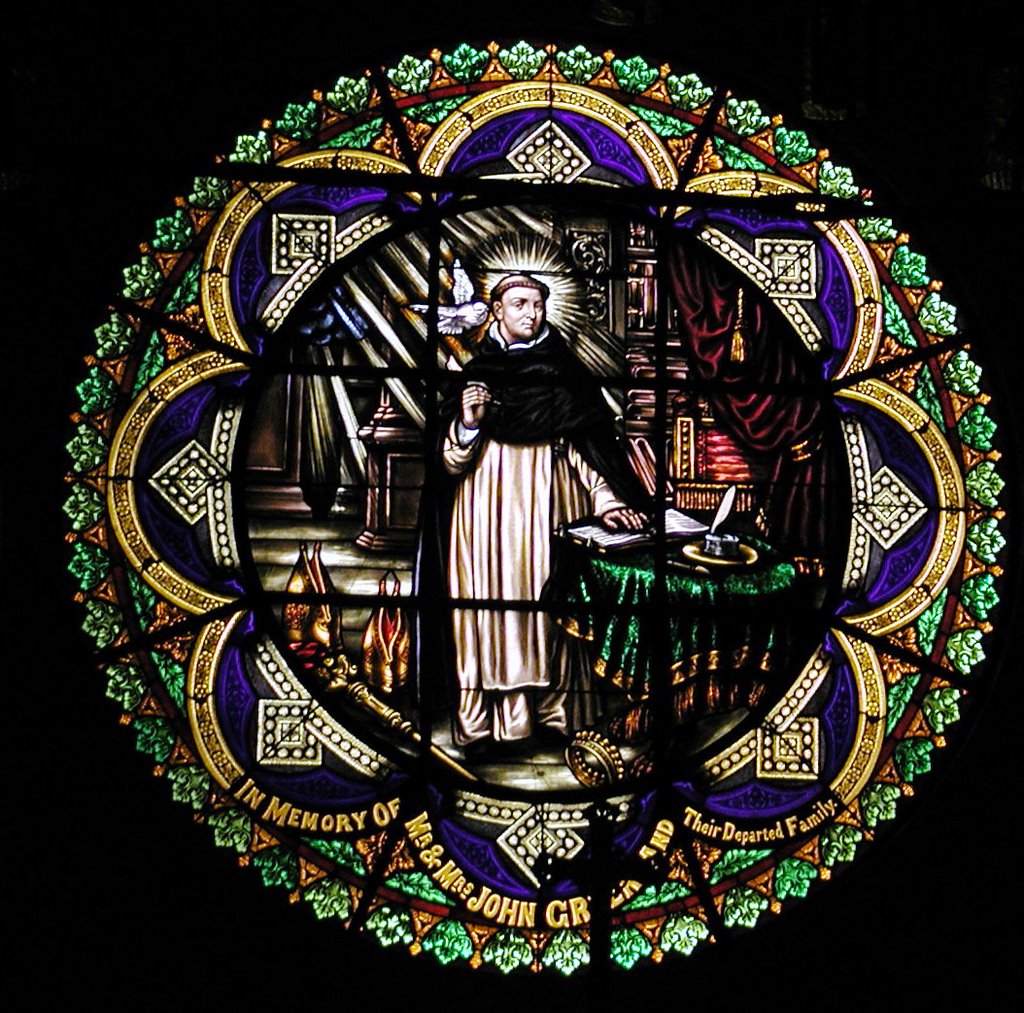
St. Thomas at St. Thomas


This is the window over the altar at St. Thomas Aquinas, my parish church. Of course, it depicts the man himself!

Thursday, May 25, 2006

The High and the Mighty


I happened to catch the 1954 John Wayne movie The High and the Mighty on TV last night. I was intrigued by the portrayal of Catholics in it, especially compared with the current attitudes coming out of Hollywood.

It was the first of the airline disaster films, and there's a long period in which the fate of the airliner and its passengers is in question (at least, as much as it could be with JW on board).

One of the passengers, a poor Italian fisherman from San Francisco, pulls out his rosary and begins to pray, first silently, then quietly aloud; when his seatmate asks him exasperatedly, "Do you have to do that?" he just answers, "Yeah." Later, he greets his family at the gate: six kids, if I recall. He's the only passenger who prays.

And again, as they pass over a ship at sea, the ship's radio operator, who has been helping track them, steps outside to the railing, makes the sign of the cross, and bows his head.

Very positive portrayals of common people with faith. I wish we had more today -- the portrayals, and the people.

One other thing: in the climactic moments, there's a beautiful shot from above, with the plane silhouetted as it flies down the centerline of the approach lights. Along that centerline, a short distance from the runway, there's a transverse bar of lights -- making a cross. I don't think that was accidental.

Three gardens

Was reading a short but wonderful article by a Prof. Rodney Delasanta, called Gardens of Good and Evil, in the May 2005 issue of First Things. (I know, it's May 2006 now, but I'll never catch up with my First Things reading). He looks at the archetypical story of the first Garden -- Eden -- and how the garden's loss has been dealt with.

The Christian view is that Eden, given to us by God, was lost by us through our refusal to live by its rules.

The Enlightenment and modernism, by way of throwing all that old stuff out, gave us Voltaire's maxim in Candide that "we must cultivate our own [man-made] garden." But this, says Delasanta, is "the garden of resignation, of suffering unfulfilled, the garden of disenchantment." Working in this garden is our necessary distraction from the pain of the long slow spiral to death and defeat. It can take your mind off the despair, but nothing more.

Postmodernists have worked out the final implications of Voltaire's vision in literature like Jose Luis Borges' The Garden of Forking Paths, a maze whose lanes lead nowhere and have no meaning. Wandering in that garden serves to pass the time, but you don't have a choice, really, they say. And everything's relative, so don't worry, be happy -- or despair and die, it's all the same.

No, thanks.

Back to the Christian vision.

Our defeat in the first Garden leads downhill to a second Garden, Gethsemane, where a man waits in anguish to sacrifice himself. Here the human race reaches a nadir; of all the human beings who surround Christ that night, one betrays him, others abandon and deny him, and the rest haul him off to be murdered. The Enemy has triumphed, it seems. He has set the stage for the ultimate sacrilege: mankind will murder God's Son. Game over.

Three days later, into a third Garden, Mary Magdalene comes early. But the tomb there is empty, the body gone. Panicked, she looks around, and sees a man; thinking he is the gardener, she begs him to tell her what happened. But he gives no explanation; he simply speaks her name. And she knows him, and knowing him, knows what has happened: the shame of the First Garden and the disaster of the Second have been redeemed utterly by the sacrifice that has just triumphed in the Third.

Thinking he is the gardener... But He is.

I'll take that vision over the other anytime.

Wednesday, May 24, 2006

Stained glass: preserving the faith till better times

One of the great things about stained glass in older churches is that it often preserves an expression of orthodox faith even when the people who now use the building are, well, no longer so orthodox.

This beautiful example, from a church I won't name, carries the motto "Thou art the Christ, the Son of God."

The Episcopalian congregation of this church is, I gather, one of the more "progressive" in California. Which is saying quite a lot. But no matter what moral and theological errors may be preached from the pulpit for a few passing years, this window will still be there, silently insisting through its beauty on the most important Truth of all.

I like that thought.

A new way to provide Da Vinci commentary?

By now, we've probably all watched a DVD that offered, as one of its extended features, running commentary by the actors or director of the movie. Pretty standard.

Yesterday, I got to thinking: what if you could distribute alternative commentary that would play right along with the DVD, perhaps pausing the playback if necessary to let lengthy commentary be heard before going on to the next scene? Wouldn't that be a great service to provide when the DVD of The Da Vinci Code comes out?

Instead of having to watch the movie first, then read a commentary and try to relate it to their recollection of the film, viewers would get the commentary in real time, while the movie was playing (you might have to mute or lower the audio playback from the DVD to let the commentary be heard). Seemed to me that it could be a far more effective way of commenting on a work in which the lies come thick and fast.

Now, here comes a weird coincidence. Today, I was delivering some photos to Stanford Law School, which hires me now and then to shoot their events. My oh-so-brilliant idea of the day before was nowhere on my mind. But being addicted to reading whatever catches my eye, I stopped at a bulletin board outside the office of one of the law profs. And while I was idly skimming a couple of newspaper articles about a copyright case he'd been involved in a couple of years back, I stopped dead at one particular paragraph and said to myself, "Hey! Wait a minute! That's my idea!"

As the article revealed, the concept of marketing supplemental commentary (the article mentioned Roger Ebert as an example) is at least a couple of years old. But it got swept up into a lawsuit from (surprise!) Hollywood, aimed at companies that were marketing versions of movies that had the profanity and smut edited out of them. Those versions were meant to make it possible for families to enjoy popular films without exposing the kids to the full gamut of Tinseltown's depravity.

The directors and studios couldn't object to actual copyright infringement, since no new copy of the material was being made; instead, they were up in arms over the possibility that their artistic integrity (cough, cough) would be compromised if everyone wasn't forced to hear every single f*** and s*** they had gratuitously sprinkled into their scripts, every single time one of their masterworks was seen.

The lawsuit appears to have been enough to kill off some small companies that were trying to get started offering the alternative editions. Others, such as Utah-based ClearPlay, pursuing a different and more sophisticated model, held on.

Then last year, Congress intervened with the Family Entertainment and Copyright Act. (At the Thomas link, scroll down to Title II). Altering the viewing experience of a legitimately-bought copy of a movie became legal, as long as "no fixed copy" of the work was made.

Now, it seems to me that supplemental commentary, synchronized to the playback of a DVD, would easily be covered by the Act. After all, the commentary would be original material, and the original work wouldn't be altered at all. It would be no more a copyright infringement than the common practice of watching a sports event on TV, turning down the volume, and listening to the play-by-play on your favorite radio station.

Ideally, a running Da Vinci Code commentary would be done by some of the prominent experts who have already weighed in with print, audio, and video rebuttals of the book. But if they don't, darn it, I'll do it myself.

Tuesday, May 23, 2006

In for the long haul

The other day, I was listening to a talk about The Da Vinci Code by Fr. Euteneuer of Human Life International. It's good, though a bit over the top at times. It's aimed at committed Catholics who are already convinced of the perversity of radical feminism and the Culture of Death. It won't appeal to many non-Christians.

But it wasn't his comments about DVC that made me sit up. He recalls, at one point, how the Church has faced similar threats from the popular press in the recent past: A Course in Miracles in the 70's, The Celestine Prophecy in the 90's, and so on.

I stopped right there. Yes, those books came out back then -- and they're still on bookshelves everywhere, continuing to deceive and mislead. And where is the Church's response to their lies? Out of print. Scattered here and there on the Web. No longer available.

Oh, the Church may have responded with some vigor when these books were new. But as the buzz died down, so did the Church's countermeasures. And today, those books still sit quietly on home bookshelves, waiting to entice new generations; they show up at used book sales, and get donated to libraries; they're for sale at Amazon. But the opposition -- the truth -- sleeps.

The Church has kept no thorough, devastating responses ready and waiting. The attitude seems to have been: just ignore the books, and they'll go away. Don't draw attention to them. Let them slide slowly toward oblivion.

Fine, as far as it goes. Which is not far enough. Their slide toward oblivion make take decades or centuries, and while they're sliding, they're dragging a lot of souls with them. We can't follow Christ and just let those souls go without a fight.

We need a way to keep the defenses fresh and available -- not just for a few weeks or months while a new pack of lies is on the Times' bestseller list, but for decades to come. Once error is in print, it becomes a permanent enemy, and needs a permanent defense. And we need to do it in a way that doesn't burn out the few who step onto the front lines in the first weeks of battle.

Web, print, and DVD: those are the weapons for the new defenses.

I remember the words of a youth hymn we sang back at my Catholic elementary school in the early 60's:

On earth's battlefield, ne'er a vantage we'll yield...
I'm tired of the long defeat. Anyone else?

Monday, May 22, 2006

Way too soon to relax

The usually ferocious William Donohue of The Catholic League went to see DVC, and had this to say at the end of his dismissive review:

Had the movie been a success, the effect would have been troubling. But because it fails to persuade, this is one movie practicing Christians have nothing to worry about.

I'm not at all convinced. I can well imagine that the movie failed to persuade Bill, since he has taken the trouble to educate himself tirelessly on early Church history, Gnosticism, and the other topics DVC muddies up. But have most practicing Catholics innoculated themselves and their families to a similar degree? I really, really doubt it. It's way too early to relax about DVC, even about its effect on Catholics who attend Mass weekly and do the other things 'practicing' Catholics do.

Yes, critical reaction was largely negative, and reaction of moviegoers in Italy was mixed, but that doesn't mean that the movie can't still deceive. The film grossed $70 million on its opening weekend. It will be seen by hundreds of millions of people before the last DVD spins, decades from now. Few of them will see it with their minds and souls properly equipped with the truth. Many will think it's at least a plausible version of history. And great damage will be done.

This is no time for any of us to breathe a sigh of relief at the movie's imperfections and think "Oh, good, nothing to worry about after all."

The will to unbelief

From a letter from J.R.R. Tolkien to his son Michael, 1963:

It takes a fantastic will to unbelief to suppose that Jesus never really 'happened', and more to suppose that he did not say the things recorded of him -- so incapable of being 'invented' by anyone in the world at that time: such as 'before Abraham came to be I am' (John viii). 'He that hath seen me hath seen the Father' (John ix); or the promulgation of the Blessed Sacrament in John v: 'He that eateth my flesh and drinketh my blood hath eternal life'. We must therefore either believe in Him and in what he said and take the consequences; or reject him and take the consequences.


From the same letter -- written, remember, in '63, just before Vatican II got into gear -- this prescient observation:

I suppose the greatest reform of our time was that carried out by St Pius X: surpassing anything, however needed, that the Council will achieve.


The 'reform' he refers to is not made fully clear in the text, but the editor of the collection of letters notes that, given the context, it was probably Pius X's exhortation to receive the Eucharist daily.

'Surpassing anything ... that the Council will achieve'? How right he was!

Sunday, May 21, 2006

At last, some good da Vinci TV

After shaking my head over the shabby me-too-and-it's-all-true "documentaries" about The daVinci Code on the History Channel and A&E, I was delighted to see something of value on, of all places, the Sci Fi Channel. Good production values, good people, and most importantly, the right attitude. Actually, it's got plenty of attitude.

Called Cracking Da Vinci's Code, it aired May 18, the day before the movie opened, and features such luminaries as the inimitable Amy Welborn; Scott Wenig, Assoc. Prof of Applied Theology at Denver Seminary; Chuck Missler, author of How We Got Our Bible; Jim Garlow, co-author of the book Cracking Da Vinci's Code; Darrell Bock, author of Breaking the da Vinci Code; Erwin Lutzer, author of The da Vinci Deception; Steve Kellmeyer, author of Fact and Fiction in The Da Vinci Code; Sandra Miesel and Carl Olson, authors of The da Vinci Hoax; and Paul Meier, Prof. of Ancient History at Western Michigan University.

Together, they do a fine job of taking Dan Brown's book down hard, exposing the major lies and misrepresentations in authoritative fashion.

Also appearing is an interesting scoundrel named Lewis Perdue, author of The da Vinci Legacy and Daughter of God, two books he penned a decade or more before DVC. Parts of the DVC bear, shall we say, a very, very close resemblance to passages in his books. But of course, Dan Brown says he never read them or heard of them. Never. Nope.

There's also a visit to Rosslyn Chapel, where DVC says a huge Star of David is carved in the floor. A tour guide even pulls up the carpet. No star.

The DVD appears to be available at ShopNetDaily. There, it's confusingly titled Breaking the da Vinci Code, and is billed as an edited version of another production, The da Vinci Code Deception. Amazon has it, too, without the reference to the longer version. Odd. Beware a similarly-titled DVD, Cracking the da Vinci Code; this is different.

Me, I'd rather read the books this production is based on. But a whole lot of people don't read anything serious, so I'm glad this show is out there. I guess things haven't changed much, come to think of it, since Boss Tweed complained about Thomas Nast's political cartoons of him: "I know my constituents can't read. But dammit, they can see pictures!"

This Sunday at St. Thomas

Sung this Sunday at the noon Mass at St. Thomas Aquinas, Palo Alto:

Josquin des Prez, Christe Fili Dei
Hans Leo Hassler, Christe Qui Lux Es et Dies

Thursday, May 18, 2006

No bells at the Consecration? How about trumpets?

From a letter from J.R.R. Tolkien to Christopher and Faith Tolkien, 1955:

I am still staggered by the frescoes at Assisi. You must visit it. We came in for the great feast of Santa Chiara... . High Mass sung by Cardinal Micara with silver trumpets at the elevation!

Silver trumpets! Not just a brief ring of bells, but silver trumpets! Now that made it clear that something big was happening!

Try it at your parish. After all, if you're Catholic, you believe in the Real Presence, don't you? How much more special a thing has to happen, before you let somebody make a really joyful noise about it? There are probably a few young trumpeters in a high school band in your neighborhood, looking to make a few extra bucks. Ask 'em. They probably know a good, solemn fanfare or two. Then get your priest's permission, and do it.

No, I'm not kidding. Do it.

And no, the trumpets don't have to be silver.

Tuesday, May 16, 2006

Laughter at Cannes

Many people have already commented on the derision that The DaVinci Code received at Cannes two days ago. Still, I can't resist noting it here. Someone once said that the thing that stings Satan most is not loathing, but laughter.

The Cannes audience clearly grew restless as the movie dragged on to two and a half hours and spun a long sequence of anticlimactic revelations.

"I kept thinking of the Energizer Bunny, because it kept going and going and going, and not in a good way," said James Rocchi, a film critic for CBS 5 television in San Francisco and the online outlet Cinematical. "Ron Howard makes handsome films. He doesn't make bad ones, but he doesn't make great ones."

One especially melodramatic line uttered by Hanks drew prolonged laughter and some catcalls, and the audience continued to titter for much of the film's remainder.

The Other-cott cometh!

If you haven't heard about the "Other-cott", you haven't heard about absolutely the best idea for striking back against the movie version of Dan Brown's compendium of lies, The DaVinci Code. Go and read all about it, but the basic idea is: this coming weekend, when the DVC movie is opening, go see the only other widely-distributed movie opening the same day: Dreamworks' Over the Hedge. The money that OTH makes -- and more importantly, the money DVC therefore does not make -- will give Sony Pictures fits.

The brilliant Barb Nicolosi is leading the charge. If you're not reading her blog, drop what you are doing and go there now.

Resignations

It seems the Vatican has just accepted the resignations of Cardinal McCarrick of Washington DC, and Bishop Imesch of Joliet, IL. I haven't read enough about Bishop Imesch, or about the replacements that have been announced for both offices, to comment on them. But I'm glad to see
Cardinal McCarrick departing from his very influential diocese. He never would lift a finger to discipline the dozens of Catholic pols who mocked their Church's teachings with their steadfast support for abortion on demand. Instead, he has already received his reward: shmoozing at countless receptions and parties, for a few decades, with the powerful, famous apostates like Kennedy and Kerry.

For handing out free passes to the Communion rail (oh, sorry, those have already been ripped out of most churches, so the reference is probably obscure), he deserved to go -- years earlier.

Friday, May 12, 2006

"This is worse than Mordor!"

Sometimes you glance again at something that you've read a dozen times before, and for the first time, you understand that it expresses and explains feelings you've had on another topic entirely.

In an important chapter of The Lord of the Rings that the movie left out, "The Scouring of the Shire", Frodo and Sam come back to their beloved homeland hoping for rest and solace in the familiar beauty of tree, inn, and hearth, whose memory had kept them going at the grimmest moments of their quest. Instead, they find that the Shire's under dreadful new management. The once lush countryside has been desecrated, trees wantonly chopped down, once-friendly inns turned into cheerless barracks, Frodo's home at Bag End stripped and empty, the hobbit population oppressed by gangs of thugs controlled by the fallen wizard Saruman.
"This is worse than Mordor!" said Sam. 'Much worse in a way. It comes home to you, as they say; because it is home, and you remember it before it was all ruined."
That, I realized today, is an echo of what bothers me, and apparently so many others, as we watch fine old Catholic churches and cathedrals get much of their beauty "renovated" out of them: high altars demolished, altar rails torn out, tabernacles with the Body of Christ within them moved out of sight as if they were something to be ashamed of, statues tossed away, seating rearranged to suit non-Catholic worship theologies, traditional stained glass windows replaced with random arrangements of colored glass such as you might find in any airport.

It comes home to you, because it was home.

It was the place where, perhaps, you grew up in the Faith, and whose every corner you can recall with that intensely detailed memory of early childhood. It looked a certain way when you had your First Communion; when you were confirmed; when you were married; when you buried someone you loved. It looked a certain way when you came for solace or courage, and found it. It looked a certain way when you first really understood, at an unexpected moment in an otherwise ordinary Mass, that you were in the Real Presence of the Son of God.

And it was home because we are flesh as well as spirit. Place matters to us because we live out our lives here and now, in the physical world. Change a place that has been vividly connected to people's spiritual lives, and you run big risks.

Now, a church can be changed in such a way that its older beauty is added to, as when a new statue or a stained glass window is installed, or an unwise remodelling is put right with a faithful restoration. When that happens, people's connection with place and with their past spiritual experiences in it is strengthened, not weakened. The connection we made with God at some past moment is reinforced, and seems all the more beautiful and significant. Not all change is bad.

But what's happening all too often is an arrogant, wanton destruction of the physical forms woven into people's faith experiences. Too often, the message delivered is that the earlier forms were wrong, the earlier spiritual experiences were false or useless, and even that the earlier beliefs are suspect. And too often, the bishops, priests, architects and liturgists who have torn up sacred spaces that the faithful loved deliver that message like this minion of Saruman ('Sharkey' in the patois of his henchmen), spitting scorn at Frodo:

'This country wants waking up and setting to rights,' said the ruffian, 'and Sharkey's going to do it; and make it hard, if you drive him to it. ... Then you'll learn a thing or two, you little rat-folk.'

Our modern minions of Sharkey should remember the message contained in the title of that chapter: the Shire was scoured. The thugs were driven out, and Sharkey was -- well, read it for yourself.

Wednesday, May 10, 2006

Turning wine to water

It's the modern Catholic miracle: take a beautiful church, one that encourages quiet, contemplation, and fervent devotion; and turn its interior into an ugly, pseudo-Protestant concert hall. It's an architectural reversal of the miracle of Cana: the wine of old beauty is turned into the brackish water of faddish awkwardness and sterility.

Karen Hall, at Some Have Hats, has penned a wonderfully passionate rant against the epidemic of radical modifications of traditionally-designed Catholic churches in the U.S. Her focus is on the desecration of St. Charles Borromeo in North Hollywood, California, which is about to begin, but it's happening all over the place, it seems. I share her bitterness over the endless delays and spinelessness exhibited by Rome when parishioners complain that their wishes are being ignored by priests and bishops intent on uglifying everything. She understands that people are not disembodied spirits to whom place is of no importance; they live out their lives of faith in specific places, whose layout and appearance are integral to their experience of God. Tinker with those places, and you risk jarring souls loose from their moorings and losing them forever -- the eternal thing that must never be risked for any temporal reason.

So why does Rome send us the consistent message that an individual soul isn't worth fretting over? Because every day that goes by with our beautiful churches being destroyed, our tabernacles being ripped from our sanctuaries, our liturgy being turned into the Cirque du Soleil, our people receiving communion from "extraordinary" eucharistic ministers 90% of the time, and worst of all, our constantly hearing things from the pulpit that are in direct contradiction to the Magisterium ... every such day that goes by without a word from Rome to stop it, the loud and consistent message is that whatever soul was lost on that day was not worth saving.

Rome needs to understand that it may pride itself in thinking in terms of centuries, but real souls are saved by the minute, the hour, and the day. And in the specific holy places where they have found solace. While the Vatican dithers and does nothing, souls are being lost forever as they are being led astray by the very shepherds who should be protecting them.

The "renovators" are like shepherds who claim to be serving the sheep better by moving the gate of the sheep-pen because they don't like the way it faces. If the sheep get lost because of it, well, too bad, they say; we must keep up with the times. Or the fads.

How long would it take for Pope Benedict to write a one-page directive to all American bishops, advising them to drop all plans for the specific architectural abuses that characterize these pernicious "renovation" campaigns? I could do it in two hours. Make it clear that disobedience of any kind will be grounds for immediate removal from office, and then yank the first bishop who objects, the day after he does so. That would automatically bring most of them into line, weaklings that they are. The number that would actually need to be disciplined would be quite small.

Abortion and the illegals

For weeks, I've been meaning to write about how illegal immigration and this country's 30-year abortion massacre are connected. Quintero over at L.A. Catholic got to it first, but I'm still going to put in my two cents.

Since 1973, American women have killed about 45 million of their children in the womb. The first three million of those children would now be in their early thirties, entering the peak years of income earning and productivity, energizing the economy and helping, through their taxes, to fund services for the growing population of elderly. Another 15 million would be somewhere in their twenties, needing low-level and entry-level jobs. But those millions have disappeared -- and now we're told we must now legalize millions of illegal immigrants to fill those jobs. But we would have no such need if we hadn't killed the very children of our own who could now be doing them.

But do we see that, and stop it? No, we're too attached to sex without the giving of life. The aptly-monikered Culture of Death just rolls on, slowly destroying the country and the culture that has embraced it. No need to invoke divine retribution here. It's just a matter of natural consequences.

Tuesday, May 09, 2006

The problem of bad bishops

Let's be clear about it: the Catholic Church in the United States is plagued with many bishops who are just plain bad. Several have turned out to be sexual offenders. Quite a few have been guilty of shifting pederast priests around so they could offend again in new places. Quite a few have little loyalty to the Magisterium, preferring a more convenient faith of their own invention, instead. Quite a few have done everything they could, seemingly, to kill vocations and drive the most dedicated Catholics out of their dioceses.

Enduring such malfeasance would try the patience of any people in any age, but it is especially galling in the U.S. because of our democratic political heritage, and may be precipitating an eruption of anticlericalism that this country has never seen.

Precisely because they're Americans, American Catholics are used to being able to take action when power is being abused in their secular lives. The right to petition the government for redress of grievances was written into our Constitution from the start. If Americans have a corrupt Congressman, they can work to get him out of office. If their boss is tyrannical, they're often able to express their objections to such behavior to higher-ups. If a co-worker is making unwelcome advances, they can file a complaint. The ability to strike back effectively at bad guys is one of the best safety valves in American public life. People who know can do this are far less likely to explode in disorderly and dangerous resistance.

But American Catholics have no option for such redress when it comes to their bishops. There is no mechanism for effective action against a bishop, except the long and tortuous road of asking Rome to intervene. And Rome has seemed mighty reluctant to intervene. Instead of actively policing the bishops and making them toe the line, Rome appears to sit back and wait for complaints to come in, and then look into it -- after a few more years go by.

And this has its price: the bishops too often act like evil prefects in a really bad boarding school -- secure in their license to bend the rules to their liking and to harrass, intimidate, and bully those who oppose them; and secure in the knowledge that if one of the little people gets uppity enough to complain to the headmaster, then that timid, complacent man will hem and haw and ultimately do nothing except to urge the victims to try to get along better with the bullies.

That approach works badly outside the Church, and it works badly inside it, too. It's terribly demoralizing to anyone who takes the teachings of the Church seriously to see their own bishop flout those teachings, year after year and decade after decade, and insist that everyone else flout them too -- and then to see that the ultimate authority in Rome will take no action to correct the situation. If anyone's still wondering why so many Catholics have left their Church, this is a darn good place to start looking.

When things reach a breaking point (and I think they're very close to it now), American Catholics will demand a voice in selecting their bishops, and an effective means of promptly removing bishops who have gone bad. And if they don't get it, some will take action to seize it -- and things will then get very messy indeed.

It's all very well to say that these men are successors to the Apostles, for so they are, but it is not a sufficient reason to just pray and remain passive. Judas was an Apostle, too, you know. And some of our bishops are his successors.

Sunday, May 07, 2006

This Sunday at St. Thomas Aquinas

From the St. Ann Choir at the noon Mass today at St. Thomas Aquinas, Palo Alto, CA:

Orlando di Lassus, Jubilate Deo
Waclaw z Szamotul, Ego Sum Pastor

Never heard of the second composer? Neither had I, despite years of collecting LP's and CD's of Renaissance music. Turns out he was a Pole, dates c. 1524- c. 1560. The site Completorium says this of him:

The history of Wacław z Szamotuł (W. of Szamotuły) was a history of bad luck for Polish early music. He was a gifted man, a true Renaissance figure. Educated in law, mathematics and philosophy, Wacław of Szamotuły was also a poet writing in Latin as well as in Polish. He died early, about the age of 35. "If the Gods had let him live longer, the Poles would have no need to envy the Italians their Palestrina, Lappi and Vadana" - wrote Szymon Starowolski, author of the first concise biography of Wacław of Szamotuły and one certainly has to agree with him. The second part of bad luck was a fact, that precariously few of his compositions remained to contemporary times.

Thursday, May 04, 2006

Standing up to China

Vatican, May. 04 (CWNews.com) - The Vatican has released a scorching criticism of the illicit ordination of two bishops for the government-approved "official" Church in China.

The statement charges that the government forced other Catholics to participate in the ceremonies, in a "grave violation of religious freedom." And it warned that the bishops ordained without the approval of the Holy See, and those who ordained them, are subject to excommunication.

So reported Catholic World News today.

It's really nice to see the Vatican's fiery response to this latest act of interference with the church. Too often, the attitude in the past has seemed similar to Google's: make the best bargain you can, then swallow your pride and your principles, because China is so big, so vast a market, etc.

The current plight of the Chinese church is a reminder of how past choices can have enormous future consequences. Back in the late 1940's, when part of China was still free but the communists were on the march, all the sophisticated people in the U.S. cautioned against "getting involved in a land war in Asia." Understandable after the sacrifices of the Pacific war, I suppose. And then look what happened: a year after Mao took over, we had our dreaded land war in Asia: Korea.

Imagine the world that might have been, had communism been turned back then. No Korean War. Probably no Vietnam War. No Tienanmen Square. A China prosperous and relatively free, and probably aligned with the West, not cozying up to rogue states like Iran in order to make trouble for us.

Oh -- and a China open to the Gospel, and maybe even now turning to Christ. It may yet happen, but not without terrible suffering on the part of countless Chinese Christians.

Tuesday, May 02, 2006

One of St. Thomas' angels


One of the transept angels at my home parish of St. Thomas Aquinas, Palo Alto, California. Don't know the artist, but all the glass dates from the early 1900's.

The reason the universe is so big

You often hear Christians draw a certain conclusion from the vast size of the universe: God surely wouldn't have created a universe so fantastically enormous if the human race were the only intelligent species in it. Sometimes you'll even hear them say that it's arrogant of us to think that He would do so.

On the contrary! I think it's perfectly likely that He would plunk us down in a universe of just the kind we have.

Put yourself in God's place. What kind of universe would you create for a race which would fall because of its prideful desire to "become as gods, knowing good and evil" (that is, everything); whose pride would become central to every one of its vices; which would today become so besotted with its technological and scientific knowledge that it would think there is no more room for God in the intelligent person's worldview? Would you create a little wisp of a thing, a few light-years across, that mankind would comprehend adequately in a few thousand years?

I sure wouldn't. It would only feed into our false pride in our ability to know and control.

Wouldn't you create just what we have: a universe that is not only incomprehensibly large now, but constantly expanding? A universe so constructed that (due to interstellar dark matter) we can't even observe most of it, let alone travel across it? And to complement this vast macro scale, a structure of matter on the micro scale so bizarre that (as Heisenberg proved) you can't even describe the smallest bit of it definitively at any given moment, because the very act of observation gets in the way?

That, I submit, is the perfect universe for mankind. One that puts us permanently in our place, in terms that can't be gainsaid. One that says to mankind, unmistakably and forever, "I am God. You're not." That's the universe we need, and so that's just what he's given us.

Monday, May 01, 2006

St. Anthony of Padua, Menlo Park


I really love traditional stained glass, and am starting to amass a nice library of photos. I'll be sharing a few here now and then.

This magnificent roundel is the handiwork an Carl Huneke, a German immigrant of great talent whose windows grace many a church throughout California. Strangely, it's the only traditional stained glass window in an otherwise nondescript 1950's Catholic church, St. Anthony of Padua.

Sunday, April 30, 2006

Cardinal Mahony and the illegals

I suppose that with his generally sound left-wing credentials, it shouldn't be a surprise that Cardinal Mahony has latched on to the cause of illegal immigrants, too. But I wonder if there isn't something else going on, too.

With his many liturgical abuses duly documented, his support for highly questionable speakers at his recent religious eduation conference, and his possible vulnerability to prosecution now that he has failed to keep records of priestly abuse out of the courts, the Cardinal has to know that he may soon be in the crosshairs for reassignment to some backwater, at best, for the rest of his career.

I wonder if he's thinking: I've paid my dues now to the forces that marshalled those hundreds of thousands of demonstrators in the streets of L.A. recently, in support of illegal immigrants. If Rome tries to move against me, maybe I can call in some favors and get a few hundred thousand of those same people demonstrating in the streets of Los Angeles in my support.

Now, I doubt that such a ploy would have any effect on Benedict, but I can certainly imagine it appealing to the very politically savvy Cardinal.

Just a thought.

Thursday, April 20, 2006

Welcoming everyone, but not every behavior

The United Church of Christ has been patting itself on the back recently with TV commercials praising its own inclusiveness: "No matter who you are, or where you are on life's journey, you are welcome here." The commercials implicitly criticize other churches for what it claims are exclusionary rules that supposedly keep certain groups out.

Fr. Thomas Williams has a fine, succinct article explaining that to welcome a person is not to welcome everything he may do, too. Here's an excerpt:

There is a difference between a church saying “We welcome all persons” and “We welcome all behavior.” After all, two things distinguish Christian belief: a body of doctrine and a moral code. Following Jesus entails both. Jesus welcomed prostitutes, but he never welcomed prostitution. He was soft on adulterers, but unyielding on adultery. After forgiving the adulterous woman, in fact, he adds: “Go and sin no more.” And the tax collector Zacchaeus, on encountering Jesus, promises to pay back all those he has cheated — fourfold. Jesus never welcomed cheating, but he did welcome reformed cheaters. This is not just a matter of semantic hair-splitting. Jesus came to call sinners but to condemn sin, much as a doctor heals sick people but eradicates sickness.

Go and read the whole thing.

Wednesday, April 05, 2006

Offering it up

Recently, when I was talking with my (non-Catholic) wife and daughter, I used the phrase "offering it up" when referring to some sort of discomfort. I think they both thought I was a little nuts, so I thought I'd write a little about the wisdom of the attitude that the phrase expresses.

When I was a boy in Catholic school in Southern California, and we kids were, for example, miserable and complaining in our non-air-conditioned classroom on some torrid September afternoon, the nuns (who, wearing the old black habits, must have been far more uncomfortable than we were) would tell us to take it patiently, and "offer it up." The idea was to take the suffering you were experiencing, large or small, and ask God to accept it along with the sufferings of Christ in recompense for sin. Since we all knew we had sins, and there was plenty of it elsewhere in the world, it made sense, and always quieted things down for a while.

I think there was a great deal of wisdom in that little practice. The problem of suffering is one that has troubled many great thinkers, and disturbs all of us when something bad happens to us, especially if we think we didn't deserve it. And one of the most desolate feelings a human being can have is that his suffering has no meaning. The fact that kids' sufferings are often small by adult standards doesn't mean that they aren't acutely felt. So "offering it up" gave us a way to attach a great -- and real -- significance to whatever we were going through; it allowed us to unite our little hurts, especially the undeserved ones, with the far greater hurts suffered by Him whose suffering was utterly undeserved, and participate a little in the great work of our own redemption.

To those of you who may be saying, "Oh, that evil, guilt-inducing Catholic Church! What kind of sins could you kids possibly have done that could merit feeling spiritually guilty for?", I would ask: do you really remember your own middle-school days? Do you remember the spite and cruelty that made school life a little hell sometimes? Seems to me those were plenty nasty enough to merit a little guilt -- and to motivate us to expiate a bit of it with a little patient "offering up" of the misery of those 100-degree dog days, late in summer.