A fine little Catholic publisher, Sophia Institute Press, is in some financial trouble. They're trying an unusual way to fix it; they're asking people to contribute just $1, and then tell one or more other people about the effort.
Actually, I decided to place a big book order instead of sending the $1, and I encourage you to go browse their site and see whether there aren't some good books that you need right now. I bought Priest: Portraits of Ten Good Men Serving the Church Today by Michael S. Rose; Ten Dates Every Catholic Should Know by Diane Moczar; The Decline and Fall of the Catholic Church in America by David Carlin; and What Went Wrong with Vatican II? by Ralph McInerny.
Oh, yeah, and then I remembered I wanted another title, Memorize the Faith! by Kevin Vost. Things just seem to roll right off my middle-aged brain these days, so I'm looking forward to learning St. Thomas Aquinas' little tricks.
Without Sophia, I would never have found one of the most enjoyable Christian works I've ever read: Creed or Chaos? by the wonderfully eloquent Dorothy Sayers (better known for her Lord Peter Wimsey mystery novels than for her extensive Christian scholarship). Sadly, this one seems to have gone out of print, at least at Sophia.
These folks deserve to survive. Please consider helping them.

In 1867, Matthew Arnold wrote "Dover Beach", a haunting poem evoking the "melancholy, long, withdrawing roar" of the Sea of Faith. As a boomer who finished Catholic elementary school in 1964 and then watched my Church falter, I've found the roar all too audible. So here I wait, listening for the whispers of that Sea's invincible return.
Tuesday, October 31, 2006
Last Sunday at St. Thomas
Sung last Sunday by the St. Ann Choir at the noon Mass at St. Thomas Aquinas:
Thomas Tallis, Eugi Coeli Porta
Thomas Mudd (c. 1560), Let Thy Merciful Ears, O Lord, be Open
Thomas Tallis, Eugi Coeli Porta
Thomas Mudd (c. 1560), Let Thy Merciful Ears, O Lord, be Open


Saturday, October 28, 2006
Michael J. Fox
I used to pity Michael J. Fox for his Parkinson's disease. Now I pity him even more because through his advertisements to the voters of Missouri in favor of embryonic stem cell research, he's now publicly saying, "Clone and kill as many human beings as you need to in order to maybe someday develop a cure for my disease, because my health is more important than their lives".
A real man would never descend to this craven attitude -- or if he did, he would recoil in shame from it before he could give it voice. A real man gives his life for others; he doesn't demand that others give up theirs to save his. Michael J. Fox needs everyone's prayers.
A real man would never descend to this craven attitude -- or if he did, he would recoil in shame from it before he could give it voice. A real man gives his life for others; he doesn't demand that others give up theirs to save his. Michael J. Fox needs everyone's prayers.
Friday, October 27, 2006
Do no harm, or don't get elected
I have a little more to explain about my position on George Allen's attacks on Jim Webb's "literary" output.
It's part of Christian belief that we are all responsible to God not only to work toward our own salvation, but also toward the salvation of the people around us. C. S. Lewis gave a wonderful speech about that belief, called The Weight of Glory -- and he wasn't talking about some narcissistic, self-righteous concern for your own salvation, but about feeling the weight of responsibility for your neighbor's. You may not believe in all that, but we do. And one implication of it is that you don't do things that are going to make it harder for other people to live good lives.
In Webb's case, like so many modern authors, he seems to have thrown the lurid sex into his novels because he could, because he thought it would help sell books, and because he thought people expected it in so-called "adult" literature. Funny how Dickens and Austen, to name just two, manage to move adult audiences today without it. But then, they were real writers, not hacks.
So Jim Webb didn't feel the weight of his neighbor's potential to live a noble life. He saw his neighbor (and inevitably, the neighbor's children -- kids are endlessly combing their parents' bookshelves when not observed) merely as customers, to be enticed to buy by any means necessary -- and if he could snag a few extra bucks by pandering to his neighbor's petty lusts, he's been happy to do it. For years.
Webb shouldn't have done it, but it's a free country, so he can. And those of us who want people in Congress who understand their duty not to harm their neighbors can vote for the other candidate.
It's part of Christian belief that we are all responsible to God not only to work toward our own salvation, but also toward the salvation of the people around us. C. S. Lewis gave a wonderful speech about that belief, called The Weight of Glory -- and he wasn't talking about some narcissistic, self-righteous concern for your own salvation, but about feeling the weight of responsibility for your neighbor's. You may not believe in all that, but we do. And one implication of it is that you don't do things that are going to make it harder for other people to live good lives.
In Webb's case, like so many modern authors, he seems to have thrown the lurid sex into his novels because he could, because he thought it would help sell books, and because he thought people expected it in so-called "adult" literature. Funny how Dickens and Austen, to name just two, manage to move adult audiences today without it. But then, they were real writers, not hacks.
So Jim Webb didn't feel the weight of his neighbor's potential to live a noble life. He saw his neighbor (and inevitably, the neighbor's children -- kids are endlessly combing their parents' bookshelves when not observed) merely as customers, to be enticed to buy by any means necessary -- and if he could snag a few extra bucks by pandering to his neighbor's petty lusts, he's been happy to do it. For years.
Webb shouldn't have done it, but it's a free country, so he can. And those of us who want people in Congress who understand their duty not to harm their neighbors can vote for the other candidate.
George Allen, Jim Webb, and "Smutgate"
It seems that the Democratic candidate for the open Senate seat in Virginia, Jim Webb, has been writing some pretty lurid fiction, and his opponent, George Allen is using it against him. Michelle Malkin, a conservative with no desire to see Webb elected, calls this a low blow and says that we should all grow up, remember that fiction is fiction, and discuss the real issues.
I don't agree. What goes into our culture is a real issue. When you write one novel after another laced generously with deviant sex, you pollute the literary environment. That, in turn, does your neighbors real harm. Some people are inevitably going to read that stuff, think it's just great, and maybe act on it; at the very least, everyone who encounters it has it stuck to their consciousnesses like so much carelessly discarded chewing gum.
It seems to me that if you're seeking public office, you're answerable to the electorate for all your public actions (and some of your private ones). They're a set of signs, assembled over a lifetime, of how thoughtfully you treat the society you live in, and how much you deserve to be trusted to do the right thing. If you dumped all your used motor oil into the river, you'd be taken severely to task by your opponent, and rightly so. Same goes for moral pollution. To make a buck, Jim Webb did the moral equivalent of dumping his motor oil in the river, and he should answer for it.
You can be part of the solution to the colossal moral problems our society faces, or you can be part of the problem. Only people in the first category should get to go to Congress.
I don't agree. What goes into our culture is a real issue. When you write one novel after another laced generously with deviant sex, you pollute the literary environment. That, in turn, does your neighbors real harm. Some people are inevitably going to read that stuff, think it's just great, and maybe act on it; at the very least, everyone who encounters it has it stuck to their consciousnesses like so much carelessly discarded chewing gum.
It seems to me that if you're seeking public office, you're answerable to the electorate for all your public actions (and some of your private ones). They're a set of signs, assembled over a lifetime, of how thoughtfully you treat the society you live in, and how much you deserve to be trusted to do the right thing. If you dumped all your used motor oil into the river, you'd be taken severely to task by your opponent, and rightly so. Same goes for moral pollution. To make a buck, Jim Webb did the moral equivalent of dumping his motor oil in the river, and he should answer for it.
You can be part of the solution to the colossal moral problems our society faces, or you can be part of the problem. Only people in the first category should get to go to Congress.
Thursday, October 26, 2006
We shape our buildings, and afterwards our buildings shape us...
Some people can't stand it if their thoughts don't seem original (as if, on most subjects of any importance, that was possible). Me, I'm glad when I find anyone else who thinks even a little like I do, and might have expressed it before I did. When I find it's also one of the men of the recent past whom I most admire, I'm on cloud nine.
I've commented before on how important it is that churches be designed to look like churches, inside and out. I've been especially hard on the 'wreckovators' who take beautiful old Catholic churches and 'modernize' them -- that is, strip them of most of the traditional Christian art that has characterized them. They thereby cut off generations of Catholics from the physical environments in which their faith was nurtured, and they cut off future generations from the inspiration that can only come from being in the actual presence of the places and things that were meaningful to those who came before us, and have now gone on ahead of us.
Practically everything about the physical environment of a past event works to keep the memory of it alive. That's just the way we human beings are hard-wired. Who hasn't felt the otherwise inexplicably vivid rush of memory when we once again encounter a certain scent or sound, or wander into a certain place, that was part of the moment when that memory was born?
Destroy the physical space associated with memory, and you go some distance toward eradicating that memory and all the connections with it.
It seems that Winston Churchill insisted on something of the same connection between a place and what people do there. After the old House of Commons in which he had built his career was demolished in one of the last raids of the London blitz, he said this about the importance of restoring the old place to the way it had previously looked:
Ah, but you might say, shouldn't we rebuild in a more convenient, modern fashion? Churchill didn't think so. He knew just what a pain the old building had been, yet he wanted its old "form, convenience, and dignity" back the way it had been. From the notes at the link above:
For all his faults -- and he had many -- Churchill understood that an essential part of the greatness of the House was the drama that could take place there at watershed moments, and he wanted the House back the way it had been, so that future generations could experience what he had.
There are some who would say that the pre-V2 Church was like the old House of Commons -- too small, too drafty, too somber, and no "lids to bang". To them, I say: too bad.
I'm a cradle Catholic, brought up before Vatican II. And as I reflect on how the hijackers of Vatican II did much the same sort of damage to the Church as that German bomb did to the House of Commons, I'm happy to borrow some of Winston's words as I recall the Catholic world I grew up in, and the prospects of its restoration, both physical and spiritual: having derived very great pleasure and advantage therefrom, I, naturally, should like to see it restored in all essentials to its old form, convenience and dignity.
I've commented before on how important it is that churches be designed to look like churches, inside and out. I've been especially hard on the 'wreckovators' who take beautiful old Catholic churches and 'modernize' them -- that is, strip them of most of the traditional Christian art that has characterized them. They thereby cut off generations of Catholics from the physical environments in which their faith was nurtured, and they cut off future generations from the inspiration that can only come from being in the actual presence of the places and things that were meaningful to those who came before us, and have now gone on ahead of us.
Practically everything about the physical environment of a past event works to keep the memory of it alive. That's just the way we human beings are hard-wired. Who hasn't felt the otherwise inexplicably vivid rush of memory when we once again encounter a certain scent or sound, or wander into a certain place, that was part of the moment when that memory was born?
Destroy the physical space associated with memory, and you go some distance toward eradicating that memory and all the connections with it.
It seems that Winston Churchill insisted on something of the same connection between a place and what people do there. After the old House of Commons in which he had built his career was demolished in one of the last raids of the London blitz, he said this about the importance of restoring the old place to the way it had previously looked:
... we have now to consider whether we should build it up again, and how, and when. We shape our buildings, and afterwards our buildings shape us. Having dwelt and served for more than forty years in the late Chamber, and having derived very great pleasure and advantage therefrom, I, naturally, should like to see it restored in all essentials to its old form, convenience and dignity.Wow. Note the sequence. We, or rather our ancestors, get the first move: they shape the buildings. But after that, the buildings take over. They are the places where our lives then happen, where we have our thoughts and emotions. They're the physical connection with our memories. Destroy them -- and fail to rebuild them -- and the priceless legacy that took its place in time within them blurs and fades, like a watercolor that's been dropped in a puddle.
Ah, but you might say, shouldn't we rebuild in a more convenient, modern fashion? Churchill didn't think so. He knew just what a pain the old building had been, yet he wanted its old "form, convenience, and dignity" back the way it had been. From the notes at the link above:
The old House of Commons was rebuilt in 1950 in its old form, remaining insufficient to seat all its members. Churchill was against "giving each member a desk to sit at and a lid to bang" because, he explained, the House would be mostly empty most of the time; whereas, at critical votes and moments, it would fill beyond capacity, with members spilling out into the aisles, in his view a suitable "sense of crowd and urgency."
For all his faults -- and he had many -- Churchill understood that an essential part of the greatness of the House was the drama that could take place there at watershed moments, and he wanted the House back the way it had been, so that future generations could experience what he had.
There are some who would say that the pre-V2 Church was like the old House of Commons -- too small, too drafty, too somber, and no "lids to bang". To them, I say: too bad.
I'm a cradle Catholic, brought up before Vatican II. And as I reflect on how the hijackers of Vatican II did much the same sort of damage to the Church as that German bomb did to the House of Commons, I'm happy to borrow some of Winston's words as I recall the Catholic world I grew up in, and the prospects of its restoration, both physical and spiritual: having derived very great pleasure and advantage therefrom, I, naturally, should like to see it restored in all essentials to its old form, convenience and dignity.
Wednesday, October 25, 2006
The Mass in Latin? Zut alors!
Catholic World News reports that some French bishops and priests are in a tizzy about the rumors that Pope Benedict will soon grant much wider permission for the celebration of the pre-Vatican-II Tridentine mass in Latin.
Let's see now. That would be the age in which Catholic churches were full to bursting, Catholic schools were taught by nuns, priests were abundant, vocations were rising, and the Church's reputation and influence were strong and growing. Good heavens, who would want to risk occasionally sampling the liturgical life that accompanied such an age?
Note that the rumored permission is just that -- a permission. It's not a command that everyone begin using the Tridentine rite. No, such sweeping declarations are made mostly by those who hijacked Vatican II to virtually forbid the use of Latin around the world.
I read that in France, Catholic churches are mostly empty anyway. Is this the successful liturgical life that the French bishops treasure so fondly that they can't abide even a permission to do things differently?
A group of 35 French bishops and priests have issued a statement urging Pope Benedict XVI not to issue the motu proprio that has been widely discussed in recent weeks. The clerics predict that by allowing broader use of the Tridentine rite, the papal document would "plunge us back into the liturgical life of another age."
Let's see now. That would be the age in which Catholic churches were full to bursting, Catholic schools were taught by nuns, priests were abundant, vocations were rising, and the Church's reputation and influence were strong and growing. Good heavens, who would want to risk occasionally sampling the liturgical life that accompanied such an age?
Note that the rumored permission is just that -- a permission. It's not a command that everyone begin using the Tridentine rite. No, such sweeping declarations are made mostly by those who hijacked Vatican II to virtually forbid the use of Latin around the world.
I read that in France, Catholic churches are mostly empty anyway. Is this the successful liturgical life that the French bishops treasure so fondly that they can't abide even a permission to do things differently?
Monday, October 23, 2006
Border wall nonsense
Something called the council of the (Catholic) Synod of the Americas has delivered itself of this priceless wisdom about the border wall we naughty Americans have decided to build (someday, maybe) on our own soil, as reported by Catholic World News):
The argument that these 11 clerics advance against the building of the border wall in the U.S. is the same claptrap the American left has been spouting for years (and I do get so tired of Catholic prelates aping the secular left): because the wall won't stop all illegal immigration by itself, it must not be built, and the people of the U.S. must tolerate unlimited illegal immigration until conditions in Latin American countries are made so wonderful that no one wants to leave his native land.
Of course, it's a straw man the synod council is knocking down. No one has claimed that 700 miles of border fence (if it ever gets fully funded and built, which is by no means a sure thing) will stop illegal immigration.
If the bishops are so convinced that illegal immigration to the U.S. could be ended by getting at the "underlying issues", I challenge them to adopt that principle where they live. You know, bishops, it's pointless for you to lock up your churches, residences, and vehicles, because locks won't put an end to theft. You're just going to have to tolerate being robbed blind until you've gotten at the "underlying issues".
The great advantage to this approach, from my viewpoint, is that you soon won't have the means to recycle leftist slogans on the Church's time.
Speaking out on one highly controversial issue, the Synod council's statement criticized proposals for a border wall blocking illegal immigration from Mexico into the United States. Such a barrier, the statement argued, would not resolve the problem of illegal migration, which can only be addressed effectively by a coordinated approach to the underlying issues that prompt people to leave their native countries.
The argument that these 11 clerics advance against the building of the border wall in the U.S. is the same claptrap the American left has been spouting for years (and I do get so tired of Catholic prelates aping the secular left): because the wall won't stop all illegal immigration by itself, it must not be built, and the people of the U.S. must tolerate unlimited illegal immigration until conditions in Latin American countries are made so wonderful that no one wants to leave his native land.
Of course, it's a straw man the synod council is knocking down. No one has claimed that 700 miles of border fence (if it ever gets fully funded and built, which is by no means a sure thing) will stop illegal immigration.
If the bishops are so convinced that illegal immigration to the U.S. could be ended by getting at the "underlying issues", I challenge them to adopt that principle where they live. You know, bishops, it's pointless for you to lock up your churches, residences, and vehicles, because locks won't put an end to theft. You're just going to have to tolerate being robbed blind until you've gotten at the "underlying issues".
The great advantage to this approach, from my viewpoint, is that you soon won't have the means to recycle leftist slogans on the Church's time.
Friday, October 13, 2006
Last Sunday at St. Thomas
A little late on this one -- too many irons in the fire lately.
Performed by the St. Ann Choir at St. Thomas Aquinas in Palo Alto:
Anon. 14c. English, Paradisi Porta
Heinrich Isaac, Tollite Hostias
Anon. 14c. Italian, Ave Verum Corpus
Occasionally, I just have to marvel how Prof. Mahrt has kept this effort going for more than forty years. What an accomplishment! To keep the great tradition of Catholic music in liturgical performance alive through such a period, in which it has been so widely disdained and abandoned in favor of the vapid modernity of "composers" like Marty Haugen.
Performed by the St. Ann Choir at St. Thomas Aquinas in Palo Alto:
Anon. 14c. English, Paradisi Porta
Heinrich Isaac, Tollite Hostias
Anon. 14c. Italian, Ave Verum Corpus
Occasionally, I just have to marvel how Prof. Mahrt has kept this effort going for more than forty years. What an accomplishment! To keep the great tradition of Catholic music in liturgical performance alive through such a period, in which it has been so widely disdained and abandoned in favor of the vapid modernity of "composers" like Marty Haugen.
Saturday, October 07, 2006
The Honor of God
From Jean Anouilh's play Becket, when Becket is explaining to Henry II why he's going to oppose him:
The full title of the play is Becket: The Honor of God. St. Thomas Becket is a figure who deserves better attention today. Unfortunately, most people get their history from TV and movies, and the very fine 1964 movie with Peter O'Toole and Richard Burton is inexplicably out of print on VHS, not yet released on DVD, and never seems to make it onto the small screen, at least around here. But the play appears to be still in print.
In the play, Becket is a worldly, successful, sophisticated man, but he's utterly hollow inside, bereft of personal honor. To his credit, he knows this and doesn't try to pretend otherwise. But then his friend the king makes him Archbishop of Canterbury, and Becket suddenly discovers the honor and integrity of God in the vocation that's thrust upon him. And when the king tries to call in a favor to make the Church subordinate itself to him, Becket defends God's honor to the death -- not, as certain religious zealots do today, by taking up the sword, but by simply standing fast and refusing to compromise.
And that's why he deserves our study today, when the Church faces challenges and pressure from so many directions to compromise its truth -- from the secular state, from Islam, from its own internal enemies. All we have to do is stand fast, like St. Thomas.
I felt for the first time that I was being entrusted with something, that's all -- there in that empty cathedral, somewhere in France, that day when you ordered me to take up this burden [Henry had made him Archbishop of Canterbury]. I was a man without honor. And suddenly I found it -- one I never imagined would ever become mine -- the honor of God.
The full title of the play is Becket: The Honor of God. St. Thomas Becket is a figure who deserves better attention today. Unfortunately, most people get their history from TV and movies, and the very fine 1964 movie with Peter O'Toole and Richard Burton is inexplicably out of print on VHS, not yet released on DVD, and never seems to make it onto the small screen, at least around here. But the play appears to be still in print.
In the play, Becket is a worldly, successful, sophisticated man, but he's utterly hollow inside, bereft of personal honor. To his credit, he knows this and doesn't try to pretend otherwise. But then his friend the king makes him Archbishop of Canterbury, and Becket suddenly discovers the honor and integrity of God in the vocation that's thrust upon him. And when the king tries to call in a favor to make the Church subordinate itself to him, Becket defends God's honor to the death -- not, as certain religious zealots do today, by taking up the sword, but by simply standing fast and refusing to compromise.
And that's why he deserves our study today, when the Church faces challenges and pressure from so many directions to compromise its truth -- from the secular state, from Islam, from its own internal enemies. All we have to do is stand fast, like St. Thomas.
Sunday, October 01, 2006
Britons, strike home!
This is pretty outrageous. From the Evening Standard (UK):
Schoolgirls forced to strip to underwear in front of boys for PESo of course the solution that immediately occurs to the headmistress is to force the kids to jettison the last pitiful shreds of natural modesty they might still possess.
30.09.06
Dawn Bedford and daughter SamParents staged an angry protest after their young daughters were forced to strip to their underwear in front of boys at school.
The girls, aged ten and 11, were left in tears after being ordered to change for PE in a mixed classroom under a school policy blamed on health and safety regulations.
The headmistress of Hillside School in Baddeley Green, Stoke-on-Trent, said the children had to get changed together as there were not enough teachers to supervise them separately.

But furious mother Dawn Bedford said her ten-year-old daughter Sam was reduced to tears by the rules.
"The regulations are ridiculous,' she said. "The girls have always changed separately. No one has ever been hurt."
Sam, who had a perfect school record, was excluded for two days because she refused to get changed for after-school football practice with boys watching.
She pulled her PE bag out of a teacher's hand and ran off to the girls' toilets to change. The school says the teacher was assaulted verbally and physically.
Yeah, I'd hate to run into that ferocious-looking Sam in a dark alley, wouldn't you?
Mrs Bedford said: "Sam was embarrassed and distressed because the boys kept looking at her and making comments. She is now wearing her first bra and taking sex education lessons.
"This is a very sensitive time for girls. Don't the teachers realise how difficult it is? Girls were trying to hide under a table so boys could not see them. It is disgusting."
Sam added: "The boys kept looking at me. I was embarrassed so I went to the toilets. But the teacher tried to take me back to the classroom with the boys."
Note that the girl wasn't defiant about class -- she was trying to get ready for PE in an area where she could still keep her modesty, and where, one assumes, she is allowed to go by herself when she needs a bathroom break. But the teacher leaves the other kids (what about their oh-so-important supervision during that expedition?) and tries to drag her back!
Astonishing how those "separate areas" became available so quickly.Headmistress Suzanne Foster has now relented following a petition from 50 parents. She refused to comment on her safety concerns but said: "The situation has now been resolved and the children are changing in separate areas."
In a statement to parents, she said: "The arrangements started this term purely for health and safety reasons. I cannot have unsupervised children at school."
The Department for Education said: "It is up to the head to decide what happens when children are changing for PE. It is a matter of personal discretion."
Truly incredible. Are you spinning in your grave yet, Winston?
It's time for ordinary Brits to take back their country and their Faith -- if it isn't already too late, which, sadly, it probably is.
This Sunday at St. Thomas
Sung by the St. Ann Choir at St. Thomas Aquinas church this noon:
Josquin des Prez, Christe, fili Dei and Ave Christe.
Fr. Harris was back this week, so we were spared the previous week's spontaneous liturgical innovations.
There were quite a few families with young children in the pews, which is a very very good thing indeed. But babies will be babies, and their very noisy presence today -- you often actually couldn't hear anything else but the howling -- brought up that age-old question: when should a crying child be taken gently out of church?
I'd say: if a child can't be quieted in a paternoster -- the time it takes to say the Our Father -- then, out of charity toward other parishioners, one or the other parent should take him outside until he's calm again. I know it's a burden to parents, usually the mother, but if the wailing is allowed to go on for five or ten minutes at a stretch, dozens of other people are going to be seriously distracted from a significant chunk of what is often the only sacred time in their entire week.
I've been a parent, and I've spent plenty of time outside on cold days, jollying my infant daughter into quietude (or not) instead of being inside where it's warm, adult, and spiritual. But that's a responsibility you take up when you become a parent, and I don't think you should force others to share it.
Josquin des Prez, Christe, fili Dei and Ave Christe.
Fr. Harris was back this week, so we were spared the previous week's spontaneous liturgical innovations.
There were quite a few families with young children in the pews, which is a very very good thing indeed. But babies will be babies, and their very noisy presence today -- you often actually couldn't hear anything else but the howling -- brought up that age-old question: when should a crying child be taken gently out of church?
I'd say: if a child can't be quieted in a paternoster -- the time it takes to say the Our Father -- then, out of charity toward other parishioners, one or the other parent should take him outside until he's calm again. I know it's a burden to parents, usually the mother, but if the wailing is allowed to go on for five or ten minutes at a stretch, dozens of other people are going to be seriously distracted from a significant chunk of what is often the only sacred time in their entire week.
I've been a parent, and I've spent plenty of time outside on cold days, jollying my infant daughter into quietude (or not) instead of being inside where it's warm, adult, and spiritual. But that's a responsibility you take up when you become a parent, and I don't think you should force others to share it.
Friday, September 29, 2006
Yeah, right
From Catholic World News:
Ah, yes, those crazy "superstitions". Like the Seljuk Turks' conquest of most of the remainder of the Byzantine Empire after the Battle of Manzikert in 1071. Like the robbing and murder of Christian pilgrims on their way to the Holy Land. Why would anyone get worked up over things like that?
Benedict was clearly not trying to prepare the way for another armed resistance movement like the Crusades -- all you have to do is read what he actually said.
But I hope he's got that speech ready somewhere, because it's looking like we might need it before too long.
Sep. 29 (CWNews.com) - The second-ranking official in Al Qaida called upon Pope Benedict XVI to convert to Islam, in a videotaped message released on September 29. In an Arabic-language message, delivered in videotape format to Islamic media outlets, Ayman al Zawahiri charged that in his Regensburg speech Pope Benedict was stirring up the same "superstitions" and fears of Islam that had led to the Crusades.
Ah, yes, those crazy "superstitions". Like the Seljuk Turks' conquest of most of the remainder of the Byzantine Empire after the Battle of Manzikert in 1071. Like the robbing and murder of Christian pilgrims on their way to the Holy Land. Why would anyone get worked up over things like that?
Benedict was clearly not trying to prepare the way for another armed resistance movement like the Crusades -- all you have to do is read what he actually said.
But I hope he's got that speech ready somewhere, because it's looking like we might need it before too long.
Wednesday, September 27, 2006
Mozart would not be amused
Mozart's opera Idomeneo won't be on the program this year at Berlin's Deutsche Oper. That's both a bad thing and a good thing.
It's bad because pulling the production has publicly been attributed to fears of a violent Muslim reaction to its staging, which includes a scene in which Mohammed is decapitated. I'm really tired of worrying about what some Muslim, somewhere, will take offense at. Defenders of Islam as the religion of peace should note that although Mohammed isn't the only religious figure who loses his head in this production, his followers are the only ones from whom retaliatory violence is being feared. And it's no wonder; look what happened when those relatively innocuous Danish cartoons surfaced.
But it's also good, because this production richly deserved to be yanked. It's a desecration of Mozart's original, which contains nothing remotely offensive to Muslims, and a fine example of what happens when the arts elites are allowed to do anything they feel like doing in order to "push the envelope". Gerald has an extensive post with photos and links, if you want to know more about this travesty, and why, given the general state of German theater today, it is hardly unexpected.
The scene that's causing the uproar isn't even in Mozart's original libretto. The director, Hans Neuenfels, made it up and tacked on it to the opera's end to amplify the title character's contempt for religion which, one can infer, he shares. Apparently Herr Neuenfels believed his audience would be too unsophisticated to understand that Idomeneo's rebellion against the god Poseidon could be taken allegorically and applied to the present day. So, embracing anachronism like a old buddy, Neuenfels treats the audience to the sight of Idomeneo bloodily beheading Jesus, Buddha, and Mohammed onstage.
So the real problem in this whole brouhaha isn't really Mozart's Idomeneo; it's the ludicrous, contemptible esthetics of the director. I say: dump him, restage the production traditionally, or at least not insanely "updated", put it back on the schedule, and get on with honoring through respectful performance one of the geniuses of Western music.
It's bad because pulling the production has publicly been attributed to fears of a violent Muslim reaction to its staging, which includes a scene in which Mohammed is decapitated. I'm really tired of worrying about what some Muslim, somewhere, will take offense at. Defenders of Islam as the religion of peace should note that although Mohammed isn't the only religious figure who loses his head in this production, his followers are the only ones from whom retaliatory violence is being feared. And it's no wonder; look what happened when those relatively innocuous Danish cartoons surfaced.
But it's also good, because this production richly deserved to be yanked. It's a desecration of Mozart's original, which contains nothing remotely offensive to Muslims, and a fine example of what happens when the arts elites are allowed to do anything they feel like doing in order to "push the envelope". Gerald has an extensive post with photos and links, if you want to know more about this travesty, and why, given the general state of German theater today, it is hardly unexpected.
The scene that's causing the uproar isn't even in Mozart's original libretto. The director, Hans Neuenfels, made it up and tacked on it to the opera's end to amplify the title character's contempt for religion which, one can infer, he shares. Apparently Herr Neuenfels believed his audience would be too unsophisticated to understand that Idomeneo's rebellion against the god Poseidon could be taken allegorically and applied to the present day. So, embracing anachronism like a old buddy, Neuenfels treats the audience to the sight of Idomeneo bloodily beheading Jesus, Buddha, and Mohammed onstage.
So the real problem in this whole brouhaha isn't really Mozart's Idomeneo; it's the ludicrous, contemptible esthetics of the director. I say: dump him, restage the production traditionally, or at least not insanely "updated", put it back on the schedule, and get on with honoring through respectful performance one of the geniuses of Western music.
Tuesday, September 26, 2006
One reason to be glad we're here

Spitzer Space Telescope image of spiral galaxy M81
As you can probably tell if you've been reading me for a while, I find lots of things in this world to complain about. But every now and then, I'm reminded of one of the many ways in which I'm very, very lucky. You, too.
When I was in high school in the 60's, I read Arthur C. Clarke's non-fiction work Profiles of the Future: an Inquiry into the Limits of the Possible. It's a science-fiction author's take on just how likely it is that certain things envisioned in science fiction can actually take place someday, and which ones are fundamentally impossible. He's kept updating it since then, and it's still a very interesting read.
Though I've liked Clarke's lighter short stories, his longer works I find less interesting, and his atheism and his sadly underinformed view of religious faith made his novel Childhood's End positively evil. Nevertheless, he often does produce a very handsome turn of phrase, and the following peroration at the very end of Profiles has stuck with me through the years:
Our Galaxy is now in the brief springtime of its life -- a springtime made glorious by such brilliant blue-white stars as Vega and Sirius, and, on a more humble scale, our own sun. Not until all these have flamed through their incandescent youth, in a few fleeting billions of years, will the real history of the universe begin.
It will be a history illuminated only by the reds and infra-reds of dully-glowing stars that would be almost invisible to our eyes; yet the sombre hues of that all-but-eternal universe may be full of colour and beauty to whatever strange beings have adapted to it. They will know that before them lie, not the millions of years in which we measure the eras of geology, nor the billions of years which span the past lives of the stars, but years to be counted literally in trillions.
They will have time enough, in those endless aeons, to attempt all things, and to gather all knowledge. They will not be like gods, because no gods imagined by our minds have ever possessed the powers that they will command.
But for all that, they may envy us, basking in the bright afterglow of Creation; for we knew the Universe when it was young.
That's a pretty nice blessing to have received, you and I and every human being who has ever lived; we've all known the Universe when it was young. We take that blessing for granted, as we do most, but we shouldn't. So it's a good thing that there's a reminder of it right overhead on every clear night of our lives.
Sunday, September 24, 2006
This Sunday at St. Thomas
Sung by the St. Ann Choir at St. Thomas Aquinas this noon:
Anon. 14th century English, Salve Virgo Virginum
Palestrina, Sicut Cervus
The recessional, played on the organ, was a set of variations on Deo Gratias, Anglia, one of the most stirring medieval melodies that you'll still hear now and then. Sir William Walton used it in his music for the movie Henry V, the one with Olivier in the title role.
On the less good side, a priest I hadn't seen before officiated at Mass today. Maybe he was a late replacement for our usual (elderly and ailing) Fr. Harris, so I should cut him some slack for not knowing how things usually flow at St. Thomas. But it was pretty much a mess. Canned, predictable sermon on helping the homeless and marginalized (yes, we have to do that, but you hear it so much you'd think that was the totality of Christianity). And he's the first priest I've heard to actually change words to suit himself (not, thank God, at the Consecration). I can't recall the many deviations this guy got into, but when he chimed in with "The Lord is with you", for example, instead of the standard "The Lord be with you", people seemed uncertain how to respond -- stick with the usual "And also with you"? Try something new, like "You da man"?
It just completely escapes me what priests like that are trying to accomplish. It also makes me realize how blessed we've been at St. Thomas.
Anon. 14th century English, Salve Virgo Virginum
Palestrina, Sicut Cervus
The recessional, played on the organ, was a set of variations on Deo Gratias, Anglia, one of the most stirring medieval melodies that you'll still hear now and then. Sir William Walton used it in his music for the movie Henry V, the one with Olivier in the title role.
On the less good side, a priest I hadn't seen before officiated at Mass today. Maybe he was a late replacement for our usual (elderly and ailing) Fr. Harris, so I should cut him some slack for not knowing how things usually flow at St. Thomas. But it was pretty much a mess. Canned, predictable sermon on helping the homeless and marginalized (yes, we have to do that, but you hear it so much you'd think that was the totality of Christianity). And he's the first priest I've heard to actually change words to suit himself (not, thank God, at the Consecration). I can't recall the many deviations this guy got into, but when he chimed in with "The Lord is with you", for example, instead of the standard "The Lord be with you", people seemed uncertain how to respond -- stick with the usual "And also with you"? Try something new, like "You da man"?
It just completely escapes me what priests like that are trying to accomplish. It also makes me realize how blessed we've been at St. Thomas.
Saturday, September 23, 2006
Bet you can't have this on YOUR courthouse!
On our recent vacation down California's central coast, we spent a couple of days in Santa Barbara. We noticed that the AAA Tour Book had bestowed one of its infrequent "Gem" ratings on the Santa Barbara county courthouse, so in our wanderings through town, we stopped there, curious why a courthouse should have earned such high marks.
What a place it turned out to be -- the kind of public building that everyone could agree upon not so long ago, but which now would be impossible get past the censors from the ACLU and People for the American Way. Built in gorgeous Spanish-colonial style in the 1920's, it's full of exquisite craftsmanship, yet it's not a museum piece; it's still very much a fully functional courthouse. The murals, metalwork, tilework and paintings are a constant and unabashed celebration of the brief history of the region -- all of it, not just the part that's politically correct to recall.
For instance, here in California, it's not fashionable to celebrate Blessed Fr. Serra's tremendous accomplishment in founding the California missions. Since white people and their influence are considered baneful here right now, the padres are seen as foreign invaders who ruined the idyllic lives of the indigenous tribes, enslaving them and infecting them with smallpox, probably on purpose, of course. So it was a refreshing surprise to see this on their courthouse doors:
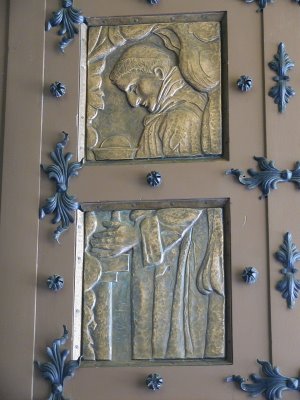
which appears to be a priest with the chalice and host; or this:
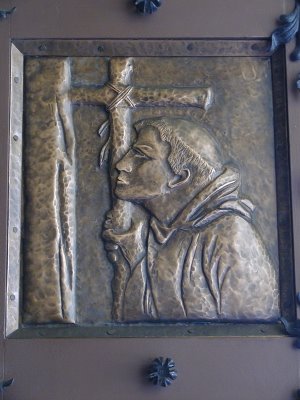
which is Fr. Serra gazing at the Santa Barbara mission -- holding a cross.
PAW and ACLU members, step away from your speed dials. Touch these artworks, and it's war.
And then there's the City Council chamber, adorned with enormous murals on three walls, showing the founding of Mission Santa Barbara, mission life, and the coming of the Americans in 1846. Each group -- Indians, the padres, the Spanish settlers, and the Americans -- is depicted with dignity. I should add that the murals are done in the style of that great American illustrator of the early 20th century, N. C. Wyeth (though not, alas, by the man himself). Wish I could show you pictures, but mine were disappointing. You'll have to see the paintings for yourself.
And then there's this motto, sitting prominently above the main entrance (and repeated in Spanish nearby):
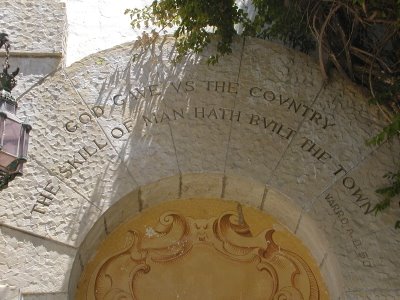
"God gave us the country; the skill of man hath built the town." (Varro, A.D. 50).
So, come to think of it, all of this together means that Santa Barbara's courthouse has more overtly Catholic imagery and more references to God than a certain pretend cathedral down the road in L.A.
What a place it turned out to be -- the kind of public building that everyone could agree upon not so long ago, but which now would be impossible get past the censors from the ACLU and People for the American Way. Built in gorgeous Spanish-colonial style in the 1920's, it's full of exquisite craftsmanship, yet it's not a museum piece; it's still very much a fully functional courthouse. The murals, metalwork, tilework and paintings are a constant and unabashed celebration of the brief history of the region -- all of it, not just the part that's politically correct to recall.
For instance, here in California, it's not fashionable to celebrate Blessed Fr. Serra's tremendous accomplishment in founding the California missions. Since white people and their influence are considered baneful here right now, the padres are seen as foreign invaders who ruined the idyllic lives of the indigenous tribes, enslaving them and infecting them with smallpox, probably on purpose, of course. So it was a refreshing surprise to see this on their courthouse doors:
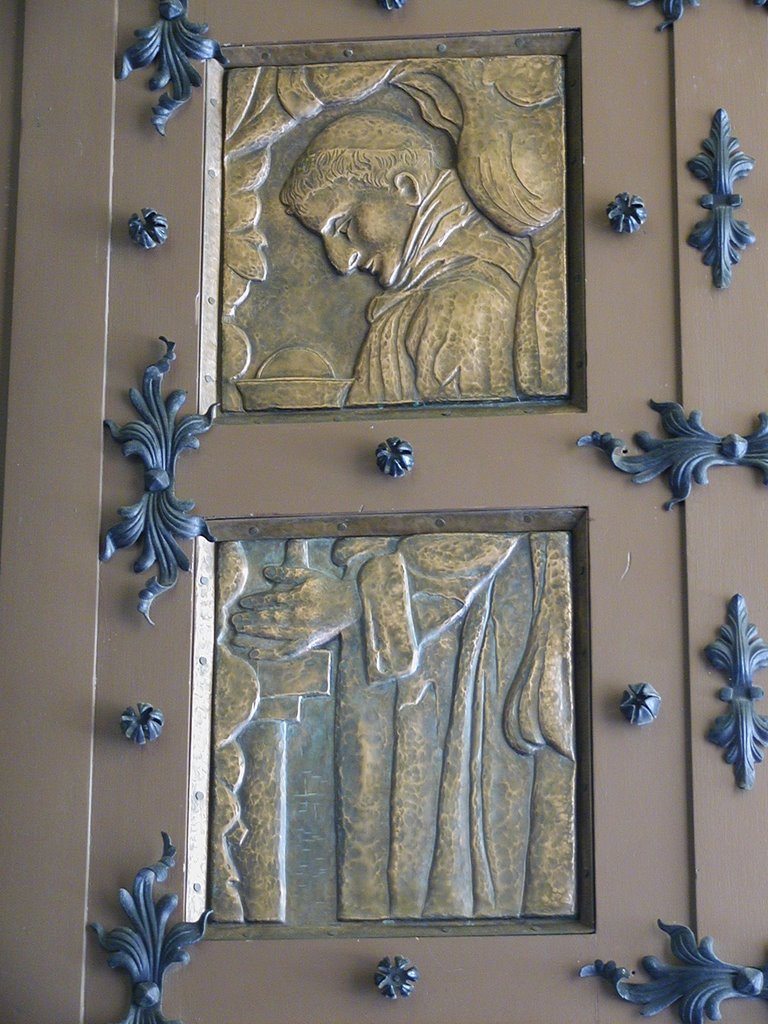
which appears to be a priest with the chalice and host; or this:

which is Fr. Serra gazing at the Santa Barbara mission -- holding a cross.
PAW and ACLU members, step away from your speed dials. Touch these artworks, and it's war.
And then there's the City Council chamber, adorned with enormous murals on three walls, showing the founding of Mission Santa Barbara, mission life, and the coming of the Americans in 1846. Each group -- Indians, the padres, the Spanish settlers, and the Americans -- is depicted with dignity. I should add that the murals are done in the style of that great American illustrator of the early 20th century, N. C. Wyeth (though not, alas, by the man himself). Wish I could show you pictures, but mine were disappointing. You'll have to see the paintings for yourself.
And then there's this motto, sitting prominently above the main entrance (and repeated in Spanish nearby):

"God gave us the country; the skill of man hath built the town." (Varro, A.D. 50).
So, come to think of it, all of this together means that Santa Barbara's courthouse has more overtly Catholic imagery and more references to God than a certain pretend cathedral down the road in L.A.
Friday, September 22, 2006
The "M" word
I hate how the word "martyr" is getting co-opted by those who are blowing other people up in the name of Allah, or the Palestinian people, or who knows what, and killing themselves in the process.
For centuries, "martyr" in the West has denoted a person who is put to death because of his witness to the Christian faith (the word itself derives from the ancient Greek legal term for a witness in court -- who, I presume, did not then blow up the court). Though the Christian might enter a dangerous situation expecting or even hoping for death, he did no harm to those around him. Death was inflicted on him, and his very defenselessness lent additional power to his witness for Christ.
Then along came the suicide bombers of Islam, and the perverse habit of translating the Arabic "shahid" as "martyr". So now what used to be a word for honorable self-sacrifice while doing no harm is being expanded to encompass killing yourself while doing others the ultimate harm. And consequently we have to read about such things as the Al-Aqsa "Martyrs" Brigade. What evil nonsense.
Followers of Muhammad, there's a better "M" word for what you're doing: Murder.
Ah, yes. The Al-Aqsa Murderers Brigade. That's better.
For centuries, "martyr" in the West has denoted a person who is put to death because of his witness to the Christian faith (the word itself derives from the ancient Greek legal term for a witness in court -- who, I presume, did not then blow up the court). Though the Christian might enter a dangerous situation expecting or even hoping for death, he did no harm to those around him. Death was inflicted on him, and his very defenselessness lent additional power to his witness for Christ.
Then along came the suicide bombers of Islam, and the perverse habit of translating the Arabic "shahid" as "martyr". So now what used to be a word for honorable self-sacrifice while doing no harm is being expanded to encompass killing yourself while doing others the ultimate harm. And consequently we have to read about such things as the Al-Aqsa "Martyrs" Brigade. What evil nonsense.
Followers of Muhammad, there's a better "M" word for what you're doing: Murder.
Ah, yes. The Al-Aqsa Murderers Brigade. That's better.
Sunday, September 17, 2006
This Sunday at St. Thomas
Most of the St. Ann Choir is singing on a tour in eastern Europe this week, but the "saving remnant" left behind still managed to produce these three Renaissance gems at the noon mass today:
Josquin d'Ascanio, In Te, Domine, Speravi
Martin de Rivaflecha, Anima Mea Liquefacta Est
Thomas Tallis, If Ye Love Me
Josquin d'Ascanio, In Te, Domine, Speravi
Martin de Rivaflecha, Anima Mea Liquefacta Est
Thomas Tallis, If Ye Love Me
Tuesday, September 12, 2006
Some common sense at last
The Salt Lake City Tribune quotes a gutsy priest about the U.S. response to 9/11:
I haven't heard such moral clarity from any representative of my Church since the whole shootin' match began.
Living as a Catholic in the San Francisco Bay area (which I'm hoping is good for at least 300 days' indulgence just by itself) I've much more often heard the following kind of thing, also from the same article:
As you might expect, The Tribune gave Ms. Rowland a flattering photo, and added this revoltingly fawning caption:
But maybe the truth doesn't always need those to prevail.
Rev. Erik J. Richtsteig, pastor of St. James Catholic Church in Ogden, says the U.S. had every right to strike back after it was attacked on Sept. 11. "If someone is pulling a gun out of their holster, you don't wait for them to pull the trigger before you do something about it."Fr. Richsteig's blog provides a link to the whole article.
I haven't heard such moral clarity from any representative of my Church since the whole shootin' match began.
Living as a Catholic in the San Francisco Bay area (which I'm hoping is good for at least 300 days' indulgence just by itself) I've much more often heard the following kind of thing, also from the same article:
The war in Iraq is not just, said Dee Rowland, director of government relations for the Salt Lake Catholic Diocese. "It was too soon and the danger was not imminent," she said. "But always, there is support for those who serve."Too soon? The danger not imminent? One can only shake one's head at the sheer blind folly of it.
As you might expect, The Tribune gave Ms. Rowland a flattering photo, and added this revoltingly fawning caption:
Dee Rowland was arrested three times for world peace. The 1999 YWCA Outstanding Woman of the Year is still fighting for a safer world through her work with the Catholic Diocese Peace and Justice Commission by lobbying Congress.Poor Fr. Richsteig's comments, in contrast, were stuck way at the article's end. No photo. No fawning caption.
But maybe the truth doesn't always need those to prevail.
Subscribe to:
Posts (Atom)