Saturday, July 29, 2006

How authority works

Quite a few American bishops seem to be clueless when it comes to the way authority and obedience work in the real world. They feel free to ignore anything coming out of Rome that they don't like, and then are surprised and indignant when their priests and administrators follow their example and decide to ignore what they say.

Now, I'd love to send the guys who need some instruction in this (and thank God there are now many who don't, like Chaput and Vasa) to a big-ticket week-long workshop with a trendy management guru and plenty of breakout sessions, in, say, Aspen or Honolulu. But I just don't think that would be right, given the cash-strapped condition of many of their dioceses, after the umpteenth settlement for the priestly pederasty they've been ignoring.

No, I think I'll just suggest they zip over to the public library and borrow Patrick O'Brian's Master and Commander, where the secret is revealed in two sentences, for free:

A commander is obeyed by his officers because he himself is obeying; the thing is not in its essence personal; and so down. If he does not obey, the chain weakens.

Thanks for coming, your excellencies. Have a safe trip home.

Tuesday, July 25, 2006

Not by scripture alone

One of the things that drove me away from Protestantism and back to the RCC was the Protestant insistence on sola scriptura, the exclusive reliance upon the Bible for Christian truth (and therefore a rejection of the authority of the teaching tradition of the Church). It did seem odd, once I finally thought about it, that so vital a doctrine as sola scriptura isn't actually in the scriptura. Then I read this, in Survivals and New Arrivals by the English convert Hilaire Belloc:

Since the authority of the Church was denied, some other authority had to be accepted. The parallel authority of Holy Scripture was put forward. Then came the obvious difficulty, that, since there was no external authoritative Church, there was no one to tell you what Holy Scripture meant, and you were thrown back on the interpretation which each individual might make of any passage in the Bible, or its general sense. For instance (to take the leading example) the individual had to decide for himself what was meant by the words of Consecration. But the modern extension of the thing has gone far beyond such comparatively orthodox limits as trusting to the authority of Holy Scripture, even under private interpretation. It has taken the form of basing religion upon individual feelings. Men and women say: "This is true, because it is true to me. I have felt this, and therefore I know it to be true."

Come to think of it, if you want a religion that's really big on sola scriptura today, you probably want Islam. Where the Koran (but only in Arabic!) is the equivalent of Christ to Christians. Or so wrote Newsweek's religion editor, when he explained why last year's riots over allegedly flushed Korans (which turned out not to have been flushed) were perfectly reasonable, because the Koran is so much more important to Muslims than the Bible is to Christians.

Which shows how things can go fatally wrong when people start thinking a book, not God, deserves the honor due to God alone.

Saturday, July 22, 2006

Darn.

A few posts ago I revealed that I didn't have a clue who the eminent architect Henry Hardinge Menzies is. His profile is here. His fine article God in a Box is here.

Friday, July 21, 2006

Why we need beauty in our churches


This world in which we live needs beauty in order not to sink into despair.

This, from John Paul II's Letter to Artists, in which he recalled what the Fathers said at the end of Vatican II, quoted in this article.

Ten myths that deserve a good whack

For those who want to see beautiful new Catholic churches built, and beautiful old ones kept that way, I'd strongly recommend Duncan Stroik's article Ten Myths of Contemporary Church Architecture. It was originally published in Mr. Stroik's periodical Sacred Architecture, but is conveniently available online here.

A few excerpts:

[Myth] 1. The Second Vatican Council requires us to reject traditional church architecture and design new churches in a Modernist style.

This myth is based more on what Roman Catholics have built during the past thirty years than on what the Church has taught. Even by professional accounts, the church architecture of the past decade has been an unmitigated disaster. However, actions often speak louder than words, and the faithful have been led to believe that the Church requires buildings to be functional abstractions, because that is what we have been building. Nothing could be farther from the intentions of the Council fathers who clearly intended the historic excellence of Catholic architecture to continue. It is most important to keep in mind that "there must be no innovations unless the good of the Church genuinely and certainly requires them, and care must be taken that any new forms adopted should in some way grow organically from forms already existing." (Sacrosanctum Concilium) ...

[Myth] 2. New churches must be designed in accordance with the document Environment and Art in Catholic Worship, published by the Bishop's Committee on Liturgy in 1977.

Due to the lack of any alternative, this pamphlet has become the veritable bible for many new and renovated churches. This document, which was never voted on by the American Bishop's conference and holds no canonical weight, is based more on the principles of Modernist architecture than on Roman Catholic teaching, or her patrimony of sacred architecture. Among its weaknesses is an overemphasis on a congregational view of the Church, an antagonism towards history and tradition, and a strident iconoclasm. Because of the controversial nature of the document, the Bishop's Committee on the Liturgy is presently drafting a new and hopefully improved version.

[Myth] 6. The fan shape, in which everyone can see the assembly and be close to the altar, is the most appropriate form for expressing the full, active and conscious participation of the body of Christ.

This myth comes out of the extreme view that the assembly is the primary symbol of the church. While the fan shape is a wonderful shape for theater, for lectures, even for representative government - it is not an appropriate shape for the liturgy. Ironically, the reason often stated for using the fan shape is to encourage participation, yet the semicircular shape is derived from a room for entertainment. The fan shape does not derive from the writings of the Second Vatican Council, it derives from the Greek or Roman theater. Up until recently, it was never used as a model for Catholic churches. In fact, the first theater churches were 19th century Protestant auditoriums designed so as to focus on the preacher.

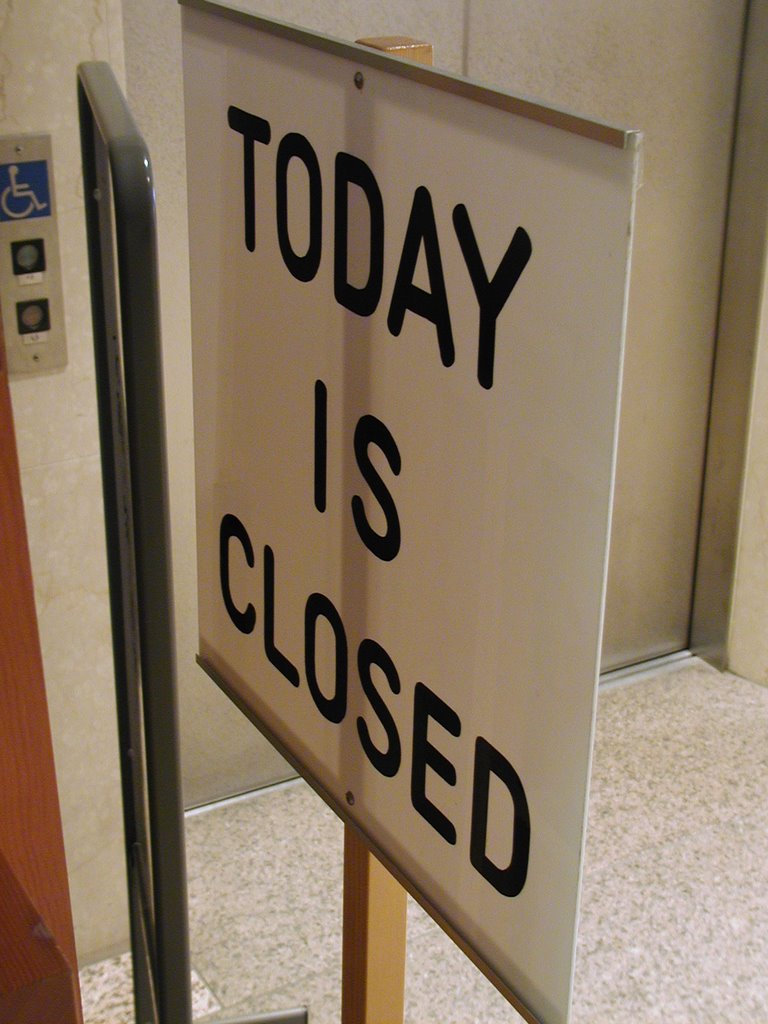
Some days are just like this


I don't know about you, but there are days when I long to put out this sign.

(Seen at the Fukugawa Edo museum in Tokyo, during our 2004 vacation. Actually, they were open.)

Thursday, July 20, 2006

A sight for sore eyes


If, like me, your heart just breaks to see the many new Catholic cathedrals and churches that look more like airport lounges, concert halls, or clean rooms; or to see fine old cathedrals and churches get the sacred renovated completely out of them; then you should definitely spend some time at The Institute for Sacred Architecture. You'll feel better, I promise!

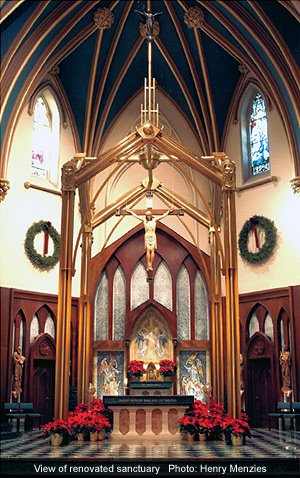
Take a look, for instance, at the renovation of the Cathedral of St. Augustine in Bridgeport, Connecticut, featured on the homepage. I hadn't heard of the architect, Henry Menzies, but I'm sure going to keep an eye on him now. Look at the baldacchino over the altar in the photo -- a very traditional element interpreted in a thoroughly contemporary way, beautifully and respectfully done.

I like the sound of this:

The centerpiece of Mr. Menzies’ design is the altar, which is, without a doubt, the crowning aspect of the project. The altar is the focus of the church, and the eye is invariably drawn to it from almost any point in the cathedral. The color scheme and floor patterns chosen by Mr. Menzies accentuate the altar’s importance and help to focus the eye. The color scheme inside consists of very pale walls and columns, highlighted by gold capitals. The eye is drawn from the capitals along the ribs of the nave ceiling. The ceiling is painted blue, reminiscent of color schemes of the Renaissance. The ceiling represents heaven, often painted blue to portray the heavens within the structure of the church. The attention is then gathered at more highly colorful areas of the church, such as the altar and side chapels.

The centerpiece is the altar -- AND it's in its proper place. The whole atmosphere is one of quiet, beauty, and reverence. I love the colors.

You could really get excited about going to Heaven in a place like that.

A typhoon rosary

Yikes! I just realized that I'm on my thirteenth Patrick O'Brian novel today (The Nutmeg of Consolation), having started the series only a few weeks ago. This has turned into a serious addiction. It's going to be hard when I get to that unfinished 21st volume.

I remarked a few posts back about the passage in which Stephen Maturin, the Irish-Catalan ship's doctor, seeks out a Mass in Boston in 1812. In the novel I just finished, The Thirteen Gun Salute, there's another fine Catholic moment. He and his friend Captain Aubrey are sitting in the dark on a desolate island as a spectacular typhoon batters their ship to matchwood just offshore. In one of the enormous lightning flashes, Aubrey looks over -- and sees Stephen praying the Rosary.

It's very interesting, the way Maturin's character has been developed to this point in the series. He's the consummate scientist and man of reason, but he's also clearly a passionate Catholic, one who can take consolation in a moment of crisis from the Rosary that is so much out of vogue in many Catholic parishes today.

I guess I have another reason to note this episode: in announcing the approach of the typhoon, with its unearthly seas and weird copper-violet skies, Stephen quotes lines from one of my favorite bits of verse, Dryden's Ode for St. Cecelia's Day:

So when the last and dreadful hour
This crumbling pageant shall devour,
The trumpet shall be heard on high,
The dead shall live, the living die,
And music shall untune the sky.

Wednesday, July 19, 2006

Echoes

What we do in life echoes in eternity.

That was the tag line of one of my favorite movies of the last ten years: Gladiator.

It's a terrifying thought, that. All that we do in each instant of time is a word that echoes not for a year, or an age, but for eternity. The good words, and the bad we cannot erase, but can only beg to be forgiven for. It will form the music we must listen to in saecula saeculorum.

And not only in eternity. Each moment's choice of virtue or vice, justice or injustice, courage or cowardice, alters the music of time, as well. Each choice makes certain things possible, and dictates that other things will never happen unto the world's end.

What colossal responsibilities even a day's worth of human life contains!

Sunday, July 09, 2006

The old ways were better, chapter 347

Sometimes, the old ways just worked better. Not so obviously at first. But sooner or later, the benefits of the old ways come out in unexpected ways. Just like the benefits of virtue.

Lately, there's been a good deal of attention paid to the potential of a bird flu epidemic. This has even stimulated some discussion about modifying certain modern practices in the distribution of the Eucharist if an epidemic really get going, to prevent the spread of contagion.

Let's review how Communion is often done today. The priest consecrates the bread and wine. The bread is handed to the communicant, who puts the bread into his own mouth with his hand, then also drinks from a common cup or chalice, whose rim is wiped with a cloth after each person drinks.

Contrast this with the bad old days we're taught to despise by many bishops and diocesan personnel. The priest would consecrate the bread and wine, but would bring only the bread to the communicants; he would then place the Host on the tongue of each person. No wine would be offered at all.

Add to these differences that before Vatican II, there was no such thing as shaking hands at the Peace, before Communion.

So let's look at all these changes from the standpoint of preventing the spread of disease -- many diseases, not just bird flu.

Under the new customs, everyone shakes hands with several other people a few minutes before Communion. News flash: shaking hands is a nifty way to transfer germs from one person to another. Then people go up for Communion, take their consecrated bread in their own now-contaminated hands, and put it in their mouth. Next, they drink a sip of wine from the same cup as several hundred other people, the rim of which has been ineffectually wiped with a cloth which itself is just collecting germs as it goes along.

Under the old customs, only one person ever touched the Host before it arrived directly on your tongue: the priest. The priest who publicly washed his hands at the beginning of the Offertory. I know, it was a ceremonial washing. I served Mass back then, and knew that some priests wanted only a few drops on the their fingertips, while others wanted a veritable flood. But either way, I never saw a priest approach either the side of the altar to wash his hands, or the altar rail to distribute Communion, with anything but scrupulously clean hands.

I hope it's pretty clear to everyone, whether liberal or conservative, that the old customs were simply less likely to transmit sickness among the congregation.

But we added the germ-spreading handshakes, and the taking of the Eucharist in the germy hand, and the drinking from the germy common cup, so we could be -- I don't know what. Trendier. Up with the times. Just different from the past. More like the Protestants.

What we got was sicker. In more ways than one.

Monday, July 03, 2006

Nine hundred years and counting

Nine-hundred and thirty-five years ago, at Manzikert in eastern Anatolia, the Islamic conquest of what we today call Turkey began its final phase, with a crushing victory over the army of the Byzantine Empire. It continues today, not with armies -- the need for such effort has long passed -- but with the solitary knife and pistol. From Catholic News Service:

A French missionary priest survived a knife attack on July 1, but Church leaders in Turkey are worried by a rising tide of anti-Christian violence in the months leading up to a visit by Pope Benedict XVI.

Father Pierre Brunissen was badly wounded when he was stabbed twice by a man who was promptly taken into police custody. Authorities said that the priest's assailant appeared mentally unbalanced.

The AsiaNews service reports, however, that Father Brunissen had received a number of threats in recent weeks, and the parish church he served in the town of Samsun had been vandalized. The violence and intimidation had increased, AsiaNews said, after the murder of an Italian missionary, Father Andrea Santoro, in the Turkish town of Trabzon, in February. The young man charged with killing Father Santoro, who was also described as unbalanced, shouted an Islamic slogan after shooting the priest.

Bishop Luigi Padovese, the apostolic nuncio in Turkey, told the Associated Press that he would like to believe officials' assurances that the assault on Father Brunissen "has nothing to do with Islamic fundamentalism." But he said that hostility toward the Church has increased significantly in recent months, with an apparent campaign against Christian influence, and "it is the Catholic priests who are being targeted."

Bishop Padovese seems to know the score. The "unbalanced" assailants of Frs. Brunissen and Santoro are no more than the undisciplined vanguard of the assault of the real Islam upon all things outside it -- including any brand of moderate Islam inclined to accommodate Western or Christian influences -- that will soon engulf Turkey. Not even the gentlest, most peaceful Christian presence, exemplified by these two priests, can be tolerated by the real Islam. A generation ago, there were still sizable religious minorities in Turkey. They are dwindling today, and soon there will be none.

What is utterly galling in this is that every square foot of what we now call "Turkey" -- and accept as naturally and natively Muslim -- was once the heartland of Christianity. Its churches at Ephesus and in Galatia were the recipients of letters from St. Paul. Its plains once fed the whole Byzantine Empire. Its sturdy Christian peasantry filled the ranks of the Empire's army, which alone fought off every pagan and Muslim challenger for centuries. Until Manzikert.

Saturday, June 24, 2006

Stephen Maturin's Mass

I've gotten hooked on the Aubrey-Maturin novels of Patrick O'Brian, which partly accounts for my last week's silence. But today I ran across something interesting from a contemporary Catholic viewpoint in the sixth novel, Fortune of War.

Stephen Maturin, the ship's surgeon and naturalist, Catalan and Irish by birth, and Catholic, has been taken prisoner with Jack Aubrey during the War of 1812, and goes hunting for somewhere to hear Mass during his captivity in Boston.

... the priest was already at the altar by the time they reached the obscure chapel in a side-alley, and crept into the enormously evocative smell of old incense. There followed an interval on a completely different plane of being: with the familiar ancient words around him, always the same, in whatever country he had ever been (though now uttered in a broad Munster Latin), he lived free of time or geography, and he might have walked out, a boy, into the streets of Barcelona white in the sun, or into those of Dublin under the soft rain. He prayed, as he had prayed so long, for Diana, but even before the priest dismissed them, the changed nature of his inner words brought him back to the immediate present and to Boston, and if he had been a weeping man it would have brought tears coursing down his face.

Lucky Stephen. He lived in a world where, indeed, a Catholic could voyage 'round the world and take solace in the same Mass in each land he visited. The world Catholics had had for a thousand years, and which we had until such a short time ago. May that world come again, and soon.

Sunday, June 18, 2006

Verdi Requiem

Recently, my brother was given tickets to a performance of the Verdi Requiem at San Francisco's Davies Hall, and kindly invited us to come along. I've heard it performed before, but this was something special. Fabulous soloists, 170-plus voices in the SF Symphony Chorus, great brass players in the SF Symphony Orchestra.

You'd think that in San Francisco, where nine-tenths of the people seem fundamentally opposed to most of what the Catholic Church stands for, a Mass setting would be treated with some disdain. Not so on that night. The audience was sternly warned on their way in by large placards proclaiming that there would be no intermission in the 100-minute performance, and that no one leaving their seat would be re-admitted to the hall. Not only did the audience treat the music with reverence, minding their manners by not applauding between movements, but the conductor (James Conlon) held the silence after the last plaintive Libera me for a full ten seconds -- and not the slightest sound was heard throughout the enormous hall. Then, of course, the place erupted for seven or eight minutes of cheering.

Of course, it was reverence for Verdi's music, not for the Church or even for God, that animated most patrons that night. But here's the great thing about Christian art of all kinds: it penetrates the soul even in the face of stark unbelief. No human being can escape unchanged from the hurricane of Verdi's treatment of the Dies Irae, all the more so when it returns by surprise near the end, when you've been lulled by several minutes of soft pleas for mercy. There in the program were the Latin and English side by side, and I wonder how many hearts were troubled -- rightly so -- by the unfamiliar sentiments, or by these disturbing lines alone:

Lacrymosa dies illa
Qui resurget ex favilla
Judicandus homo reus.

(Lamentable is the day
on which the guilty shall arise
from the ashes to be judged.)

And I wonder how many felt drawn by this wish:

Sed signifer Sanctus Michael
repraesentet eas in lucem sanctam,
Quam olim Abrahae promisisti
et semini eius.

But let Saint Michael, the standard-bearer,
bring them forth into the holy light,
which you once promised
to Abraham and his seed.

Corpus Christi at St. Thomas

Today there was a procession of the Blessed Sacrament in connection with Corpus Christi Sunday, at my little home parish of St. Thomas Aquinas, accompanied by:

Josquin des Prez, Missa Pange Lingua

sung by the St. Ann Choir.

Sunday, June 11, 2006

Lies > opinion > substance

Darn, that Francis Bacon just keeps on delivering up good ones!

And in these and the like kinds, it often falls out, that something is produced of nothing; for lies are sufficient to breed opinion, and opinion brings on substance.

And that insight explains why, for example, we have to continue to debunk Dan Brown, even though his book is claptrap, no one with any sense will believe it, etc., etc. We have to continue because the lies are out there -- powerfully out there -- and they are already breeding opinion. If that opinion brings on substance, watch out.

Not alone

It's nice to know one's not alone in certain sentiments, so I was encouraged to run across this, from Sir Francis Bacon:

A man's nature runs either to herbs or weeds: therefore let him seasonably water the one, and destroy the other.

Trinity Sunday at St. Thomas

From the St. Ann Choir at St. Thomas Aquinas today:

Josquin d'Ascano, In Te, Domine, Speravi
Antoine de Fevin, Sancta Trinitas

Wednesday, June 07, 2006

Womenpriests right down the street

Given what a wacky place the Bay Area is, I guess I shouldn't have been surprised that we're home to yet another wackiness: women declaring that they are now priests of the Roman Catholic Church. And only a convenient 20-minute drive from my front door!

To say the least, I'm not too impressed with the response of the diocese. Here's the entire acknowledgement of the situation from the current issue of the diocesan newspaper:

Recent news reports of “Roman Catholic Woman Priest” Victoria Rue leading celebrations of the Mass on the campus of San Jose State University require the Diocese of San Jose to issue the following statement: Victoria Rue is not a validly ordained priest of the Roman Catholic Church. Members of the Roman Catholic Church should not participate in celebrations of the sacraments that are conducted by Victoria Rue, as those celebrations are not in union with the local or universal Church.

That's it. Note that although this has been going on for some time, it's "recent news reports" that led the diocese to do something, finally. And there's to be no punishment for anyone -- no excommunication of the "priestesses", no warning of grave sin attaching to attendance at these "celebrations of the sacraments". And what a wishy-washy way of putting the reason for not attending: the bogus masses are "not in union with the local or universal church." Come to think of it, why was it necessary to mention the "local" church at all?

At least they put "Roman Catholic Woman Priest" in quotes.

According to a May 28 story in the San Jose Mercury News, the diocesan spokeswoman, Roberta Ward, believes that

most of the services are so small... there's no point in drawing attention to them.

How many times have we seen that attitude before. Let's not say anything about the evil in our midst. It's small now. Maybe it'll just go away. Subtext: think of how inconvenient and uncomfortable it might become to actually stand up for our Faith.

The diocese's grand strategy has been to try to avoid giving the group publicity. And what happens? The Mercury News, circulation 300,000+, runs a fawning 1,200 word front-page story with three attractive photos, a full schedule of when and where you can attend these false masses, and the group's website.

Well, that idea sure worked great.

Monday, June 05, 2006

This Sunday at St. Thomas

Since this Sunday was Pentecost, the St. Ann Choir performed a full Renaissance mass, Missa Osculetur Me by Orlando de Lassus, along with the Gregorian sequence Veni, Sancte Spiritus.

No Rainbow sashers, thank God.

There was one little girl making her First Communion, very charming in her white dress and veil, the only one of her group of 170 in this three-church parish to learn all the required prayers in Latin! And so she wanted to have her First Communion at St. Thomas, where Latin is used and honored.

There's hope!

Sunday, June 04, 2006

Weed 'n' feed

A friend once explained to me why his (non-denominational) pastor didn't talk much about sin and evil: one should just talk about the "good news" of the Gospels, not the "bad news" of evil, lest one become fascinated, even fixated, on the latter.

Quite aside from the danger of making a kind of "happy talk" Christianity, it just isn't honest to ignore evil. To do so gives an incomplete picture of the world, and begs the question of what we needed to be saved from in the first place. There is good in the world, and there is evil. Deal with both.

Anyone who has ever successfully tended a garden knows about celebrating Good while confronting Evil. How's that? Well, what happens if you just plant nice flowers in your garden, but never pull any weeds? The weeds take over. What happens if you weed like mad but never plant any flowers? You get a barren patch of ground. But if you both weed and plant, then you get a garden.