Sunday, October 01, 2006

Britons, strike home!

This is pretty outrageous. From the Evening Standard (UK):

Schoolgirls forced to strip to underwear in front of boys for PE
30.09.06

Dawn Bedford and daughter Sam

Parents staged an angry protest after their young daughters were forced to strip to their underwear in front of boys at school.

The girls, aged ten and 11, were left in tears after being ordered to change for PE in a mixed classroom under a school policy blamed on health and safety regulations.

The headmistress of Hillside School in Baddeley Green, Stoke-on-Trent, said the children had to get changed together as there were not enough teachers to supervise them separately.

So of course the solution that immediately occurs to the headmistress is to force the kids to jettison the last pitiful shreds of natural modesty they might still possess.

But furious mother Dawn Bedford said her ten-year-old daughter Sam was reduced to tears by the rules.

"The regulations are ridiculous,' she said. "The girls have always changed separately. No one has ever been hurt."

Sam, who had a perfect school record, was excluded for two days because she refused to get changed for after-school football practice with boys watching.

She pulled her PE bag out of a teacher's hand and ran off to the girls' toilets to change. The school says the teacher was assaulted verbally and physically.

Yeah, I'd hate to run into that ferocious-looking Sam in a dark alley, wouldn't you?

Mrs Bedford said: "Sam was embarrassed and distressed because the boys kept looking at her and making comments. She is now wearing her first bra and taking sex education lessons.

"This is a very sensitive time for girls. Don't the teachers realise how difficult it is? Girls were trying to hide under a table so boys could not see them. It is disgusting."

Sam added: "The boys kept looking at me. I was embarrassed so I went to the toilets. But the teacher tried to take me back to the classroom with the boys."

Note that the girl wasn't defiant about class -- she was trying to get ready for PE in an area where she could still keep her modesty, and where, one assumes, she is allowed to go by herself when she needs a bathroom break. But the teacher leaves the other kids (what about their oh-so-important supervision during that expedition?) and tries to drag her back!

Headmistress Suzanne Foster has now relented following a petition from 50 parents. She refused to comment on her safety concerns but said: "The situation has now been resolved and the children are changing in separate areas."

Astonishing how those "separate areas" became available so quickly.

In a statement to parents, she said: "The arrangements started this term purely for health and safety reasons. I cannot have unsupervised children at school."

The Department for Education said: "It is up to the head to decide what happens when children are changing for PE. It is a matter of personal discretion."

Truly incredible. Are you spinning in your grave yet, Winston?

It's time for ordinary Brits to take back their country and their Faith -- if it isn't already too late, which, sadly, it probably is.

This Sunday at St. Thomas

Sung by the St. Ann Choir at St. Thomas Aquinas church this noon:

Josquin des Prez, Christe, fili Dei and Ave Christe.

Fr. Harris was back this week, so we were spared the previous week's spontaneous liturgical innovations.

There were quite a few families with young children in the pews, which is a very very good thing indeed. But babies will be babies, and their very noisy presence today -- you often actually couldn't hear anything else but the howling -- brought up that age-old question: when should a crying child be taken gently out of church?

I'd say: if a child can't be quieted in a paternoster -- the time it takes to say the Our Father -- then, out of charity toward other parishioners, one or the other parent should take him outside until he's calm again. I know it's a burden to parents, usually the mother, but if the wailing is allowed to go on for five or ten minutes at a stretch, dozens of other people are going to be seriously distracted from a significant chunk of what is often the only sacred time in their entire week.

I've been a parent, and I've spent plenty of time outside on cold days, jollying my infant daughter into quietude (or not) instead of being inside where it's warm, adult, and spiritual. But that's a responsibility you take up when you become a parent, and I don't think you should force others to share it.

Friday, September 29, 2006

Yeah, right

From Catholic World News:

Sep. 29 (CWNews.com) - The second-ranking official in Al Qaida called upon Pope Benedict XVI to convert to Islam, in a videotaped message released on September 29. In an Arabic-language message, delivered in videotape format to Islamic media outlets, Ayman al Zawahiri charged that in his Regensburg speech Pope Benedict was stirring up the same "superstitions" and fears of Islam that had led to the Crusades.

Ah, yes, those crazy "superstitions". Like the Seljuk Turks' conquest of most of the remainder of the Byzantine Empire after the Battle of Manzikert in 1071. Like the robbing and murder of Christian pilgrims on their way to the Holy Land. Why would anyone get worked up over things like that?

Benedict was clearly not trying to prepare the way for another armed resistance movement like the Crusades -- all you have to do is read what he actually said.

But I hope he's got that speech ready somewhere, because it's looking like we might need it before too long.

Wednesday, September 27, 2006

Mozart would not be amused

Mozart's opera Idomeneo won't be on the program this year at Berlin's Deutsche Oper. That's both a bad thing and a good thing.

It's bad because pulling the production has publicly been attributed to fears of a violent Muslim reaction to its staging, which includes a scene in which Mohammed is decapitated. I'm really tired of worrying about what some Muslim, somewhere, will take offense at. Defenders of Islam as the religion of peace should note that although Mohammed isn't the only religious figure who loses his head in this production, his followers are the only ones from whom retaliatory violence is being feared. And it's no wonder; look what happened when those relatively innocuous Danish cartoons surfaced.

But it's also good, because this production richly deserved to be yanked. It's a desecration of Mozart's original, which contains nothing remotely offensive to Muslims, and a fine example of what happens when the arts elites are allowed to do anything they feel like doing in order to "push the envelope". Gerald has an extensive post with photos and links, if you want to know more about this travesty, and why, given the general state of German theater today, it is hardly unexpected.

The scene that's causing the uproar isn't even in Mozart's original libretto. The director, Hans Neuenfels, made it up and tacked on it to the opera's end to amplify the title character's contempt for religion which, one can infer, he shares. Apparently Herr Neuenfels believed his audience would be too unsophisticated to understand that Idomeneo's rebellion against the god Poseidon could be taken allegorically and applied to the present day. So, embracing anachronism like a old buddy, Neuenfels treats the audience to the sight of Idomeneo bloodily beheading Jesus, Buddha, and Mohammed onstage.

So the real problem in this whole brouhaha isn't really Mozart's Idomeneo; it's the ludicrous, contemptible esthetics of the director. I say: dump him, restage the production traditionally, or at least not insanely "updated", put it back on the schedule, and get on with honoring through respectful performance one of the geniuses of Western music.

Tuesday, September 26, 2006

One reason to be glad we're here


Spitzer Space Telescope image of spiral galaxy M81

As you can probably tell if you've been reading me for a while, I find lots of things in this world to complain about. But every now and then, I'm reminded of one of the many ways in which I'm very, very lucky. You, too.

When I was in high school in the 60's, I read Arthur C. Clarke's non-fiction work Profiles of the Future: an Inquiry into the Limits of the Possible. It's a science-fiction author's take on just how likely it is that certain things envisioned in science fiction can actually take place someday, and which ones are fundamentally impossible. He's kept updating it since then, and it's still a very interesting read.

Though I've liked Clarke's lighter short stories, his longer works I find less interesting, and his atheism and his sadly underinformed view of religious faith made his novel Childhood's End positively evil. Nevertheless, he often does produce a very handsome turn of phrase, and the following peroration at the very end of Profiles has stuck with me through the years:

Our Galaxy is now in the brief springtime of its life -- a springtime made glorious by such brilliant blue-white stars as Vega and Sirius, and, on a more humble scale, our own sun. Not until all these have flamed through their incandescent youth, in a few fleeting billions of years, will the real history of the universe begin.

It will be a history illuminated only by the reds and infra-reds of dully-glowing stars that would be almost invisible to our eyes; yet the sombre hues of that all-but-eternal universe may be full of colour and beauty to whatever strange beings have adapted to it. They will know that before them lie, not the millions of years in which we measure the eras of geology, nor the billions of years which span the past lives of the stars, but years to be counted literally in trillions.

They will have time enough, in those endless aeons, to attempt all things, and to gather all knowledge. They will not be like gods, because no gods imagined by our minds have ever possessed the powers that they will command.

But for all that, they may envy us, basking in the bright afterglow of Creation; for we knew the Universe when it was young.

That's a pretty nice blessing to have received, you and I and every human being who has ever lived; we've all known the Universe when it was young. We take that blessing for granted, as we do most, but we shouldn't. So it's a good thing that there's a reminder of it right overhead on every clear night of our lives.

Sunday, September 24, 2006

This Sunday at St. Thomas

Sung by the St. Ann Choir at St. Thomas Aquinas this noon:

Anon. 14th century English, Salve Virgo Virginum
Palestrina, Sicut Cervus

The recessional, played on the organ, was a set of variations on Deo Gratias, Anglia, one of the most stirring medieval melodies that you'll still hear now and then. Sir William Walton used it in his music for the movie Henry V, the one with Olivier in the title role.

On the less good side, a priest I hadn't seen before officiated at Mass today. Maybe he was a late replacement for our usual (elderly and ailing) Fr. Harris, so I should cut him some slack for not knowing how things usually flow at St. Thomas. But it was pretty much a mess. Canned, predictable sermon on helping the homeless and marginalized (yes, we have to do that, but you hear it so much you'd think that was the totality of Christianity). And he's the first priest I've heard to actually change words to suit himself (not, thank God, at the Consecration). I can't recall the many deviations this guy got into, but when he chimed in with "The Lord is with you", for example, instead of the standard "The Lord be with you", people seemed uncertain how to respond -- stick with the usual "And also with you"? Try something new, like "You da man"?

It just completely escapes me what priests like that are trying to accomplish. It also makes me realize how blessed we've been at St. Thomas.

Saturday, September 23, 2006

Bet you can't have this on YOUR courthouse!

On our recent vacation down California's central coast, we spent a couple of days in Santa Barbara. We noticed that the AAA Tour Book had bestowed one of its infrequent "Gem" ratings on the Santa Barbara county courthouse, so in our wanderings through town, we stopped there, curious why a courthouse should have earned such high marks.

What a place it turned out to be -- the kind of public building that everyone could agree upon not so long ago, but which now would be impossible get past the censors from the ACLU and People for the American Way. Built in gorgeous Spanish-colonial style in the 1920's, it's full of exquisite craftsmanship, yet it's not a museum piece; it's still very much a fully functional courthouse. The murals, metalwork, tilework and paintings are a constant and unabashed celebration of the brief history of the region -- all of it, not just the part that's politically correct to recall.

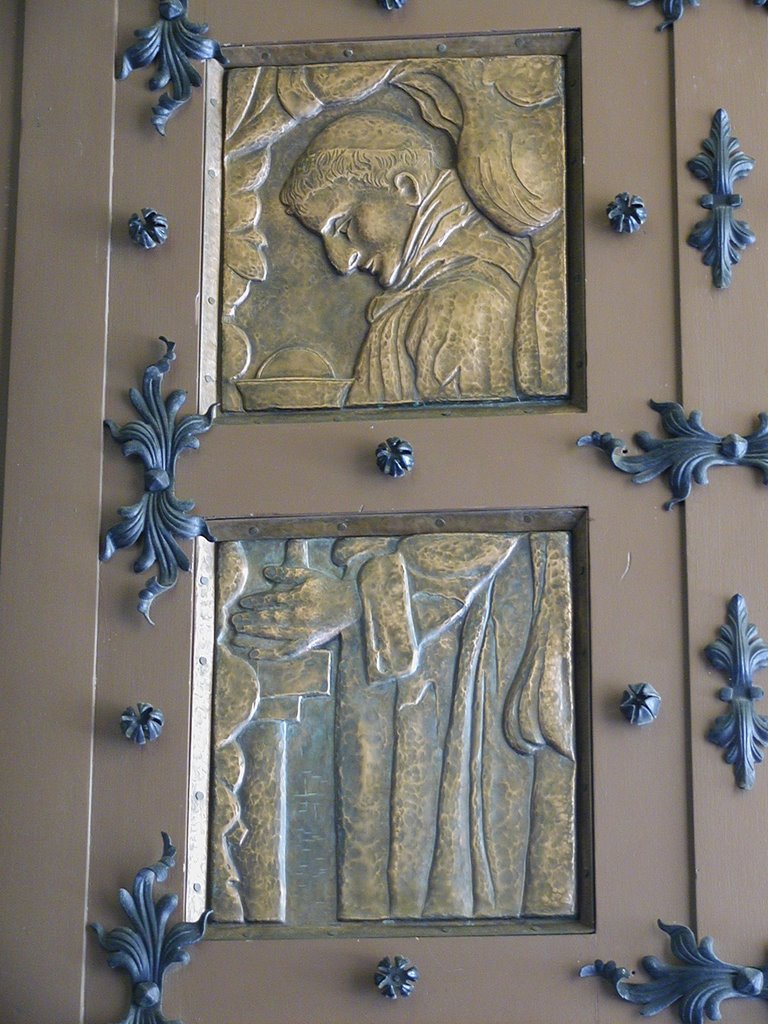
For instance, here in California, it's not fashionable to celebrate Blessed Fr. Serra's tremendous accomplishment in founding the California missions. Since white people and their influence are considered baneful here right now, the padres are seen as foreign invaders who ruined the idyllic lives of the indigenous tribes, enslaving them and infecting them with smallpox, probably on purpose, of course. So it was a refreshing surprise to see this on their courthouse doors:


which appears to be a priest with the chalice and host; or this:


which is Fr. Serra gazing at the Santa Barbara mission -- holding a cross.

PAW and ACLU members, step away from your speed dials. Touch these artworks, and it's war.

And then there's the City Council chamber, adorned with enormous murals on three walls, showing the founding of Mission Santa Barbara, mission life, and the coming of the Americans in 1846. Each group -- Indians, the padres, the Spanish settlers, and the Americans -- is depicted with dignity. I should add that the murals are done in the style of that great American illustrator of the early 20th century, N. C. Wyeth (though not, alas, by the man himself). Wish I could show you pictures, but mine were disappointing. You'll have to see the paintings for yourself.

And then there's this motto, sitting prominently above the main entrance (and repeated in Spanish nearby):


"God gave us the country; the skill of man hath built the town." (Varro, A.D. 50).

So, come to think of it, all of this together means that Santa Barbara's courthouse has more overtly Catholic imagery and more references to God than a certain pretend cathedral down the road in L.A.


Friday, September 22, 2006

The "M" word

I hate how the word "martyr" is getting co-opted by those who are blowing other people up in the name of Allah, or the Palestinian people, or who knows what, and killing themselves in the process.

For centuries, "martyr" in the West has denoted a person who is put to death because of his witness to the Christian faith (the word itself derives from the ancient Greek legal term for a witness in court -- who, I presume, did not then blow up the court). Though the Christian might enter a dangerous situation expecting or even hoping for death, he did no harm to those around him. Death was inflicted on him, and his very defenselessness lent additional power to his witness for Christ.

Then along came the suicide bombers of Islam, and the perverse habit of translating the Arabic "shahid" as "martyr". So now what used to be a word for honorable self-sacrifice while doing no harm is being expanded to encompass killing yourself while doing others the ultimate harm. And consequently we have to read about such things as the Al-Aqsa "Martyrs" Brigade. What evil nonsense.

Followers of Muhammad, there's a better "M" word for what you're doing: Murder.

Ah, yes. The Al-Aqsa Murderers Brigade. That's better.

Sunday, September 17, 2006

This Sunday at St. Thomas

Most of the St. Ann Choir is singing on a tour in eastern Europe this week, but the "saving remnant" left behind still managed to produce these three Renaissance gems at the noon mass today:

Josquin d'Ascanio, In Te, Domine, Speravi
Martin de Rivaflecha, Anima Mea Liquefacta Est
Thomas Tallis, If Ye Love Me

Tuesday, September 12, 2006

Some common sense at last

The Salt Lake City Tribune quotes a gutsy priest about the U.S. response to 9/11:
Rev. Erik J. Richtsteig, pastor of St. James Catholic Church in Ogden, says the U.S. had every right to strike back after it was attacked on Sept. 11. "If someone is pulling a gun out of their holster, you don't wait for them to pull the trigger before you do something about it."
Fr. Richsteig's blog provides a link to the whole article.

I haven't heard such moral clarity from any representative of my Church since the whole shootin' match began.

Living as a Catholic in the San Francisco Bay area (which I'm hoping is good for at least 300 days' indulgence just by itself) I've much more often heard the following kind of thing, also from the same article:
The war in Iraq is not just, said Dee Rowland, director of government relations for the Salt Lake Catholic Diocese. "It was too soon and the danger was not imminent," she said. "But always, there is support for those who serve."
Too soon? The danger not imminent? One can only shake one's head at the sheer blind folly of it.

As you might expect, The Tribune gave Ms. Rowland a flattering photo, and added this revoltingly fawning caption:
Dee Rowland was arrested three times for world peace. The 1999 YWCA Outstanding Woman of the Year is still fighting for a safer world through her work with the Catholic Diocese Peace and Justice Commission by lobbying Congress.
Poor Fr. Richsteig's comments, in contrast, were stuck way at the article's end. No photo. No fawning caption.

But maybe the truth doesn't always need those to prevail.

Monday, September 11, 2006

This Sunday at St. Thomas

Sung by the St. Ann Choir at today's noon Mass at St. Thomas Aquinas:

di Lassus, Adoramus Te, Christe
Palestrina, Super Flumina Babylonis

Saturday, September 09, 2006

On the folly of taking no action

From Jean Anouilh's 1960 play Becket:

KING HENRY: Life is one long web of difficulties. The secret of it ... is to give them no importance whatever. In the end one difficulty swallows up the other and you find yourself ten years later still alive with no harm done. Things always work out.

BECKET: Yes. But badly. My prince, when you play tennis, do you simply sit back and let things work out? Do you wait for the ball to hit your racket and say "It's bound to come this way eventually"?

Thursday, September 07, 2006

What "diversity" will always become

Joseph Bottum, writing about the banning of evangelical groups from Georgetown University:

There’s an obvious irony here—employed too often to be surprising—in which people begin by protesting in the name of diversity against centralized authority, and later discover, once they’re in charge, how useful those old forms of authority can be in controlling diversity.

Those of us who were at college in the 1960's certainly have seen that happen before. At my alma mater, Pomona College, the conservative values the school espoused when I got there have now been completely replaced by the usual dreary soft-leftist orthodoxies, and heaven help you if you dissent. But back to Georgetown:

But it also represents a tactic we’re likely to see more of: claims of old-fashioned Catholicism, used by people who are far from old-fashioned Catholics, to maintain control of officially Catholic institutions and to ban the people whose political opinions they don’t like. Watch for it at Boston College, and Marquette, and Notre Dame, and Loyola Marymount, and on and on.

The trouble for these institutions is that sooner or later, people catch on, and they take their money elsewhere, where it will actually support what people think is worth preserving. Though we still send a little money annually to Pomona, mostly for old times' sake, we send as much or more now to Thomas Aquinas College.

Eventually, maybe money will talk.

Sunday, September 03, 2006

This Sunday at St. Thomas

Sung by the St. Ann Choir at St. Thomas Aquinas church in Palo Alto, at today's Gregorian mass:

Josquin des Prez, Tu Pauperum Refugium
Lodovico Viadana, Exsultate Justi

Wednesday, August 23, 2006

Next time you're in California...


... you absolutely have to visit this mission if you can. Because unlike most of the California missions, this one is a time machine.

This is Mission San Antonio de Padua, in the remote hills of central California, maybe 100 miles south of San Jose. The Spanish missions were connected by a road called El Camino Real (i.e. The Royal Road), and today's Highway 101 -- one of the main north-south routes in the state -- usually follows its path. So most of the missions are right along the busy interstate, or surrounded by the towns that grew up around most of them. Well restored in most cases, but when you're there you have no doubt you're still in the 21st century.

Not San Antonio. It's in the middle of nowhere, because when Hwy. 101 was laid out, it took a different, easier route, about 15 miles farther inland. To get there, you take Jolon Road from near King City, which follows the old route of El Camino, winding past a few lonely ranches and seeing very very few other cars. It's a beautiful, quiet drive.

The mission is all the more isolated because it's on the grounds of Fort Hunter Liggett, an Army training base which is mostly just open, untouched land. So to actually get to it, you have to show your driver's license, registration, and insurance card to the courteous but obviously armed guard at the gate, who takes those things, goes back into his hut and (I sure hope) makes certain you haven't been sending money to Hezbollah lately, and then comes back with your pass.

The base headquarters disappears behind you, and a little farther down the road, you come to the mission. You pull up in front, switch off the ignition, get out and shut the door. And then you hear it:

Nothing.

Not a sound of the modern world. Probably not another visitor, either. Just you and the padres' pride and joy, baking there in the afternoon sun with that glorious California summer scent of hot dry grass and oaks and evergreens. Look around you, and all you'll see is the same golden brown hills they saw. You'll have a sense of the immense sacrifice they made to come to this wilderness and bring the Faith with them.

Close your eyes just a little, and it's 1780.

If there's a caretaker, he's not in evidence, yet everything is wide open, reminiscent of those days, only yesterday, when pretty much everyone left their doors unlocked.

You might wander into the dim and peaceful sanctuary:


or maybe pause at this luminous side chapel:


but when you leave, you'll know you've been in not just another place, but in a little private hidden corner where another time is still there to be savored.

Tuesday, August 22, 2006

Too familiar

Most of the rank and file were devout, self-denying, and upright, but a crust of politically covetous, worldly, and cynical prelates had weakened and degraded the dignity and influence of organised Christianity.
Thus Winston Churchill, in his History of the English-Speaking Peoples, on the state of the Catholic Church in France on the eve of the Revolution.

But it's also a pretty good description of the Catholic Church in America, don't you think? Though much demoralized and often misled, the laity are still often surprisingly devout; but the Weaklands and Lynches and Laws and Mahonys and Gumbletons have indeed weakened and degraded the influence that the Catholic Church might have brought to bear on the rotten culture around us.

Sunday, August 20, 2006

The (mis)information highway

Something made me think of a quotation I'd heard years ago, and so, like any good netizen, of course I googled what I could recall of it. I duly was presented with a few hundred hits, but in reading the summaries I noticed that part of the quotation as cited in the majority of hits was strangely different from what I remembered. And so I got a useful reminder of how risky it can be to rely on that first screen of Google hits.

Here's the correct quotation:

Truth lies within a little and certain compass, but error is immense.

It's by Henry St. John, 1st Viscount Bolingbroke, writing ca. 1716. The first time I read it, many years ago, I loved it for the way it just sticks it to relativism. Hey, bub, there aren't many dissimilar truths about a thing; there is one, and it's closely circumscribed, and you can know what it is if you try hard enough. The vast remainder of what else you might say about the thing are not other truths, or "true for you but not for me"; they're just wrong.

Go get 'em, Henry!

But a funny thing happened to this fine sentence on its way to the web; on website after website that I checked out, it had turned into:

Truth lies within a little uncertain compass, but error is immense.

Just a few letters of difference, but what a change. Now the compass in which truth is to be found is no longer certain; gone is the author's confident assurance that we can know that compass, and the limits of what is true about a thing. We're still told that error is immense, but we can't be sure just where the truth is.

How did this change happen, so that it could be strewn all over the web? I think I can guess.

I suspect that whoever first goofed it up only heard the quotation, and never read it. And the speaker he was listening to slurred the "and" into the sloppy " 'n' " you hear all the time. My imagined listener parsed the " 'n' certain " he had heard into "uncertain", then wrote it down feverishly into his notebook or PDA or laptop, and without checking, or even reading his corrupt version carefully and realizing that it doesn't really make sense with the change, threw it up onto his website. And as things do on the web, it was picked up by one person after another who never checked it, and just trustingly repeated it -- also without noticing that it really didn't make sense.

So the search for truth hasn't really changed much. Centuries ago, when news traveled largely by word of mouth, you knew you couldn't trust everyone, and you honed the skills by which you could tell a reliable person from a rumor-mongering halfwit.

Now, after enormous technological change and the invention of the greatest information-gathering tool ever known, we're still right where we always were: trying to tell the reliable witness from the halfwit, and keep our inheritance of wisdom from morphing into gibberish.

Thursday, August 17, 2006

New cathedral in Arizona


From the architects of the new cathedral in Phoenix:

"This distinctive shape has two iconic relationships -- one to the Native American mandala form, ... and two to the barrel cactus form that is indigenous to the area."

OK, I'm lying. This is the new stadium of the Arizona Cardinals football team.

But given some of the absurd Catholic churches that have been built in the past thirty years, wasn't it believable for just a second that this structure was indeed a new cathedral? And weren't the architects' comments above reminiscent of the pretentious cant that we've often had to endure as money was wasted on yet another monstrosity?

Friday, August 04, 2006

Even better

After twenty-two years of marriage, you'd think I'd have learned to ask my wife about things. Perhaps this is why I'm in the casa del perro so often.

I knew that she had spent six months living with a Catalan family in Castellon de la Plana back in our college days, but did I think of asking her first whether she had ever heard the valediction "May no new thing arise" (que no hayan novedades) when she was there? No.

Turns out she had not. I suppose that if that fine little phrase is genuine at all (which I'm quite uncertain about at this point, though I'm sure hoping it is), it may have simply fallen out of fashion -- perhaps just as the once-universal complimentary close "your humble and obedient servant" disappeared from English letters by the late 1800's. Or maybe it was always more of a Castilian than a Catalan thing.

Interestingly, though, she also told me that novedades, which is translated "new thing" in the O'Brian novels, is more properly translated as "novelties." You know, as in "new and improved." So the valediction really means something more like "May no New Coke* arise."

Now that's a wish I can wholeheartedly agree with.


* For those who are too young to remember, about 25 years ago the Coca-Cola folks tried to replace their flagship time-tested favorite soda with some glop their marketeers dreamed up, which they called New Coke. Disaster ensued. It lasted only a few weeks, until they shamefacedly brought back the formula everyone loved, as Classic Coke. As far as I can tell, New Coke was taken out back and shot, probably together with the marketeers.

Wednesday, August 02, 2006

"May no new thing arise"

That wish (scroll down if you follow the link) -- used throughout Patrick O'Brian's seafaring novels by his Irish-Catalan ship's surgeon, Stephen Maturin, and purportedly a traditional Spanish (or perhaps Catalan) parting remark, much as we might say "see you later" -- sums up my attitude much of the time.

I'm not a Luddite or a complete traditionalist. There's my iPod right here on my desk, to prove it. But the world is awash in stuff that claims to be new and improved but so often is really just different, and worse. That certainly goes for my Catholic Church, where so much of the change of the past forty years has been sheer careless novelty.

The next time I hear someone piously say, "The only constant is change," there's going to be trouble. The only reason change may sometimes seem constant is that too few people say "you got another thing comin', bub." Or if I'm unexpectedly touched by grace, maybe I'll just say...

Que no hayan novedades.