Tuesday, May 23, 2006

In for the long haul

The other day, I was listening to a talk about The Da Vinci Code by Fr. Euteneuer of Human Life International. It's good, though a bit over the top at times. It's aimed at committed Catholics who are already convinced of the perversity of radical feminism and the Culture of Death. It won't appeal to many non-Christians.

But it wasn't his comments about DVC that made me sit up. He recalls, at one point, how the Church has faced similar threats from the popular press in the recent past: A Course in Miracles in the 70's, The Celestine Prophecy in the 90's, and so on.

I stopped right there. Yes, those books came out back then -- and they're still on bookshelves everywhere, continuing to deceive and mislead. And where is the Church's response to their lies? Out of print. Scattered here and there on the Web. No longer available.

Oh, the Church may have responded with some vigor when these books were new. But as the buzz died down, so did the Church's countermeasures. And today, those books still sit quietly on home bookshelves, waiting to entice new generations; they show up at used book sales, and get donated to libraries; they're for sale at Amazon. But the opposition -- the truth -- sleeps.

The Church has kept no thorough, devastating responses ready and waiting. The attitude seems to have been: just ignore the books, and they'll go away. Don't draw attention to them. Let them slide slowly toward oblivion.

Fine, as far as it goes. Which is not far enough. Their slide toward oblivion make take decades or centuries, and while they're sliding, they're dragging a lot of souls with them. We can't follow Christ and just let those souls go without a fight.

We need a way to keep the defenses fresh and available -- not just for a few weeks or months while a new pack of lies is on the Times' bestseller list, but for decades to come. Once error is in print, it becomes a permanent enemy, and needs a permanent defense. And we need to do it in a way that doesn't burn out the few who step onto the front lines in the first weeks of battle.

Web, print, and DVD: those are the weapons for the new defenses.

I remember the words of a youth hymn we sang back at my Catholic elementary school in the early 60's:

On earth's battlefield, ne'er a vantage we'll yield...
I'm tired of the long defeat. Anyone else?

Monday, May 22, 2006

Way too soon to relax

The usually ferocious William Donohue of The Catholic League went to see DVC, and had this to say at the end of his dismissive review:

Had the movie been a success, the effect would have been troubling. But because it fails to persuade, this is one movie practicing Christians have nothing to worry about.

I'm not at all convinced. I can well imagine that the movie failed to persuade Bill, since he has taken the trouble to educate himself tirelessly on early Church history, Gnosticism, and the other topics DVC muddies up. But have most practicing Catholics innoculated themselves and their families to a similar degree? I really, really doubt it. It's way too early to relax about DVC, even about its effect on Catholics who attend Mass weekly and do the other things 'practicing' Catholics do.

Yes, critical reaction was largely negative, and reaction of moviegoers in Italy was mixed, but that doesn't mean that the movie can't still deceive. The film grossed $70 million on its opening weekend. It will be seen by hundreds of millions of people before the last DVD spins, decades from now. Few of them will see it with their minds and souls properly equipped with the truth. Many will think it's at least a plausible version of history. And great damage will be done.

This is no time for any of us to breathe a sigh of relief at the movie's imperfections and think "Oh, good, nothing to worry about after all."

The will to unbelief

From a letter from J.R.R. Tolkien to his son Michael, 1963:

It takes a fantastic will to unbelief to suppose that Jesus never really 'happened', and more to suppose that he did not say the things recorded of him -- so incapable of being 'invented' by anyone in the world at that time: such as 'before Abraham came to be I am' (John viii). 'He that hath seen me hath seen the Father' (John ix); or the promulgation of the Blessed Sacrament in John v: 'He that eateth my flesh and drinketh my blood hath eternal life'. We must therefore either believe in Him and in what he said and take the consequences; or reject him and take the consequences.


From the same letter -- written, remember, in '63, just before Vatican II got into gear -- this prescient observation:

I suppose the greatest reform of our time was that carried out by St Pius X: surpassing anything, however needed, that the Council will achieve.


The 'reform' he refers to is not made fully clear in the text, but the editor of the collection of letters notes that, given the context, it was probably Pius X's exhortation to receive the Eucharist daily.

'Surpassing anything ... that the Council will achieve'? How right he was!

Sunday, May 21, 2006

At last, some good da Vinci TV

After shaking my head over the shabby me-too-and-it's-all-true "documentaries" about The daVinci Code on the History Channel and A&E, I was delighted to see something of value on, of all places, the Sci Fi Channel. Good production values, good people, and most importantly, the right attitude. Actually, it's got plenty of attitude.

Called Cracking Da Vinci's Code, it aired May 18, the day before the movie opened, and features such luminaries as the inimitable Amy Welborn; Scott Wenig, Assoc. Prof of Applied Theology at Denver Seminary; Chuck Missler, author of How We Got Our Bible; Jim Garlow, co-author of the book Cracking Da Vinci's Code; Darrell Bock, author of Breaking the da Vinci Code; Erwin Lutzer, author of The da Vinci Deception; Steve Kellmeyer, author of Fact and Fiction in The Da Vinci Code; Sandra Miesel and Carl Olson, authors of The da Vinci Hoax; and Paul Meier, Prof. of Ancient History at Western Michigan University.

Together, they do a fine job of taking Dan Brown's book down hard, exposing the major lies and misrepresentations in authoritative fashion.

Also appearing is an interesting scoundrel named Lewis Perdue, author of The da Vinci Legacy and Daughter of God, two books he penned a decade or more before DVC. Parts of the DVC bear, shall we say, a very, very close resemblance to passages in his books. But of course, Dan Brown says he never read them or heard of them. Never. Nope.

There's also a visit to Rosslyn Chapel, where DVC says a huge Star of David is carved in the floor. A tour guide even pulls up the carpet. No star.

The DVD appears to be available at ShopNetDaily. There, it's confusingly titled Breaking the da Vinci Code, and is billed as an edited version of another production, The da Vinci Code Deception. Amazon has it, too, without the reference to the longer version. Odd. Beware a similarly-titled DVD, Cracking the da Vinci Code; this is different.

Me, I'd rather read the books this production is based on. But a whole lot of people don't read anything serious, so I'm glad this show is out there. I guess things haven't changed much, come to think of it, since Boss Tweed complained about Thomas Nast's political cartoons of him: "I know my constituents can't read. But dammit, they can see pictures!"

This Sunday at St. Thomas

Sung this Sunday at the noon Mass at St. Thomas Aquinas, Palo Alto:

Josquin des Prez, Christe Fili Dei
Hans Leo Hassler, Christe Qui Lux Es et Dies

Thursday, May 18, 2006

No bells at the Consecration? How about trumpets?

From a letter from J.R.R. Tolkien to Christopher and Faith Tolkien, 1955:

I am still staggered by the frescoes at Assisi. You must visit it. We came in for the great feast of Santa Chiara... . High Mass sung by Cardinal Micara with silver trumpets at the elevation!

Silver trumpets! Not just a brief ring of bells, but silver trumpets! Now that made it clear that something big was happening!

Try it at your parish. After all, if you're Catholic, you believe in the Real Presence, don't you? How much more special a thing has to happen, before you let somebody make a really joyful noise about it? There are probably a few young trumpeters in a high school band in your neighborhood, looking to make a few extra bucks. Ask 'em. They probably know a good, solemn fanfare or two. Then get your priest's permission, and do it.

No, I'm not kidding. Do it.

And no, the trumpets don't have to be silver.

Tuesday, May 16, 2006

Laughter at Cannes

Many people have already commented on the derision that The DaVinci Code received at Cannes two days ago. Still, I can't resist noting it here. Someone once said that the thing that stings Satan most is not loathing, but laughter.

The Cannes audience clearly grew restless as the movie dragged on to two and a half hours and spun a long sequence of anticlimactic revelations.

"I kept thinking of the Energizer Bunny, because it kept going and going and going, and not in a good way," said James Rocchi, a film critic for CBS 5 television in San Francisco and the online outlet Cinematical. "Ron Howard makes handsome films. He doesn't make bad ones, but he doesn't make great ones."

One especially melodramatic line uttered by Hanks drew prolonged laughter and some catcalls, and the audience continued to titter for much of the film's remainder.

The Other-cott cometh!

If you haven't heard about the "Other-cott", you haven't heard about absolutely the best idea for striking back against the movie version of Dan Brown's compendium of lies, The DaVinci Code. Go and read all about it, but the basic idea is: this coming weekend, when the DVC movie is opening, go see the only other widely-distributed movie opening the same day: Dreamworks' Over the Hedge. The money that OTH makes -- and more importantly, the money DVC therefore does not make -- will give Sony Pictures fits.

The brilliant Barb Nicolosi is leading the charge. If you're not reading her blog, drop what you are doing and go there now.

Resignations

It seems the Vatican has just accepted the resignations of Cardinal McCarrick of Washington DC, and Bishop Imesch of Joliet, IL. I haven't read enough about Bishop Imesch, or about the replacements that have been announced for both offices, to comment on them. But I'm glad to see
Cardinal McCarrick departing from his very influential diocese. He never would lift a finger to discipline the dozens of Catholic pols who mocked their Church's teachings with their steadfast support for abortion on demand. Instead, he has already received his reward: shmoozing at countless receptions and parties, for a few decades, with the powerful, famous apostates like Kennedy and Kerry.

For handing out free passes to the Communion rail (oh, sorry, those have already been ripped out of most churches, so the reference is probably obscure), he deserved to go -- years earlier.

Friday, May 12, 2006

"This is worse than Mordor!"

Sometimes you glance again at something that you've read a dozen times before, and for the first time, you understand that it expresses and explains feelings you've had on another topic entirely.

In an important chapter of The Lord of the Rings that the movie left out, "The Scouring of the Shire", Frodo and Sam come back to their beloved homeland hoping for rest and solace in the familiar beauty of tree, inn, and hearth, whose memory had kept them going at the grimmest moments of their quest. Instead, they find that the Shire's under dreadful new management. The once lush countryside has been desecrated, trees wantonly chopped down, once-friendly inns turned into cheerless barracks, Frodo's home at Bag End stripped and empty, the hobbit population oppressed by gangs of thugs controlled by the fallen wizard Saruman.
"This is worse than Mordor!" said Sam. 'Much worse in a way. It comes home to you, as they say; because it is home, and you remember it before it was all ruined."
That, I realized today, is an echo of what bothers me, and apparently so many others, as we watch fine old Catholic churches and cathedrals get much of their beauty "renovated" out of them: high altars demolished, altar rails torn out, tabernacles with the Body of Christ within them moved out of sight as if they were something to be ashamed of, statues tossed away, seating rearranged to suit non-Catholic worship theologies, traditional stained glass windows replaced with random arrangements of colored glass such as you might find in any airport.

It comes home to you, because it was home.

It was the place where, perhaps, you grew up in the Faith, and whose every corner you can recall with that intensely detailed memory of early childhood. It looked a certain way when you had your First Communion; when you were confirmed; when you were married; when you buried someone you loved. It looked a certain way when you came for solace or courage, and found it. It looked a certain way when you first really understood, at an unexpected moment in an otherwise ordinary Mass, that you were in the Real Presence of the Son of God.

And it was home because we are flesh as well as spirit. Place matters to us because we live out our lives here and now, in the physical world. Change a place that has been vividly connected to people's spiritual lives, and you run big risks.

Now, a church can be changed in such a way that its older beauty is added to, as when a new statue or a stained glass window is installed, or an unwise remodelling is put right with a faithful restoration. When that happens, people's connection with place and with their past spiritual experiences in it is strengthened, not weakened. The connection we made with God at some past moment is reinforced, and seems all the more beautiful and significant. Not all change is bad.

But what's happening all too often is an arrogant, wanton destruction of the physical forms woven into people's faith experiences. Too often, the message delivered is that the earlier forms were wrong, the earlier spiritual experiences were false or useless, and even that the earlier beliefs are suspect. And too often, the bishops, priests, architects and liturgists who have torn up sacred spaces that the faithful loved deliver that message like this minion of Saruman ('Sharkey' in the patois of his henchmen), spitting scorn at Frodo:

'This country wants waking up and setting to rights,' said the ruffian, 'and Sharkey's going to do it; and make it hard, if you drive him to it. ... Then you'll learn a thing or two, you little rat-folk.'

Our modern minions of Sharkey should remember the message contained in the title of that chapter: the Shire was scoured. The thugs were driven out, and Sharkey was -- well, read it for yourself.

Wednesday, May 10, 2006

Turning wine to water

It's the modern Catholic miracle: take a beautiful church, one that encourages quiet, contemplation, and fervent devotion; and turn its interior into an ugly, pseudo-Protestant concert hall. It's an architectural reversal of the miracle of Cana: the wine of old beauty is turned into the brackish water of faddish awkwardness and sterility.

Karen Hall, at Some Have Hats, has penned a wonderfully passionate rant against the epidemic of radical modifications of traditionally-designed Catholic churches in the U.S. Her focus is on the desecration of St. Charles Borromeo in North Hollywood, California, which is about to begin, but it's happening all over the place, it seems. I share her bitterness over the endless delays and spinelessness exhibited by Rome when parishioners complain that their wishes are being ignored by priests and bishops intent on uglifying everything. She understands that people are not disembodied spirits to whom place is of no importance; they live out their lives of faith in specific places, whose layout and appearance are integral to their experience of God. Tinker with those places, and you risk jarring souls loose from their moorings and losing them forever -- the eternal thing that must never be risked for any temporal reason.

So why does Rome send us the consistent message that an individual soul isn't worth fretting over? Because every day that goes by with our beautiful churches being destroyed, our tabernacles being ripped from our sanctuaries, our liturgy being turned into the Cirque du Soleil, our people receiving communion from "extraordinary" eucharistic ministers 90% of the time, and worst of all, our constantly hearing things from the pulpit that are in direct contradiction to the Magisterium ... every such day that goes by without a word from Rome to stop it, the loud and consistent message is that whatever soul was lost on that day was not worth saving.

Rome needs to understand that it may pride itself in thinking in terms of centuries, but real souls are saved by the minute, the hour, and the day. And in the specific holy places where they have found solace. While the Vatican dithers and does nothing, souls are being lost forever as they are being led astray by the very shepherds who should be protecting them.

The "renovators" are like shepherds who claim to be serving the sheep better by moving the gate of the sheep-pen because they don't like the way it faces. If the sheep get lost because of it, well, too bad, they say; we must keep up with the times. Or the fads.

How long would it take for Pope Benedict to write a one-page directive to all American bishops, advising them to drop all plans for the specific architectural abuses that characterize these pernicious "renovation" campaigns? I could do it in two hours. Make it clear that disobedience of any kind will be grounds for immediate removal from office, and then yank the first bishop who objects, the day after he does so. That would automatically bring most of them into line, weaklings that they are. The number that would actually need to be disciplined would be quite small.

Abortion and the illegals

For weeks, I've been meaning to write about how illegal immigration and this country's 30-year abortion massacre are connected. Quintero over at L.A. Catholic got to it first, but I'm still going to put in my two cents.

Since 1973, American women have killed about 45 million of their children in the womb. The first three million of those children would now be in their early thirties, entering the peak years of income earning and productivity, energizing the economy and helping, through their taxes, to fund services for the growing population of elderly. Another 15 million would be somewhere in their twenties, needing low-level and entry-level jobs. But those millions have disappeared -- and now we're told we must now legalize millions of illegal immigrants to fill those jobs. But we would have no such need if we hadn't killed the very children of our own who could now be doing them.

But do we see that, and stop it? No, we're too attached to sex without the giving of life. The aptly-monikered Culture of Death just rolls on, slowly destroying the country and the culture that has embraced it. No need to invoke divine retribution here. It's just a matter of natural consequences.

Tuesday, May 09, 2006

The problem of bad bishops

Let's be clear about it: the Catholic Church in the United States is plagued with many bishops who are just plain bad. Several have turned out to be sexual offenders. Quite a few have been guilty of shifting pederast priests around so they could offend again in new places. Quite a few have little loyalty to the Magisterium, preferring a more convenient faith of their own invention, instead. Quite a few have done everything they could, seemingly, to kill vocations and drive the most dedicated Catholics out of their dioceses.

Enduring such malfeasance would try the patience of any people in any age, but it is especially galling in the U.S. because of our democratic political heritage, and may be precipitating an eruption of anticlericalism that this country has never seen.

Precisely because they're Americans, American Catholics are used to being able to take action when power is being abused in their secular lives. The right to petition the government for redress of grievances was written into our Constitution from the start. If Americans have a corrupt Congressman, they can work to get him out of office. If their boss is tyrannical, they're often able to express their objections to such behavior to higher-ups. If a co-worker is making unwelcome advances, they can file a complaint. The ability to strike back effectively at bad guys is one of the best safety valves in American public life. People who know can do this are far less likely to explode in disorderly and dangerous resistance.

But American Catholics have no option for such redress when it comes to their bishops. There is no mechanism for effective action against a bishop, except the long and tortuous road of asking Rome to intervene. And Rome has seemed mighty reluctant to intervene. Instead of actively policing the bishops and making them toe the line, Rome appears to sit back and wait for complaints to come in, and then look into it -- after a few more years go by.

And this has its price: the bishops too often act like evil prefects in a really bad boarding school -- secure in their license to bend the rules to their liking and to harrass, intimidate, and bully those who oppose them; and secure in the knowledge that if one of the little people gets uppity enough to complain to the headmaster, then that timid, complacent man will hem and haw and ultimately do nothing except to urge the victims to try to get along better with the bullies.

That approach works badly outside the Church, and it works badly inside it, too. It's terribly demoralizing to anyone who takes the teachings of the Church seriously to see their own bishop flout those teachings, year after year and decade after decade, and insist that everyone else flout them too -- and then to see that the ultimate authority in Rome will take no action to correct the situation. If anyone's still wondering why so many Catholics have left their Church, this is a darn good place to start looking.

When things reach a breaking point (and I think they're very close to it now), American Catholics will demand a voice in selecting their bishops, and an effective means of promptly removing bishops who have gone bad. And if they don't get it, some will take action to seize it -- and things will then get very messy indeed.

It's all very well to say that these men are successors to the Apostles, for so they are, but it is not a sufficient reason to just pray and remain passive. Judas was an Apostle, too, you know. And some of our bishops are his successors.

Sunday, May 07, 2006

This Sunday at St. Thomas Aquinas

From the St. Ann Choir at the noon Mass today at St. Thomas Aquinas, Palo Alto, CA:

Orlando di Lassus, Jubilate Deo
Waclaw z Szamotul, Ego Sum Pastor

Never heard of the second composer? Neither had I, despite years of collecting LP's and CD's of Renaissance music. Turns out he was a Pole, dates c. 1524- c. 1560. The site Completorium says this of him:

The history of Wacław z Szamotuł (W. of Szamotuły) was a history of bad luck for Polish early music. He was a gifted man, a true Renaissance figure. Educated in law, mathematics and philosophy, Wacław of Szamotuły was also a poet writing in Latin as well as in Polish. He died early, about the age of 35. "If the Gods had let him live longer, the Poles would have no need to envy the Italians their Palestrina, Lappi and Vadana" - wrote Szymon Starowolski, author of the first concise biography of Wacław of Szamotuły and one certainly has to agree with him. The second part of bad luck was a fact, that precariously few of his compositions remained to contemporary times.

Thursday, May 04, 2006

Standing up to China

Vatican, May. 04 (CWNews.com) - The Vatican has released a scorching criticism of the illicit ordination of two bishops for the government-approved "official" Church in China.

The statement charges that the government forced other Catholics to participate in the ceremonies, in a "grave violation of religious freedom." And it warned that the bishops ordained without the approval of the Holy See, and those who ordained them, are subject to excommunication.

So reported Catholic World News today.

It's really nice to see the Vatican's fiery response to this latest act of interference with the church. Too often, the attitude in the past has seemed similar to Google's: make the best bargain you can, then swallow your pride and your principles, because China is so big, so vast a market, etc.

The current plight of the Chinese church is a reminder of how past choices can have enormous future consequences. Back in the late 1940's, when part of China was still free but the communists were on the march, all the sophisticated people in the U.S. cautioned against "getting involved in a land war in Asia." Understandable after the sacrifices of the Pacific war, I suppose. And then look what happened: a year after Mao took over, we had our dreaded land war in Asia: Korea.

Imagine the world that might have been, had communism been turned back then. No Korean War. Probably no Vietnam War. No Tienanmen Square. A China prosperous and relatively free, and probably aligned with the West, not cozying up to rogue states like Iran in order to make trouble for us.

Oh -- and a China open to the Gospel, and maybe even now turning to Christ. It may yet happen, but not without terrible suffering on the part of countless Chinese Christians.

Tuesday, May 02, 2006

One of St. Thomas' angels


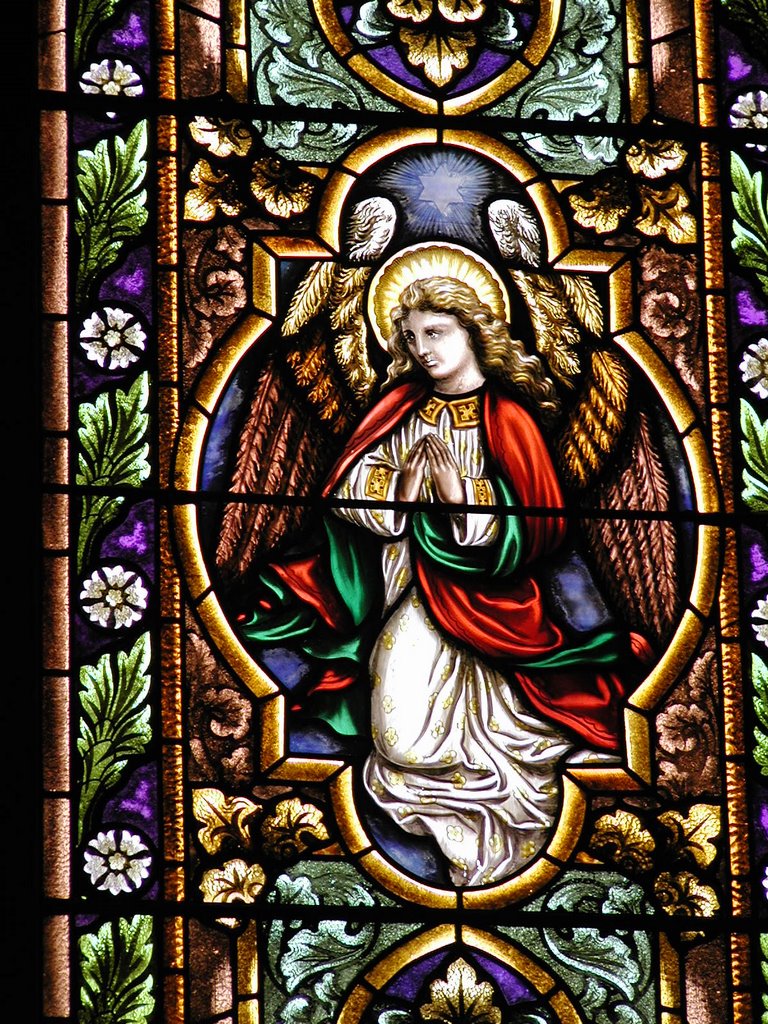
One of the transept angels at my home parish of St. Thomas Aquinas, Palo Alto, California. Don't know the artist, but all the glass dates from the early 1900's.

The reason the universe is so big

You often hear Christians draw a certain conclusion from the vast size of the universe: God surely wouldn't have created a universe so fantastically enormous if the human race were the only intelligent species in it. Sometimes you'll even hear them say that it's arrogant of us to think that He would do so.

On the contrary! I think it's perfectly likely that He would plunk us down in a universe of just the kind we have.

Put yourself in God's place. What kind of universe would you create for a race which would fall because of its prideful desire to "become as gods, knowing good and evil" (that is, everything); whose pride would become central to every one of its vices; which would today become so besotted with its technological and scientific knowledge that it would think there is no more room for God in the intelligent person's worldview? Would you create a little wisp of a thing, a few light-years across, that mankind would comprehend adequately in a few thousand years?

I sure wouldn't. It would only feed into our false pride in our ability to know and control.

Wouldn't you create just what we have: a universe that is not only incomprehensibly large now, but constantly expanding? A universe so constructed that (due to interstellar dark matter) we can't even observe most of it, let alone travel across it? And to complement this vast macro scale, a structure of matter on the micro scale so bizarre that (as Heisenberg proved) you can't even describe the smallest bit of it definitively at any given moment, because the very act of observation gets in the way?

That, I submit, is the perfect universe for mankind. One that puts us permanently in our place, in terms that can't be gainsaid. One that says to mankind, unmistakably and forever, "I am God. You're not." That's the universe we need, and so that's just what he's given us.

Monday, May 01, 2006

St. Anthony of Padua, Menlo Park


I really love traditional stained glass, and am starting to amass a nice library of photos. I'll be sharing a few here now and then.

This magnificent roundel is the handiwork an Carl Huneke, a German immigrant of great talent whose windows grace many a church throughout California. Strangely, it's the only traditional stained glass window in an otherwise nondescript 1950's Catholic church, St. Anthony of Padua.

Sunday, April 30, 2006

Cardinal Mahony and the illegals

I suppose that with his generally sound left-wing credentials, it shouldn't be a surprise that Cardinal Mahony has latched on to the cause of illegal immigrants, too. But I wonder if there isn't something else going on, too.

With his many liturgical abuses duly documented, his support for highly questionable speakers at his recent religious eduation conference, and his possible vulnerability to prosecution now that he has failed to keep records of priestly abuse out of the courts, the Cardinal has to know that he may soon be in the crosshairs for reassignment to some backwater, at best, for the rest of his career.

I wonder if he's thinking: I've paid my dues now to the forces that marshalled those hundreds of thousands of demonstrators in the streets of L.A. recently, in support of illegal immigrants. If Rome tries to move against me, maybe I can call in some favors and get a few hundred thousand of those same people demonstrating in the streets of Los Angeles in my support.

Now, I doubt that such a ploy would have any effect on Benedict, but I can certainly imagine it appealing to the very politically savvy Cardinal.

Just a thought.

Thursday, April 20, 2006

Welcoming everyone, but not every behavior

The United Church of Christ has been patting itself on the back recently with TV commercials praising its own inclusiveness: "No matter who you are, or where you are on life's journey, you are welcome here." The commercials implicitly criticize other churches for what it claims are exclusionary rules that supposedly keep certain groups out.

Fr. Thomas Williams has a fine, succinct article explaining that to welcome a person is not to welcome everything he may do, too. Here's an excerpt:

There is a difference between a church saying “We welcome all persons” and “We welcome all behavior.” After all, two things distinguish Christian belief: a body of doctrine and a moral code. Following Jesus entails both. Jesus welcomed prostitutes, but he never welcomed prostitution. He was soft on adulterers, but unyielding on adultery. After forgiving the adulterous woman, in fact, he adds: “Go and sin no more.” And the tax collector Zacchaeus, on encountering Jesus, promises to pay back all those he has cheated — fourfold. Jesus never welcomed cheating, but he did welcome reformed cheaters. This is not just a matter of semantic hair-splitting. Jesus came to call sinners but to condemn sin, much as a doctor heals sick people but eradicates sickness.

Go and read the whole thing.