Recently, when I was talking with my (non-Catholic) wife and daughter, I used the phrase "offering it up" when referring to some sort of discomfort. I think they both thought I was a little nuts, so I thought I'd write a little about the wisdom of the attitude that the phrase expresses.
When I was a boy in Catholic school in Southern California, and we kids were, for example, miserable and complaining in our non-air-conditioned classroom on some torrid September afternoon, the nuns (who, wearing the old black habits, must have been far more uncomfortable than we were) would tell us to take it patiently, and "offer it up." The idea was to take the suffering you were experiencing, large or small, and ask God to accept it along with the sufferings of Christ in recompense for sin. Since we all knew we had sins, and there was plenty of it elsewhere in the world, it made sense, and always quieted things down for a while.
I think there was a great deal of wisdom in that little practice. The problem of suffering is one that has troubled many great thinkers, and disturbs all of us when something bad happens to us, especially if we think we didn't deserve it. And one of the most desolate feelings a human being can have is that his suffering has no meaning. The fact that kids' sufferings are often small by adult standards doesn't mean that they aren't acutely felt. So "offering it up" gave us a way to attach a great -- and real -- significance to whatever we were going through; it allowed us to unite our little hurts, especially the undeserved ones, with the far greater hurts suffered by Him whose suffering was utterly undeserved, and participate a little in the great work of our own redemption.
To those of you who may be saying, "Oh, that evil, guilt-inducing Catholic Church! What kind of sins could you kids possibly have done that could merit feeling spiritually guilty for?", I would ask: do you really remember your own middle-school days? Do you remember the spite and cruelty that made school life a little hell sometimes? Seems to me those were plenty nasty enough to merit a little guilt -- and to motivate us to expiate a bit of it with a little patient "offering up" of the misery of those 100-degree dog days, late in summer.

In 1867, Matthew Arnold wrote "Dover Beach", a haunting poem evoking the "melancholy, long, withdrawing roar" of the Sea of Faith. As a boomer who finished Catholic elementary school in 1964 and then watched my Church falter, I've found the roar all too audible. So here I wait, listening for the whispers of that Sea's invincible return.
Wednesday, April 05, 2006
Sunday, March 26, 2006
Loud. Way too loud.
I was visiting the Montgomery Theater in downtown San Jose, California, yesterday afternoon to deliver some photos for an upcoming production of the Johann Strauss operetta Die Fledermaus. The Montgomery is a venerable old place at the south end of a plaza ringed by big hotels, the Tech Museum, and other spots the city fathers (oops, non-inclusive phrase! sorry!) would like you to visit and spend your money at. It's normally a fairly inviting spot, too, as urban spaces go.
However, it's also frequently used for rallies and outdoor concerts, and yesterday was such a day -- Mexican Heritage Day, I think. Unfortunately, outdoor concerts mean only one thing: loud -- really loud -- music. And loud -- sometimes really loud -- spectators.
The bandstand was almost a quarter of a mile away, but I could barely make a cell phone call outside the theater. I don't want to think what the decibel level was at the other end of the plaza. It wasn't helped by the two cars that were blocking traffic, a fifty feet from me, blowing their horns endlessly while waving huge Mexican flags at each other.
The problem is that popular culture firmly endorses the principle that in order for music to be good, it must be as loud as it's possible to make it. And if you're outside and want to hear your music, it's OK to you force anyone within a mile to listen to it too.
Nor will going inside a building always give you some quiet in which you might do something other than the Officially Sanctioned Loudness. I've been in the Montgomery during performances when a band is playing in the plaza, and whenever it's only dialogue from the stage, you hear, faintly, the whump-whump-BOOM, whump-whump-BOOM and the overamped singers from outside, ruining the effect the actors are trying so hard to achieve, and that the audience paid to experience.
Ah, well. Everything that is not forbidden is compulsory.


Sunday, March 19, 2006
Deception
One thing I've learned about falsehood: it seldom is a complete falsehood. Almost always, it has a good deal of truth mixed in with it, especially in the early going. But that's just the bait; the Deceiver tolerates it, in order to get us to believe that the hook isn't really a hook, the fishline isn't really a fishline -- and the frying pan isn't really a frying pan.
Monday, March 13, 2006
The AP poll on abortion
The new AP poll on abortion attitudes is out, and it's being trumpeted by my local paper (the San Jose Murky News) because it purports to show that the majority of Americans support most abortions for most reasons. Never mind that this result contradicts several other recent polls from CBS, Gallup, and Wirthlin (and that the all-important texts of the questions asked to respondents were "unavailable at press time". But I digress.
The real shocker for me was this:
Of course, not all are equally guilty. Some, like Vasa in Oregon and Chaput in Denver, are doing great work. Unfortunately, however, some of the worst, like Cardinals Mahony of Los Angeles and McCarrick of DC, are also in control of the largest and most influential dioceses. And too many parish priests, overworked and discouraged, would rather preach another homily on "God is love" than on the greatest social evil of our time.
The real shocker for me was this:
Looking at other results from the new AP poll, two-thirds of white evangelicals said abortion should be illegal all or most of the time while 54 percent of Protestants agreed. Catholics were evenly split.That is, the only church with an official worldwide policy against abortion can barely manage to influence the opinion of half its American membership. And who is responsible for seeing to it that the official policy is clearly and frequently explained to rank-and-file Catholics, to counter the daily drumbeat of pro-abortion propaganda they hear from news outlets? American bishops and priests.
Of course, not all are equally guilty. Some, like Vasa in Oregon and Chaput in Denver, are doing great work. Unfortunately, however, some of the worst, like Cardinals Mahony of Los Angeles and McCarrick of DC, are also in control of the largest and most influential dioceses. And too many parish priests, overworked and discouraged, would rather preach another homily on "God is love" than on the greatest social evil of our time.
Tuesday, March 07, 2006
Ten words
I recently encountered a lullaby called "Slumber, My Darling" by Stephen Foster, and these lines struck me:
They struck me because, in ten words, they sum up the things that good parents do, and the sacrifices they make to do them. As they see many of their childless peers spending all their time and money on their own pleasures and advancement -- travel, undistracted education, possessions, careers, promotions, and the rest -- parents choose to conceive and bear children, make good homes for them, play with them, give up career advancement to keep from having to uproot them, worry over them, protect them, teach them, read to them, pour thousands of hours helping them grow up in every way, and then endure the pain of letting them go.
And yes, often, just quietly watch over them as they drift off to sleep.
While others their revels keep,
I will watch over thee.
They struck me because, in ten words, they sum up the things that good parents do, and the sacrifices they make to do them. As they see many of their childless peers spending all their time and money on their own pleasures and advancement -- travel, undistracted education, possessions, careers, promotions, and the rest -- parents choose to conceive and bear children, make good homes for them, play with them, give up career advancement to keep from having to uproot them, worry over them, protect them, teach them, read to them, pour thousands of hours helping them grow up in every way, and then endure the pain of letting them go.
And yes, often, just quietly watch over them as they drift off to sleep.
Sunday, March 05, 2006
This Sunday at St. Thomas
From the St. Ann Choir today during the noon Mass at St. Thomas Aquinas, Palo Alto, CA:
Orlando de Lassus, Ne Reminiscaris and Audi Benigne Conditor
Cristobal de Morales, Inter Vestibulum et Altare
Orlando de Lassus, Ne Reminiscaris and Audi Benigne Conditor
Cristobal de Morales, Inter Vestibulum et Altare
At last, truth in advertising
Remember Jesus talking about not being able to serve both God and Mammon? If Mammon ever did some nice, truthful advertising, it would probably look like this, noted at White Around the Collar (scroll down to the March 1 posting). Very funny, in a sort of whistling-past-Gehenna sort of way...
Friday, March 03, 2006
Getting baptized here? Bring a snorkel!
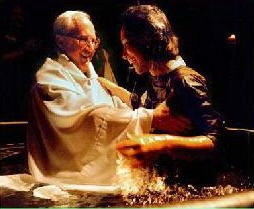
At that church I wrote about in my post about acolyte training, I learned that they have plans to spend as much as $100,000 to install a huge baptistry in their sanctuary. How could you spend that much on a baptismal font, you ask? Ah, but this will be no mere font. It will be a pool, large and deep enough to allow full-immersion baptism -- which, I was told, has been mandated by our bishop. That is, all adult baptisms in our diocese are one day to be performed by submerging the poor catechumens completely, it seems.
I'm sure glad I was baptized in the bad old days, and as a child. A little water, poured with dignity and decorum over the forehead. I won't need to pretend I'm a Southern Baptist, getting dunked in the Chattahoochee.
Talk about an impediment to adult conversions! I don't know about you, but if I was a potential convert and heard that I had to endure this:

... I'd think again about the whole thing.
I'm sure glad I was baptized in the bad old days, and as a child. A little water, poured with dignity and decorum over the forehead. I won't need to pretend I'm a Southern Baptist, getting dunked in the Chattahoochee.
Talk about an impediment to adult conversions! I don't know about you, but if I was a potential convert and heard that I had to endure this:
... I'd think again about the whole thing.
Staying in the boat
Catholics who prize fidelity to the Church's teachings have a lot to be angry and disappointed about these days, especially those of us who live in the United States. From the cover-up of priestly sexual abuse by some bishops, to the imposition of liturgical abuses by some of the same bishops, to the mandating of highly questionable sex-ed classes for Catholic school children by some of the same bishops again, it seems that there's something outrageous happening almost all the time.
The ever-present temptation is to get out, in one way or another. Get out of the Church and start going to one of those big Protestant churches, where admittedly sometimes you'll hear the Gospel preached far better, and more faithfully, than you did in your Catholic parish. Or get out of the Church and go defiantly Traditionalist with the St. Pius X folks, where at least you'll get the liturgy done reverently and solemnly, as it was before things started rolling downhill -- but not in communion with the rest of the Church.
The common thread, of course, is Getting Out. But I think that's exactly what Old Nick is hoping for: that our legitimate frustration will lead to our breaking away, so that the Body of Christ will be even more broken than it already was.
That's exactly what happened in the early sixteenth century. You think we have abuses now? Read up on it. There was plenty for ardent, sincere Christians to be outraged by back then. But when the Church didn't immediately respond with positive change, Luther and others let their zeal drive them into disastrous impatience: they said, "We won't wait any longer. We're breaking off to set up our own church, which, by the way, is the real Church."
That's not reform; that's rebellion. The Catholic Church used to call it that, too -- the Catholic history texts I read from in seventh and eighth grade did so. We're too polite for that nowadays, of course. But we called a spade a spade not too long ago.
Protestants, don't be insulted. Just accept your origins for what they were. The 'Reformers' had no intention to work humbly and slowly within the Church to effect real reform. That would have taken decades, maybe longer. That would have taken consummate humility and great personal sacrifice. They wanted action, and they wanted it now, in their lifetimes, so they could enjoy its supposed fruits. When they didn't get it, they Got Out.
That's a cautionary recollection for all of us who are discontented now. Let's not follow that terrible example, whose main fruit, five centuries later, is the spectacle of 40,000 denominations who all claim to have the truth.
Instead, let's follow this one from St. Theresa, via Fr. Robert Altier: [Update: this link to the website containing transcriptions of Fr. Altier's homilies no longer works. Fr. Altier has been silenced by his bishop, apparently for opposing too noticeably the very questionable Virtus sex-education program now being forced on Catholic families by the same bishops who betrayed them with thirty years of abuse cover-ups.]
That's mighty hard advice to follow, especially when the boat appears to be getting steered in the wrong direction by one of the Apostles (i.e., one of their successors). It's hard to trust that Christ will "wake up" (i.e., intervene) at just the right moment to right every wrong and dry every tear with His incomparable power. It's hard not to jump out, to drown in unbelief or to be "rescued" by another boat (but the wrong one).
But staying in the boat -- remaining in the Church and working quietly but ardently for what's right -- is our job. These are the times we we born in, and this is our work. Let's do it.
The ever-present temptation is to get out, in one way or another. Get out of the Church and start going to one of those big Protestant churches, where admittedly sometimes you'll hear the Gospel preached far better, and more faithfully, than you did in your Catholic parish. Or get out of the Church and go defiantly Traditionalist with the St. Pius X folks, where at least you'll get the liturgy done reverently and solemnly, as it was before things started rolling downhill -- but not in communion with the rest of the Church.
The common thread, of course, is Getting Out. But I think that's exactly what Old Nick is hoping for: that our legitimate frustration will lead to our breaking away, so that the Body of Christ will be even more broken than it already was.
That's exactly what happened in the early sixteenth century. You think we have abuses now? Read up on it. There was plenty for ardent, sincere Christians to be outraged by back then. But when the Church didn't immediately respond with positive change, Luther and others let their zeal drive them into disastrous impatience: they said, "We won't wait any longer. We're breaking off to set up our own church, which, by the way, is the real Church."
That's not reform; that's rebellion. The Catholic Church used to call it that, too -- the Catholic history texts I read from in seventh and eighth grade did so. We're too polite for that nowadays, of course. But we called a spade a spade not too long ago.
Protestants, don't be insulted. Just accept your origins for what they were. The 'Reformers' had no intention to work humbly and slowly within the Church to effect real reform. That would have taken decades, maybe longer. That would have taken consummate humility and great personal sacrifice. They wanted action, and they wanted it now, in their lifetimes, so they could enjoy its supposed fruits. When they didn't get it, they Got Out.
That's a cautionary recollection for all of us who are discontented now. Let's not follow that terrible example, whose main fruit, five centuries later, is the spectacle of 40,000 denominations who all claim to have the truth.
Instead, let's follow this one from St. Theresa, via Fr. Robert Altier: [Update: this link to the website containing transcriptions of Fr. Altier's homilies no longer works. Fr. Altier has been silenced by his bishop, apparently for opposing too noticeably the very questionable Virtus sex-education program now being forced on Catholic families by the same bishops who betrayed them with thirty years of abuse cover-ups.]
Saint Therese, whose feast we celebrated yesterday, made the point so clearly and so simply when she was talking about the apostles when they were in the boat with Jesus, and Our Lord was sleeping in the bow. The water was sloshing over the top and the boat was being pushed about by the winds and the waves. The apostles, many of whom were fishermen, were afraid that the boat was going to sink. And she said simply, Do you really think the boat is going to sink if Jesus is in it? ... As long as you are in the boat, you have nothing to fear! As long as you are with Jesus, you are just fine. Do not try to showboat it and walk on the water or do something cute because you are going to be in trouble, but stay in the boat with Jesus. Keep your eye on Him. Do not worry about the winds and the waves; let it happen. It is not our problem. Let the Lord take care of that. Our task is to keep our eyes on Him, to pray, to live the life, to keep our focus on what is good and beautiful and excellent – and that is Jesus. If it seems like He is not answering and He is a million miles away when you come to pray then just let Him sleep and keep your eyes on Him.
That's mighty hard advice to follow, especially when the boat appears to be getting steered in the wrong direction by one of the Apostles (i.e., one of their successors). It's hard to trust that Christ will "wake up" (i.e., intervene) at just the right moment to right every wrong and dry every tear with His incomparable power. It's hard not to jump out, to drown in unbelief or to be "rescued" by another boat (but the wrong one).
But staying in the boat -- remaining in the Church and working quietly but ardently for what's right -- is our job. These are the times we we born in, and this is our work. Let's do it.
Thursday, March 02, 2006
Acolyte school, then and now
I happened into a Catholic parish church a few weeks ago after Mass and found a small group of children, mostly girls, attending a class for acolytes, or altar servers, or whatever they call what used to be known as "altar boys."
It was barely controlled chaos. Kids crawling over the pews, talking, laughing, barely paying attention. (Remember, this was going on in the front pews, a few feet from the Real Presence in the Blessed Sacrament). The poor young woman teaching the class wasn't able to convey much because she was constantly interrupting herself to plead with the miscreants to stop, without more than a few seconds success each time. The miscreants were beyond help; the majority looked bored; the few serious ones looked angry and frustrated. The only topic she could cover during my 15 minutes there was how to hold the Bible so the priest could read it during Mass, including reassurances that if they held it upside down, no problem, the priest would turn it over for them.
Roaming down memory lane about 45 years, I recalled my altar boy classes at St. Mary's, a little parish in Fullerton, California. Our little bunch of third and fourth graders were taught our Latin (and the tiny bit of Greek in the Kyrie) outside at the school lunch tables on Saturday morning by the redoubtable Fr. O'Brien, straight from Dublin and strict as all get-out. Did you catch that about Latin? All the responses, including the daunting Confiteor, from memory. Third and fourth graders. And we all got it.
Needless to say, Fr. O'Brien didn't allow even the slightest irreverence while we were finally allowed inside to practice at the altar. After all, Jesus was there. And everyone knew that the sanctuary was only used for worship, and that worship was solemn and reverent.
By the lights of modern liturgists, we kids shouldn't have been able to do it. We shouldn't have had so much demanded from us. We shouldn't have wanted to do it. But we did. And I think we did because it was hard, but it was real; we were being allowed to take part in something big, something adult, something rightly awe-inspiring.
Contrasts: Being taught by a priest who demanded respect and attention, and behaved like he deserved it, vs. being taught by a harried young lay woman who begged for attention and respect and so got neither. Being taught the ancient traditions in the ancient languages, vs. being taught dumbed-down contemporary liturgy in Oprah-speak. Being allowed inside to the sacred space as a privilege, vs. using an already demeaned sanctuary as just another noisy classroom.
This parish church is one of three in a town of 70,000, and they're down to one Mass per Sunday. If they keep it up, they'll get down to zero. Soon.
A hidden treasure: the St. Ann Choir, Palo Alto
Since I often complain here about things that are wrong in the Catholic Church, I'm going to take a break from that and mention a wonderful thing that has been going on here in Palo Alto for many years: the St. Ann Choir.
Every Sunday and on all the major feast days since 1963, the St. Ann Choir -- about a dozen dedicated men and women, with personnel changing over the years -- has provided Gregorian chant and one or two Renaissance motets for a Mass in our town. For many years, that Mass was celebrated at St. Ann's Chapel, a modern but rather attractive church built by Clare Booth Luce for Stanford University students in the 1950s. When St. Ann's closed a few years ago (it was ultimately sold to the Anglican Province of Christ the King -- more about that another time), that Choir moved to St. Thomas Aquinas, a gorgeous 1902 wooden Gothic revival church near downtown.
The Choir probably wouldn't exist without the tireless work of William Mahrt, a professor in the music department at Stanford. He's there almost every Sunday to sing and conduct, and to play the recessional on the little pipe organ in the choir loft -- usually something by Bach, Buxtehude, or one of the other baroque masters.
Not only do we get the Introit, Gradual, and other parts of the Proper sung in Latin, there's a little Mass booklet for the congregation, customized for each week, with the neume notation of the Gloria, Credo, and Agnus Dei, which we're encouraged to join in on. Scripture readings and much of the rest of the Mass are chanted in English.
At the Offertory and Communion, the Choir sings motets from the Renaissance or late Middle Ages -- Dufay, Byrd, Palestrina, di Lasso, and so on. There's another little booklet with the words to their entire repertoire, in Latin and English, so we understand what's being sung.
What a treasure!
It's safe to say that if the St. Ann Choir hadn't been there when I decided to return to the Church, I would have had a much harder time getting as far as I have. Everywhere else in this very politically and religiously liberal area, I would have encountered Masses stripped of all beauty, all good music, not to mention all Latin. I guess I've gotten to share in quite an unusual blessing!
Tuesday, February 28, 2006
The wisdom of Catholic confession
It's part of the wisdom of confessing to a priest that we find it far more embarrassing to reveal our sins to another human being than we do to admit them to God. The sting is far greater! It shouldn't be, of course — obviously we should be far more abashed in front of God, in prayer — but human nature works that way.
Perhaps the lack of confessing to a human being robs Protestants -- and "progressive" Catholics, who scoff at individual confession -- of an important motivator in resisting sin. After all, if you know that if you do the sin, you have to admit it to another person to get right with God, that's uncomfortable, and the thought of having to do that just might provide the strength to resist the temptation.
Perhaps the lack of confessing to a human being robs Protestants -- and "progressive" Catholics, who scoff at individual confession -- of an important motivator in resisting sin. After all, if you know that if you do the sin, you have to admit it to another person to get right with God, that's uncomfortable, and the thought of having to do that just might provide the strength to resist the temptation.
Saturday, February 25, 2006
Down the memory hole
In 1984, George Orwell's protagonist Winston Smith has a nice job at the Ministry of Truth vaporizing inconvenient documents by shoving them into a receptacle at his desk. The receptacle is called a Memory Hole. Once the documents are ashes, history has changed.
Something similar recently happened in Sweden. It seems that one Swedish schoolbook, a textbook for religious history classes, contained two images of the Prophet Mohammed. In the wake of the torrent of violence and vitriolic hatred pouring out of the Islamic world following the publication of the Danish cartoons, Sweden has decided to pull the textbooks from the classrooms, and the publisher has taken them out of circulation.
A gesture of reasonable conciliation, you might think -- cowardly, but within the bounds of reasonability. Except that the two depictions of Mohammed weren't scurrilous caricatures from the pen of some insensitive Western cartoonist; they were both from Islamic manuscripts of the 13th and 14th centuries. They are a legitimate part of the historical record; when the book was written, the Swedes probably thought they were being sensitive by depicting Mohammed with historical Islamic artwork.
But historical truth doesn't matter to the imams. If you don't like something from the past, suppress it. Just shove it down the Memory Hole, and trust the suicidal West to forget the whole thing ever happened.
Monday, February 20, 2006
Divestment as a tool of jihad
David Horowitz's FrontPage magazine has a very interesting article that describes the left's highly-organized attempt to weaken Israel by getting American and European institutions to get rid of their investments in the Israeli economy. All this is smokescreened with concern over supposedly cruel Israeli treatment of Palestinians, etc., etc.
As I see it, all Israel has done in its brief existence is to build a Western-style democracy in, as Golda Meir famously commented, the one plot of Middle Eastern geography that had absolutely no oil. Palestine was an unproductive backwater until they came; now, their bit of Palestine is a world leader in technology. For this, they've been attacked ruthlessly from the first hour of their existence to the present moment.
Western civilization has already allowed millions of God's chosen people to be murdered in the Holocaust. If it allows the rest to be murdered by militant Islam, I can't help but think that God's retribution on us will swift and hard.
Thursday, February 16, 2006
'Lost': blame U.S. for torture
We're all big fans of the ABC series 'Lost' here, so it was sad to see the plot take a politically correct detour. Last night's episode included more of the backstory of the Iraqi character, Said. He gets captured by U.S. troops during the first Gulf War and finds himself employed as an interpreter during interrogations of other Iraqis. One of these is his former commander, who is believed to know the whereabouts of a downed Amerian pilot. His American handler, a non-uniformed older guy (CIA, I suppose), coerces him into doing something he's never done before: torture a prisoner to extract information. He does it, and then bitterly blames the Americans for forcing this terrible experience into his life.
Never mind, I guess, that Saddam's army had regularly used torture for twenty years before Gulf War I) and taught the finer points of its techniques to thousands of its men, making it by far the more likely place a soldier like Said would learn how to do it. No, let's have him be loyal, good-hearted and decent -- until the evil Americans get hold of him.
I'm not saying Americans have never used torture (and I'm not talking about the Abu Ghraib abuses, which were mainly discomforts and humiliations, but the real thing). But you really have to have a political agenda to have Said be forced into torture by Americans -- the same dreary agenda that all of Hollywood seems to share: Blame America for everything.
The more we let these people control our impression of our country, the more the real bad guys will rejoice.
Saturday, February 11, 2006
What if... ?
What if the early Christians had made a successful effort to convert the Arabs before Mohammed came along? It looks like everyone in the centuries between 300 (when Christianity was legalized) and 600 wrote the Arabs off as a difficult, scattered, and unimportant people. The Christian emperors of the Eastern Roman Empire seem not to have sent missionaries in that direction, preferring to buy off the Arab tribes now and then, to keep their occasional raids from becoming a significant distraction from the empire's struggle with its traditional enemy, the Persians.
What if, in his spiritual misery, Mohammed had been surrounded not by a polyglot paganism, but by a vibrant Christianity that had been going for a century or two?
Yes, things might have happened just as they did; he might still have wandered off to a cave and begun having those visions that have had such fateful and bloody consequences for the world.
But perhaps not. Perhaps there would have been a kindly parish priest to talk to. Perhaps there would have been a monastery nearby, where he could immerse himself in the already formidable Christian intellectual and spiritual heritage, and explore his spiritual yearnings with good guidance. Perhaps, as happened to countless others, he might simply have been helped to Christ by a Christian neighbor.
How many times did Christians think about evangelizing the Arabs during those centuries? How many times did they decide that those motley desert tribes just weren't worth it, that the Great Commandment somehow didn't apply to them?
The price of not spreading the Gospel can have repercussions stretching millennia into the future.
Friday, February 10, 2006
So why are they doing it?
Cliff May has a good article at Townhall.com discussing the reasons why the militant Islamists are doing what they're doing. He argues that those who are orchestrating the violence (and most of it is quite well orchestrated) know quite well that they're doing far more harm to the image of Islam than the cartoons were. But they know their Machiavelli: for those who would rule, "it is better to be feared than loved." For ruling is exactly what they're after: rule over non-Muslims, and even over those Muslims who would like to join the modern world.
As an aside, I think it's great that one key to understanding their behavior is contained not in some bright new analysis from some think tank, but in the writings of one who was observing politics five hundred years ago.
Another key is the long tradition of Muslim aggression against non-Muslims, and of intimidation and threats when their targets were beyond their physical reach. It was that way when Islam first exploded out of the desert in the 640's. It was that way when they started roughing up Christian pilgrims to the Holy Land in the 1000's. It was that way when Islam kept pressing into eastern Europe during the Renaissance, and besieged Vienna in 1529 and again in 1683.
And it's still that way today, when terrorism has provided an effective weapon such as Islam hasn't had since the decline of the Ottoman Empire in the 1800's.
May's article draws parallels between the Islamists and Nazi Germany; the insatiable lust to rule is common to both. I'd draw another parallel. In the mid-1930's, when the Nazis consolidated their hold on German politics, many Germans tried to oppose them, and others, less courageous, despised the Nazis but were too afraid to resist. It's the same with Islamic countries now. We keep hearing that the Islamists are a minority, and that most Muslims don't share their extremism. I'll grant that, for the sake of argument. But that minority has gained control of Iran and Syria, is close to it in Egypt and Turkey, and is flexing its muscles everywhere else. When Europe was overrun in 1939-41, it didn't matter that dedicated Nazis were a political minority in Germany; the overrunning took place anyway. And it won't matter to the rest of us that Islamists are a minority when they hold the reins of national power in a dozen countries and use oil money to buy nuclear weapons and missles.
Tuesday, February 07, 2006
You just gotta love that Religion of Peace...

One of those peace-loving signs at the peaceful demonstration by followers of the Religion of Peace in front of the Danish embassy in London a few days ago.
Being a person who doesn't like confrontation, I have to admit I'm a little uncomfortable with those original Danish cartoons of Mohammed (or is it Muhammad, now? Sorry, don't behead me, peaceful Muslims to whom jihad only denotes an internal struggle against one's own sins!). Still less comfortable with some of the truly vitriolic follow-on cartoons from Europeans that are popping up on the net.
With that said, none of it justifies rioting, burning down buildings, and suggesting beheadings. One gets the impression that when the chips are down, this is what the Q'uran really teaches people: spite, revenge, murder, destruction. I sure don't hear many Muslim voices speaking up and denouncing this latest round of violence as a perversion of Islam -- the excuse we heard after 9/11.
No, I'd put up this plaque on the burned-out shell of the Danish embassy in Syria: "Sacred to the memory of the Religion of Peace. Si monumentum requiris, circumspice."
Wednesday, February 01, 2006
Chant and praise music
The music minister at a large Presbyterian church once told me that modern "praise songs" were like Gregorian chant because they were repetitious (e.g., "Worthy, worthy, worthy, worthy, is the Lord, Oh, he's so worthy, worthy, worthy...").
This amiable fellow had had a long and pretty distinguished career as a classical vocal soloist, but I guess he had never spent any time carefully listening to, or better yet, singing chant. If he had, he would have known that although chant will sometimes spread a single syllable over several notes, it never repeats itself gratuitously the way praise music habitually does. When chant does repeat a phrase or sentence, it's part of a verse-and-response structure that makes contextual sense. The longest sections of chant in the Ordinary -- the Gloria, Credo, and Pater Noster -- have no repetition at all.
Chant does deliver the words more slowly than we would normally speak them, and maybe that's where some of the confusion comes in. But that's part of its effectiveness: it gives us time to slow down, quiet down, and really let the meaning of the words we're singing soak in.
That democracy of the dead
Chesterton's remark about a "democracy of the dead" is hardly news, but since this is a journal of thoughts I've found it interesting to encounter, here it is again:
I love this, because it's a slap in the face to the pride that's peculiar to our times: that the people of the past were ignorant loons because they didn't know certain things (usually technological) discovered in our lifetime. Why study Socrates or Aquinas, we say. Why read Utopia or The Consolation of Philosophy? So boring! After all, Boethius and More and all those other dead people had no computers, no internet! They never downloaded anything! They didn't know about DNA or even electricity! How could they have anything useful to say to us, who are so much better informed?
As if, after sixteen years of oh-so-modern schooling, the average college graduate today could put together two coherent sentences about any of those technological developments.
Tradition means giving votes to the most obscure of all classes, our ancestors. It is the democracy of the dead. Tradition refuses to submit to the small and arrogant oligarchy of those who merely happen to be walking about.
I love this, because it's a slap in the face to the pride that's peculiar to our times: that the people of the past were ignorant loons because they didn't know certain things (usually technological) discovered in our lifetime. Why study Socrates or Aquinas, we say. Why read Utopia or The Consolation of Philosophy? So boring! After all, Boethius and More and all those other dead people had no computers, no internet! They never downloaded anything! They didn't know about DNA or even electricity! How could they have anything useful to say to us, who are so much better informed?
As if, after sixteen years of oh-so-modern schooling, the average college graduate today could put together two coherent sentences about any of those technological developments.
Subscribe to:
Posts (Atom)