Wednesday, January 31, 2007

700 years and counting


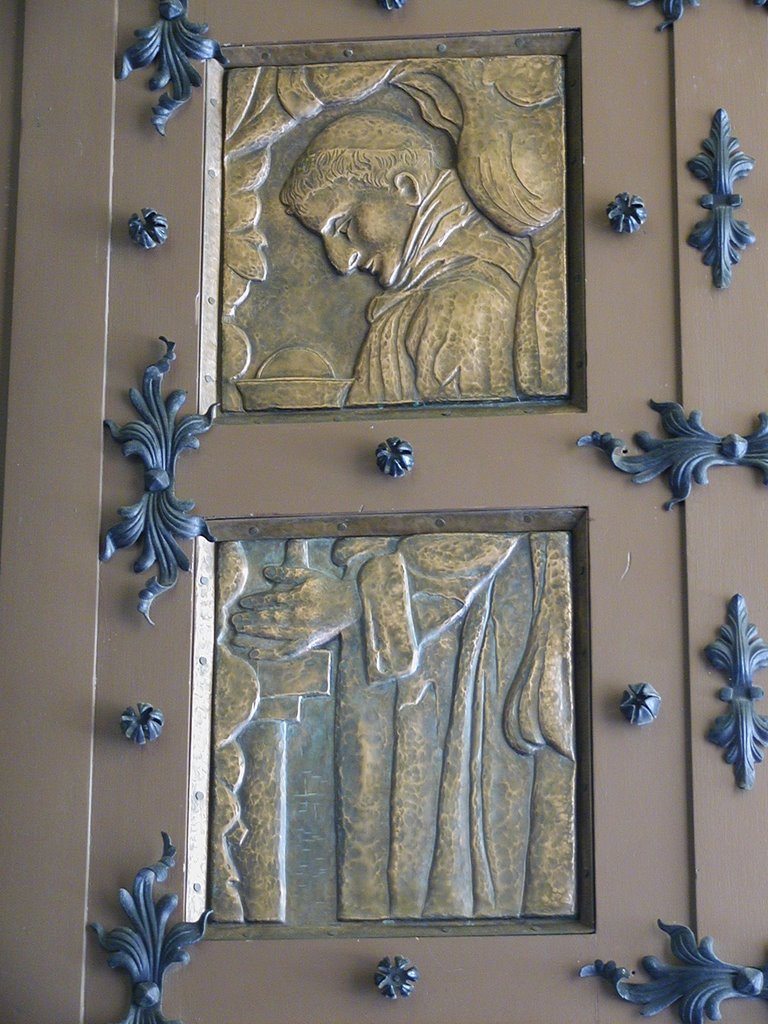
These three panels started out in France in the late 1200's, but are now making up part of the ceiling of the late William Randolph Hearst's bedroom at Hearst Castle in central California.

Amazingly, other than a professional cleaning according to current conservation practices, the panels have not been restored at all. The colors are clear and vibrant; when you see them "in person" the characters look like they're ready to step right out into the room.

Chalk up another accomplishment for those poor benighted medieval folks. Their knowledge of the chemistry of their paints was rudimentary, but they knew what lasted and what didn't. When an ordinary medieval artist painted something, it stayed painted. (Interesting that Leonardo, by modern acclaim an incomparable genius, botched the technical side of his Last Supper fresco so badly it started to fall apart within a few decades).

I wonder how much of the "art" that hangs in today's galleries will still be around in 100 years, let alone 700. Or how much of that anyone would think of hanging in their bedroom.

Tuesday, January 30, 2007

Join up!

Over across the pond, Fr. John Boyle (Ashford, Kent, GB) has added a resolution to the LiveSimply website, but not the PC sort that they appear to be used to.

I will promise to pray every day for an end to abortion so that all who have begun to live may have the chance to "follow after us" and "enjoy the fruits of (God's) creation" but I want 10 other people to join me.

Lest you think the last bit is strange, the request for others to join in is common to the LiveSimply site, which emphasizes group action and cooperation.

It took only a few hours for the required ten (I think I was #9) to sign up.

Wouldn't it say a lot to the world if this was one of the most heavily-subscribed projects ever offered at LiveSimply? Can you spend a few minutes a day joining Fr. Boyle in praying that the daily slaughter of thousands of children will cease? No? What were you planning to do with that little smidgin of time, instead? OK, I knew you'd come round. Go here and sign up, and let the man know he's not alone.

Right!

From the 1955 encyclical Musicae Sacrae:

It is the duty of all those to whom Christ the Lord has entrusted the task of guarding and dispensing the Church's riches to preserve this precious treasure of Gregorian chant diligently and to impart it generously to the Christian people…. And if in Catholic churches throughout the entire world Gregorian chant sounds forth without corruption or diminution, the chant itself, like the sacred Roman liturgy, will have a characteristic of universality, so that the faithful, wherever they may be, will hear music that is familiar to them and a part of their own home. In this way they may experience, with much spiritual consolation, the wonderful unity of the Church. This is one of the most important reasons why the Church so greatly desires that the Gregorian chant traditionally associated with the Latin words of the sacred liturgy be used.

Quoted, appropriately enough, at the Church Music Association of America's site Musica Sacra. They have a link to the text of the entire encyclical.

Monday, January 29, 2007

A new lion

Fr. Erik Richtsteig over at Orthometer has posted his homily for the recent anniversary of Roe v. Wade.

One of my favorite things about being a Catholic is that we have saints. Not only do they pray for us, but their lives give us examples of how to follow Our Lord in very concrete situations. There are saints for every situation and every state of life.

Roger that. By comparison, the lack of attention to saints always struck me as a huge hole in Protestantism during the years I wandered there. The big Presbyterian church I worked at for several years hardly ever said a thing even about John Knox, their founder.

Each year as this weekend approaches, I turn in prayer and thought to one of my favorite of the new saints, actually a blessed, Clemens August Graf von Galen. (Isn’t that a wonderful, German name?) Blessed Clemens was the Bishop of Munster in Germany during the time of Hitler. He had the nickname of “The Lion of Munster”. What do lions do? They roar. Blessed Clemens roared against the injustices perpetrated by the government of his own, beloved country. He was a patriot, but this did not stop him from denouncing the evils of the Nazi regime; against the Jews, against the handicapped, and against the sick. He did not shrink from doing so even though by doing so he took his own life in his hands. I pray that I will have the courage to be like Blessed Clemens.

So should we all, if only to get things changed before we have to face what Clemens faced. We don't have to fear being hauled off to a concentration camp -- yet. I don't know about you, but I'd prefer that things never get that way here. But the only way to see to that is to turn things around now, not years or decades from now.

What then are we to do? First, we need to pray and do penance both in reparation for the sins of our country regarding innocent human life and also for the conversion of those who are pro-abortion. Conversions are possible. Conversions have been remarkable. Norma McCorvey, Jane Roe, worked many years in abortion clinics. Yet, through the prayerful witness of Christians and other people of good will, she is now a pro-life, believing Catholic. Second, every Catholic need to learn what the Church teaches about the sanctity of innocent human life and why She teaches it. We need to learn this so we can speak intelligently on this issue at home, work, school, or even socially. We need to learn this so we are not silent in the face of so much pro-abortion propaganda. Lastly, we need to work politically to change our country’s policy. It has been through politics that we have been stuck with this abomination and it is partially through politics that it will be changed. Like it or not, it is through political means that things happen in our country; by elections; by voting for candidates and politically parties who support our position on the sanctity of innocent human life. Unfortunately, there are some candidate and some parties that are directly opposed to the Church’s infallible and certain teaching on this issue. We cannot vote for these people regardless of their stand on other issues. Nothing is more important than the right to life, not the economy, not national defense, nothing! If you are dead, nothing else matters.

Habemus leonem!

Our pride and joy has a website


I didn't know until recently that the St. Ann Choir, which provides us with Gregorian chant and Renaissance motets every Sunday and major feast day here at St. Thomas Aquinas, has a website. If you're ever curious about the words of the motets I report about more or less weekly, go there and click on Motet Texts and Translations.

Sunday, January 28, 2007

Keys of the Kingdom


A detail from St. Peter's window at my home parish of St. Thomas Aquinas.

This Sunday at St. Thomas

Sung by the St. Ann Choir today at St. Thomas Aquinas church:

Martin de Rivaflecha (d. 1528), Anima mea liquefacta est
Antoine Brumel (d. 1515), Ecce panis angelorum

Today was the feast day of our parish's patron, St. Thomas Aquinas. The motets were nicely chosen: the first is a text from the Song of Songs, which Aquinas reportedly asked to have read to him on his deathbed (instead of being badgered by his students, who wanted him to dictate the conclusions to various unfinished passages in the Summa Theologica); the second is a text of one of Thomas' own hymns.

Friday, January 26, 2007

Anyone for taking back Catholic schools?

The California Catholic Daily is turning into a wonderful resource -- sort of a localized Catholic World News.

In their story today about Alexandra Pelosi, daughter of Nancy Pelosi and maker of a new (and reportedly rather hostile) documentary about Evangelicals, she talks about the wonderful way the teachers at her Catholic schools faithfully passed on the Catholic moral tradition to her back in the 80's. Not.

Pelosi, a graduate of San Francisco’s upscale Convent of the Sacred Heart High School and Loyola Marymount University in Los Angeles, said what she was taught in these Catholic schools differed dramatically from what she learned from the Evangelicals. “We were taught just to accept people, that was just a given,” she told the Jan. 17 San Francisco Chronicle. “I don't ever remember being told at Convent of the Sacred Heart that gay was wrong. They never even told us there was anything wrong with abortion. They were just choices.

This just really annoys me. Add these institutions to the list of Catholic schools and colleges that solicit donations from the Catholic faithful, and then turn right around and deliver a moral education that differs in no significant way from secular schools. Ms. Pelosi has just given us a couple of additional examples of how the aggiornamento called for by John XXIII so quickly got translated to "throw out every teaching that doesn't conform to the editorial positions of The New York Times."

Perhaps her teachers might respond that if they had tried to convince their students of the rightness of the Church's teachings on abortion and homosexuality, the students would simply have tuned out. If so, it's very interesting what Ms. Pelosi then says about the impact of spending even the few weeks of research she did for her film with some really dedicated Evangelical Protestants who weren't afraid of what she would think.

Talking of her experiences to the New York Times of Jan. 11, Pelosi said, “I believe in the culture war. And you know what? If I have to take a side in the culture war, I’ll take their [Christian conservative] side. Because if you give me the choice of Paris Hilton or Jesus, I’ll take Jesus.”

So maybe if her teachers back at Sacred Heart, and her professors at Loyola Marymount, had simply laid out the case for the teachings of the Church that employed them...

Wednesday, January 24, 2007

Couldn't stand it

Well, I decided that the redone "Scribe" layout on New Blogger was just too ugly, so I'm trying this look instead. Not as elegant, but at least not actively offensive.

It seems to have worked, but...

Updating to one of New Blogger's rewritten templates seems to have worked fine, I guess, but I can't say I'm entranced by some of the typographical changes -- the underlined post title, the lack of space between the title and the post body, the variable line spacings in older posts. Ah, well.

Updating template

I'm going to try updating to one of the New Blogger templates. Pray for success.

Tuesday, January 23, 2007

Explain this one

As you've probably read (here, for instance), California Assemblywoman Sally Lieber, a Democrat from Mountain View (which is the next town down the Peninsula from us), wants to ban the spanking of children under the age of four.

OK, so she's getting a lot of derision and it looks like the measure is going nowhere for now. But isn't there something just a little bizarre about this?

This woman is an ardent proponent of abortion rights. So basically, she's saying simultaneously:

  1. Spank your kid after she's born, and you go to jail.
  2. Kill your kid before she's born, and you're just exercising your rights.

Explain it if you can. I can't.

Counting heads is not that hard

California Catholic Daily reports that there are wildly differing opinions about the size of the crowd at the West Coast Walk for Life this past Saturday:
Sponsors said between 20,000 and 25,000 people turned out, but a spokesman for the San Francisco Police Department told California Catholic Daily just hours after the event that officers at the scene estimated only about 2,500 marchers. The spokesman was asked to repeat the number to ensure there was no confusion, and confirmed the 2,500 estimate. In a followup phone call to the police operations center shortly before 10 p.m., a dispatcher said, "It could even have been less."

"Whoever told you that was not there," said Stan Devereux, a spokesman for LifeWalk. He said the march stretched more than a mile along the San Francisco waterfront. "You can say 20,000 to 25,000. That's what we were told."

I'm inclined to believe the larger numbers, since some of wider-angle photos posted here seem to take in only a part of the march, yet show a number that must be close to the lower estimate. But it's so darned simple to establish this these days that I'm at a loss to think why some very simple steps weren't taken by the organizers to avoid the inevitable bickering about crowd size. After all, they must know that officialdom in San Francisco is going to do everything they can to downplay the magnitude of participation.

All that's needed is to post someone with an ordinary camcorder at any point along the march that allows the camera to take in perhaps thirty or forty yards of the column as it passes bay. Then you just let the thing run until the march ends. You bring the footage home, cue up to the first batch of marchers as they pass, pause the playback at that frame, then count the heads in that scene. You then fast-forward to the frame in which the last marchers you counted in the first frame are just leaving the field of view, you pause again, and you count heads. And so on to the end of the march. Might be a good idea to capture each "counting" frame as a still, so you could post them as proof of the process' validity.

A small group or even a single person could do the count this way in no more than a few hours, and produce documented results that would be beyond dispute.

So why are we still playing these stupid games with hostile secular authorities and media?

Friday, January 19, 2007

Things are seldom what they seem...

I'm a Gilbert & Sullivan fan, as as any such fan can tell you, there's a G&S quotation suitable for expressing almost every worthwhile sentiment under the sun. And once again, it's so. Take this little couplet from H.M.S. Pinafore:

Things are seldom what they seem,
Skim milk masquerades as cream...

Remember how, a few days ago, a New York Times story revealed the shocking news that fewer than 50% of American women were living with a husband? Remember how everyone rushed to draw dire conclusions from this "fact"?

Now go read Michael Medved's blistering piece that debunks the story and reveals the agenda of the writer. Excerpts below:

On Tuesday, January 16th, 2007, the American people awoke to startling and disturbing news: for the first time ever, the majority of women in the country were living without a husband.

...

With all the debate and pontification about the new minority status of married women, it’s just too bad that no significant media outlet (beyond this writer, on my nationally syndicated radio show) made the single most important and salient observation about the big news--

That is, it’s not true.

The entire story (based on the work of one ax-grinding, irresponsible, agenda-driven journalist for the New York Times) has been cooked up from willful, blatant and shameful distortions. Amazingly enough, none of the most respected and purportedly responsible media authorities have taken the trouble to call him on it.

First, the truth—a truth that is easily accessible from the United States Census Bureau.

According to the most recent available figures (from 2005), a clear majority (56%) of all women over the age of 20 are currently married.

Moreover, nearly all women in this country will get married at one time or another. Among those above the age of 50 (a group that includes the celebrated Baby Boomers of the famously revolutionary ‘60’s generation), an astonishing 94% have been married at one time or another and some 79% are either currently married or widowed.

Even including the younger, supposedly “post-marriage” generation, and considering all women above the age of 30, some 61% are currently married and another 12% are widowed. In other words, nearly three-fourths (73%, a crushing majority) of all women who have reached the tender age of 30 now occupy a traditional female role as either current wives or widows – avoiding the supposedly trendy status of divorced, separated, co-habiting or single.

So how did the writer get the numbers to support his conclusions?

It’s all based on a fundamentally dishonest decision that Roberts never acknowledges in the entire course of his lengthy article. It turns out that in his analysis he chose to count some 10,154,000 girls between the ages of 15 and 19 as “women.” It should come as no surprise that this vast group of teenagers (yes, teenagers, most of whom live at home) are officially classified as “single.” In fact, 97% of the 15 to 19 year olds identify themselves as “never married.” The Census Bureau, by the way, doesn’t call these youngsters “women” – it labels them “females” (a far more appropriate designation).

Yet even the ridiculous inclusion of his ten million unmarried teenagers couldn’t give Sam Roberts the story he wanted to report – that most American “women” are now unmarried. As a matter of fact, the Census Bureau shows that among all females above 15 the majority (51%!) are still classified as “married.”

So the New York Times required yet another sneaky distortion to shave off that last 2% from the married majority, though this bit of statistical sleight-of-hand Sam Roberts had the decency to acknowledge. “In a relatively small number of cases, the living arrangement is temporary, because the husbands are working out of town, are in the military, or are institutionalized,” he writes. In other words, in his brave new majority of “women” without spouses, he includes all those thousands upon thousands of wives and mothers who are waiting and praying at home for the return of their husbands from Iraq or Afghanistan. By arbitrarily removing this 2% of all females (2,400,000 individuals) who are classified as “married/spouse absent” from the ranks of the married, and then designating as “unmarried” his millions of middle school and high school girls who are living with their parents, together with some 9 million elderly widows who have devoted much of their lives to marriage and husbands (42% of all women over 65 are widows), Roberts can finally arrive at his desired but meaningless conclusion that “most women” now “are living without a husband.” Eureka!

But hey, it's just a newspaper story, right? No big deal, right? Think again.
The endlessly repeated lies – that married people are now a minority, that most women don’t have husbands, that half of all first marriages end in divorce – exert a real world influence on young people trying to make decisions about their own intimate arrangements. The relentless media portrayal of matrimony as a wounded, collapsing, outmoded, dysfunctional institution discourages prospective husbands and wives from making the lifelong commitments on which societal health and effective childrearing depend.
It's the same sort of thing I posted on a few weeks ago: when a petty official's hamhanded insistence that the singing of Christmas carols be stopped, the act was repudiated soon afterward by her superiors, yet the deed was done; the music was stopped, and a moment that might have been, but was not, graced by a tiny sliver of the Christmas message will never come again.

And in journalism, even when apologies are made and stories are retracted (always on an obscure inside page, of course), the lie is out there, ready to deceive and demoralize for decades to come.

Wednesday, January 17, 2007

Visit Italy (while there are still Italians)

Catholic World News reports:

Rome, Jan. 17, 2007 (CWNews.com) - The latest demographic statistics for 2005 show only 1.33 children being born to the average woman in Italy over the course of her childbearing years (15-49).

That figure remains one of the lowest in Europe, and well below the “replacement level” needed to maintain a constant population, but somewhat higher than the all-time low of 1.19 recorded in Italy in 1995.

In recent decades Italy has consistently ranked among Europe’s least fertile countries in terms of population, with the number of children born to the average woman falling regularly below the replacement level, except for a brief “baby-boom” in the early 1960s that brought the average childbearing figure up to 2.7.

I'm reminded of the oft-quoted Proverbs 14:12 : "There is a way that seems right to a man, but in the end it leads to death." And not just the death of one man, but of an entire nation, it now appears.

Clearly, part of this Italian "way" -- one being followed in most other Western countries, too -- is the devaluation of having and raising children, and the widespread use of contraception and abortion. Maybe Italy is nominally still a Catholic country, but obviously the teachings of the Church on these subjects long ago ceased to guide the way Italians behave. They're now far too sophisticated to obey their Church.

The reward of their sophistication will very likely be the disappearance of the Italian people as an ethnic group. Or, more accurately, the disappearance of all those Italians who follow their own, very sophisticated way.

The sad history of the human race tells many a tale of the extermination of ethnic groups by others. But the suicide of ethnic groups -- now that's an innovation that will surely rank as one of the distinctives of our own very, very sophisticated age.

Tuesday, January 16, 2007

Give me that old-time religion!


Gerald has posted on the non-response of D.C's Archbishop Wuerl to Nancy Pelosi's ardent and public opposition to the church's teachings on matters of abortion, euthanasia, embryonic stem cell research, and so on. The comments are well worth reading, too, particularly those that urge us to respect the Archbishop's decision to forego any public criticism of Ms. Pelosi in favor of a more "pastoral" approach.

Me, I think that the "pastoral" approach -- that is, doing nothing publicly (and probably nothing privately, either) -- has been given far too much time already. About twenty years' too much. It's time for Ms. Pelosi to be confronted publicly, given a short deadline for public repentance and admission of error, and then publicly excommunicated and denied the sacraments. Some people will think me heartless for suggesting this, but I ask them: what about the 4,000 children killed in the U.S. every day through the abortion rights on which Ms. Pelosi has built her career? Do they count for nothing? What about the 4,000 who will be killed tomorrow? and the day after that? and the day after that? If Ms. Pelosi were to have a change of heart because her church finally spoke honestly to her about the spiritual consequences she has already brought upon herself, might some future day's 4,000 live, not die? Isn't such a goal worth a little strong language?

And what about Ms. Pelosi's immortal soul? If twenty years of pastoral (in)action has made no change in her public behavior, which by canon law has already separated her from the Church by latae sententiae, turning every reception of Holy Communion by her into sacrilege, isn't it kinder to point out her peril to her in a way that she can no longer ignore?

A while ago I posted on the chilling scene in the 1964 movie Becket in which the title character, Archbishop Thomas Becket of Canterbury, excommunicates a baron who has publicly stepped over the line (by standing by approvingly while his men murdered a priest). Here are the words he uses:

In that Lord Gilbert has rendered no act of contrition or repentance ... we do here and now separate him from the precious Body and Blood of Christ, and from the society of all Christians. We exclude him from Holy Mother Church and from all her sacraments, in heaven or on earth. We declare him excommunicate and anathema. We cast him into the outer darkness. We judge him damned with the Devil and his fallen angels and all the reprobate to eternal fire and everlasting pain.

Does this old-time religion seem outdated? Does this strong warning seem too strong? It doesn't to me. Archbishop Wuerl and all the other bishops with pro-abortion Catholic politicians in their dioceses should take a page from Becket's book. It may be the only way to save Ms. Pelosi, not to mention tomorrow's 4,000. And tomorrow's. And tomorrow's.

Monday, January 08, 2007

Epiphany at St. Thomas

Sung by the St. Ann Choir at St. Thomas Aquinas on Epiphany Sunday (yesterday):
  • Ludwig Senfl, Missa Nisi Dominus
  • Tomas Luis de Victoria, Magi viderunt stellam

Friday, January 05, 2007

Not intended, but very apt

I was listening to a CD I'd never paid much attention to after the first quick listening, and came upon a song set to these lines by the English poet Edmund Blunden (1896-1974):

Is not this enough for moan
To see this babe all motherless --
A babe beloved -- thrust out alone
Upon death's wilderness?
Out tears, fall, fall, fall -- I would weep
My blood away to make her warm,
Who never went on earth one step,
Nor heard the breath of the storm.
How shall you go, my little child,
Alone on that most wintry wild?


It's called To Joy, which sounds like sheer bitterness until you know that "Joy" was the name of one of Blunden's daughters, who died when only forty days old. It's his lament for a child who was very beloved indeed, and motherless only in the sense that death had made her so.

But I also read it a different way: as Christ's lament for the millions of unborn children who have died in America by the abortionist's arts.

Read it again, with that perspective in mind. How much more true even than its original meaning is it to call those children "motherless": rejected and abandoned by the one person on whom they should be able to rely, when all others reject and abandon them? How true it rings to note the deathly winter chill of a world where so many mothers cast their babies out upon "that most wintry wild."

And how true it rings that Christ would weep His blood away to keep the warm breath of life in them -- if the Father had left that task to him.

But he didn't. He left it to us.

Hope in the waiting room

I took my daughter's car in to the dealership today to get a couple of recall things taken care of while she's on vacation.

The bad news is that the TV in the waiting room was tuned to CNN's coverage of opening day of the new Congress, and I had to take pains not to have to listen to all the fawning over Nancy Pelosi's ascent to the Speaker's role.

The good news is that among the waiting room's cross-section of citizenry in this hyper-liberal part of California, no one else was listening to it, either.

There's hope for the country yet.

Wednesday, January 03, 2007

Get the candles ready...

I'm sure we all have certain scenes from certain movies that have stuck with us throughout our lives. One of mine is from the 1964 movie version of Jean Anouilh's play Becket.

In it, the clergy of Canterbury have gathered to perform the ceremony by which the excommunication of King Henry II, ordered by Archbishop Thomas Becket, will be proclaimed. Each man carries a heavy candlestick with a lighted candle. As Becket (formidably played by Richard Burton) declaims the final terrible words, casting Henry out of communion with all Christians, each man turns his candlestick over so that the flame is lowermost, jams the candle into the floor to snuff it out, then thrusts it away from him in an echoing clatter.

It gives me shivers, even now, to describe it.

I don't know if such a ceremony ever existed, but whether as a revival or an innovation, I want to see it done for incoming House Speaker Nancy Pelosi when she stops at Catholic churches in Baltimore and Washington, D.C. on her "celebration tour."

For ages, this... person has blithely claimed to be Catholic and received communion, all the while using her political office to push an extreme anti-Catholic position on abortion, and abetting the hideous destruction of more than forty million American children over the past decades. And during all her many terms in Congress, no bishop of San Francisco has ever said a public word against it.

I can't travel to the East coast to take part, but I sure would like to see a few pro-life Catholic lay people get together to give her the Becket treatment on the steps of the churches she's visiting. If anyone's brave enough to take me seriously, I'll just offer some practical advice. I wouldn't spend a lot on the candlesticks; make 'em out of 2x2 lumber, maybe three feet tall; drill a hole for the candle and make sure it won't fall out when you turn it over, spoiling the effect. Make sure you've checked local ordinances to find out if you need a demonstration or parade permit. Let the local TV stations know you're up to something unusually interesting, and show up in time to get in front of the cameras. Get someone with a Richard-Burton-size voice to read out the pertinent section of canon law that demonstrates that Ms. Pelosi has already excommunicated herself a zillion times over. Then over go the candles.

And if the bishops of those dioceses are silent or prevaricating? Then sorry, gentlemen. We'd far prefer it if you would lead, but if you won't, laymen will step forward. Vexilla regis prodeunt.

Wednesday, December 27, 2006

Laetabundus

This post's title is the opening word of the Sequence sung at St. Thomas Aquinas last Sunday. It means full of joy. And it gives some good reasons for the joy we call everyone to join in at Christmas. Note that people didn't just follow in lock-step in medieval times, when this poem was written; they needed convincing back then, too.

Here's the Latin, then the English:

Laetabundus
Exsultet fidelis chorus.
Alleluia.

Full of joy
let the chorus of the faithful exult,
Alleluia.

Regem regum
Intactae profundit torus;
Res miranda!

A spotless womb brings forth
the King of kings,
cause for wonder!

Angelus Consilii
Natus est de Virgine,
Sol de stella.

The Angel of Great Counsel
is born of the virgin,
Sun is born of a star.

Sol occasum nesciens,
Stella semper rutilans,
Semper clara.

A Sun which knows no setting,
a star forever shining,
always bright.

Sicut sidus radium,
Profert Virgo Filium
Pari forma.

The Virgin as unsullied
by bringing forth her son
as the star by its light.

Neque sidus radio
Neque Mater Filio
Fit corrupta.

The star loses nothing of its radiance
Nor is the Mother corrupted
by the Son.

Cedrus alta Libani
Conformatur hyssopo
Valle nostra.

The tall cedar of Lebanon
conforms itself to hyssop-size
in our valley.

Verbum ens Altissimi
Corporari passum est,
Carne sumpta.

He the Word of the Most-High
suffers to become embodied,
taking flesh.

Isaias cecinit,
Omnis terra meminit;
Numquam tamen desinit
Esse caeca.

Isaiah sang of it,
All the world remembered it,
yet it has never ceased
to remain blind.

Si non Judae vatibus,
Credat vel gentilibus,
Sybillinus versibus
Haec praedicta;

If not the prophets of the Jews,
One might believe the gentiles,
in the verses of the Sybils
it was predicted;

Infelix, propera,
Crede vel vetera:
Cur meditaberis
Inania?

Hurry, unhappy one,
believe these ancient wonders:
Why will you meditate
on vain things?

Quem docet littera
Natum considera:
Ipsum genuit
Puerpera.

Behold His birth of whom
all scriptures taught:
she who was in labor
has brought Him forth.
Amen.

--

I like the part about "if you won't believe the prophets of the Jews, how about all the others, like the Sybils?" Unbelief, and endless meditation on vain things, have always been with us.

Christmas Eve

I attended an Episcopalian service on Christmas Eve because a flutist friend of ours was performing there. It was... interesting.

In accord with the Episcopal tradition, which is very strong on good music, the music director at this church is very committed to playing and singing the classics. We had Vivaldi, Sammartini (I think), and Handel. Not terribly well done, except for the flute sonata by our friend and her husband (on harpsichord). The choir is just not big enough, nor does it have enough strong singers, to tackle the kind of repertoire the music director picked. But at least they were trying. That's more than you can say about many Catholic churches.

Despite this, there was something very noticeably missing from the service, that's present at even the humblest Catholic Mass when reverently celebrated: a sense of awe and wonder at the presence of God.

Which, I suppose, isn't too surprising. When you've dumped the belief in the Real Presence, all you have left is that kind of presence Christ promised when he said, "Wherever two or three of you are gathered in my name, there am I also." That's a very good thing, of course, but it's just not the same as having Him physically in the room with you. Perhaps it's a little like the difference between (1) chatting with someone on the phone and (2) talking with them face to face. The first is nice, and may be perfectly satisfying for the more philosophically advanced, but the second is what most of us mere humans would prefer if we can get it.

In this case, we were also stuck with a kind of entertainment, one that We Must Get On With. There was the minister's bumptious "let me tell you about the interesting things that happened to me" sermon, and the jaunty remarks he tossed in here and there. But the real prize came at the Sanctus, when the music director found that the organ stops had stuck on the previous settings, which were loud and trumpety, not the softer ones he wanted. In the few seconds' pause that ensued, the minister turned to the congregation and said, "Well, let's go on," and then launched into his Eucharistic Prayer. He skipped the Sanctus completely! Couldn't we have just have... spoken it? Guess not.

The Episcopalians have traditionally had great gifts for music and the English language -- the renderings of the 1979 Book of Common Prayer, not to mention the gorgeous 1928 version on which the later one is based, beats the wretched Catholic ICEL translations of the 1970's, hands down).

But for all the beauty they can produce with those gifts, I'm convinced that the kindest thing one can possibly do is to try, gently but persistently, to draw them back to where they can find the Real Presence; and the road to that destination runs through Rome.

Sunday, December 24, 2006

This Sunday at St. Thomas

Sung at the noon Mass today (the Fourth Sunday of Advent) at St. Thomas Aquinas church by the St. Ann Choir under the direction of Prof. William Mahrt:
  • Tomas Luis de Victoria, Ave Maria
  • Pierre de la Rue, O salutaris hostia
  • Paolo Aretino, Verbum caro factus est

Saturday, December 16, 2006

The power of one

From Riverside, California, we get a new lesson in what happens when bad ideas start to become dominant in a society, and that one person with that bad idea can ruin things for a whole bunch of people.

By now you probably know the story: at an ice skating show featuring Olympic figure skater Sasha Cohen, a local high school choir was ordered to stop singing Christmas carols by a low-level special events official, because the official was suddenly concerned that Cohen, who is partly Jewish by birth, might be offended by the music.

A few items to note:

According to her mother, Cohen herself was "stunned" to hear, well after the event was over, that the carols had been stopped on her account. She thinks the official's action was ridiculous, period. Score one for Miss Cohen.

Higher-ups were quick to distance themselves from the action. The suppressed annoyance in the mayor's remarks is palpable:

Mayor Ron Loveridge called the incident "unfortunate."

"You kind of wish people [would] do a little checking first. You certainly have my apology," he said, referring to the choir members.

... and here:
City Development Director Belinda J. Graham confirmed the incident.

"This request was simply made by a staff member who was attempting to be sensitive to the celebrity guest, without considering the wider implications ... or consulting with her supervisor for guidance," Graham said in an e-mail to the newspaper.

And we also learn this:
The city staff member, special-events employee Michelle Baldwin, could not be reached for comment.

... probably because she is already on her way to the unemployment office. If so, score one for Riverside's government.

But to me, the most notable thing about the incident was contained here:

A city staff member, accompanied by a police officer, approached the Rubidoux High School Madrigals at the Riverside Outdoor Ice Skating Rink just as they launched into "God Rest Ye Merry Gentleman" and requested that the troupe stop singing...

So this Michelle Baldwin thought she needed to bring along a police officer??? So typical of the low-level staffer determined to wield the power of the state on behalf of her impulse. Those carols are stopping right now, ya hear, or believe me, the cuffs are coming out!

But think: how did it come to this?

This wasn't some carefully considered corporate policy to forbid employees to say "Merry Christmas", or some leftist judge with a fifty-page judgment ordering a creche off city property. No, this was the impulsive act of one person -- probably a successful graduate of our public education system -- who had gotten imbued with one of the many bad ideas that are now taking over the American psyche, the idea that the every public voicing of specifically Christmas cheer has to be suppressed because someone, somewhere, might someday, somehow be offended by it.

And no matter how repentant she and the rest of Riverside's government may be, the fact remains that she stopped the music. The bad idea that she had absorbed carried the day. She won.

And everyone else lost.

Moral of the story: when you hear one of these bad ideas being put forward, don't let yourself turn away; attack it and crush it with the truth. Or someday, some low-level official with a police officer in tow may approach you, armed with that same bad idea, and you may not like the result one bit.

Thursday, December 14, 2006

Those nasty Middle Ages

As an historical period, the Middle Ages don't get a lot of respect these days. Come to think of it, they haven't gotten much since the Renaissance, when the intellectual elites first adopted their permanent sneer when looking back into the immediate past. They idolized and idealized the world of Greece and Rome, and so the culture of the centuries since the end of the Roman Empire just had to be all bad -- a catalog of unmitigated ignorance and disaster -- because it was, well, not Roman.

That's how the period got to be thought of an age of simply marking time, an age of no other significance than that it was between the glories of pagan Rome and the glories that the elites were now going to build in emulation of Rome. The period got another drubbing during the Enlightenment, notably at the hands of Gibbon and Voltaire. Modern authors occasionally decide to take another swing at it, e.g., William Manchester's well-written monument to his own bias and ignorance, A World Lit Only by Fire. (From the first time I heard of it, I've always thought that his title was absurd. What did he think the cities and homes of Greece and Rome had been lit by? Compact fluorescents?).

"Feudal" is another word that's now become a term of contempt; if some corner of the world is thought to be particularly backward, it is often (absurdly) said to be a feudal society. And since the Catholic Church's period of greatest cultural influence occurred during the Middle Ages, in whose early centuries feudalism was the primary organizing pattern of European politics, the Church is often tarred with the same brush that has turned feudalism very black indeed in common wisdom. Our modern world is, of course, so much more civilized and humane than those nasty, feudal Middle Ages. Isn't it?

Maybe not so much. Here's something from one of the few college textbooks I've hung on to through all these years, Prof. Robert Hoyt's Europe in the Middle Ages (first published in 1957, before the PC roof fell in on American education):

It has been said that feudalism "would have been a very excellent device if it had been administered by archangels." In other words, theory and practice diverged, in the tenth and eleventh centuries, even as they do today. But feudal strife should not be exaggerated; armies were small, wars were local, and fighting rarely extended beyond the summer months. The feudal age knew no total war, no genocide, no mass destruction of life or property -- all characteristics of a more modern civilization. In a world where violence and hardship were normal, where the danger of invasion was perennial, rather than recurring from one generation to another as in the twentieth century, feudal lords and vassals accomplished much without benefit of archangels and without being angelic themselves.

So, Beatles fans, imagine. Imagine there's no total war. Imagine there's no genocide. Imagine there's a Church that is far and away the dominant influence in human society.

Imagine the Middle Ages.

Monday, December 11, 2006

This Sunday at St. Thomas Aquinas

I've been away for almost a month, mostly handling the aftermath of my 93-year-old mom's most recent hospitalization. There have certainly been plenty of events to comment on these past few weeks, and I've got a lot of catching up to do! Might as well get started with an easy one:

Sung yesterday by the St. Ann Choir at the noon Mass at St. Thomas Aquinas in Palo Alto, CA:

  • Jean Mouton, Ave Maria
  • Heinrich Isaac, Jerusalem surge
  • Guillaume Dufay, Conditor Alme Siderum

The last item is from the 14th century, but sounded remarkably daring and "modern". Everything old is new again!

Monday, November 13, 2006

This Sunday at St. Thomas

Sung by the St. Ann Choir at yesterday's noon Mass at St. Thomas Aquinas in Palo Alto:

Tomas Luis de Victoria, O vos omnes
Pierre de la Rue, O salutaris hostia
Heinrich Isaac, Amen dico vobis

Wednesday, November 08, 2006

Our Battle of Maldon

Yesterday's elections were a disaster for the prospects of the advancement of many of the social
teachings of the Church. South Dakota voters, not known for their liberal views generally, succumbed to a massive (and partly taxpayer-funded) campaign by Planned Parenthood, and rejected a ban on abortion that basically was the viewpoint of the Church. California and Oregon voters rejected even modest requirements for parental notification when a minor is about to have her child aborted. Many senators and congressmen who have been reliable supporters of the Church's position on abortion, euthanasia, and embryonic stem cell research went down to defeat.

For the next two years, the Church's influence on public policy in these areas, which tracks best with the current positions of the Republican party, will wane precipitously. There will be very strong efforts to lift the ban on Federal spending on ESCR. Abortion funding and promotion will get a very strong push. If, as I think, one or more of the pro-abortion Supreme Court justices should resign during the next two years, it will be very difficult for President Bush to get a conservative, pro-life replacement through the Senate.

None of that is news. You can read it everywhere today. But I haven't yet seen it remarked on in relation to the embodiment of the Church's positions in public policy.

So, those of us who remain convinced of the truth of pro-life positions have a choice to make. What do we do now?

We can keep on feeling as crushed and disappointed as we feel this morning, and let that paralyze us for months or years to come.

Or we can do something else.

More than a thousand years ago, at a place called Maldon, a band of English warriors found themselves in desperate circumstances. They were in a pitched battle with a shipload of Vikings, the most feared and ferocious raiders in Europe, and they were about to lose. Their leader had made a fatal tactical error that the Norsemen had quickly exploited, and he had just fallen under their axes. The remaining English fighting men had a choice to make, and fast: run and hide, or stay and fight.

As most wavered and some ran, one spoke up, and his thoughts are remembered in some of the most stirring lines in English verse. From the ninth-century fragmentary poem called The Battle of Maldon:

Byrhtwold spoke, shield raised aloft --
he was an old loyal retainer -- and brandished his spear;
he very boldly commanded the warriors:
"Our hearts must grow resolute, our courage more valiant,
our spirits must be greater, though our strength grows less."

Our strength certainly grew less yesterday. Luckily for us, the choice before us is not whether to face cold steel without hope, but only whether, despite this defeat, to pick up our weapons of speaking and writing again today, just as we've done during the days when truth's prospects seemed brighter, and fight on.

For those of us who are Catholics, the place to start is in our own parishes. The Catholic Church's teachings are clear on abortion, on euthanasia, on embryonic stem cell research. They're exquisitely well reasoned and abundantly supported by science and sound logic. Yet too often, no one at the parish level teaches the faithful why the Church's position on these topics make such good sense, even if one relies only on natural reason. The other side takes advantage of this ignorance and, with a few glib slogans dressed up as rational argument, can convince some Catholics that their Church has no real reasons for its position. Those Catholics silently fall away from the truth, and start electing politicians who reject that truth, and will codify falsehood into law.

The Catholic Church is the only institution that I can see in the present landscape that has any hope of presenting organized resistance to the tide of secular disregard for vulnerable human life that is likely to wash over our nation now. But if it's to do so, the faithful have to be educated. The Church badly needs an organization whose sole purpose is to teach the faithful why it's right to think about these things as it does.

Who's to do this? Well, for now, I'd suggest we start here, you and I. Though the battle seems to go against us now, let our spirits grow greater, though our strength grows less.

Oh -- the battle of Maldon? The English went down to defeat that day. But waiting not long in the future was King Alfred, the only English king to be universally called The Great -- and the utter triumph of the English. Take heart from that. And fight on.

Friday, November 03, 2006

Harry Potter, Catholic boy

That's the title of this fine essay by philosopher John O'Callaghan. Here's a sample:

Finally, the mythic symbol of Dumbledore is the phoenix, again a medieval symbol of Christ because of its ability to rise from the ashes on the third day after it has been consumed in a holocaust. It is the phoenix that comes to Harry in the Chamber of Secrets, when he recalls Dumbledore’s promise to remain at Hogwarts as long as someone there thinks of him. The phoenix gives to Harry the gift of the sword of Godric Gryffindor with which he will slay the Basilisk. The name Godric is a pre-Norman Conquest English name that means “the power of God.” So we have in the scene the association of two symbols of Christ, the phoenix and the griffon. And the gift the phoenix gives to Harry is the power of God, the power of Christ, to slay the basilisk, a symbol of Satan.

In short: Hogwarts is not a school of sorcery and the occult mastery of nature. It is a school of virtue, a community of inquiry in pursuit of wisdom, an academy of philosophy.

I know there's been a lot of suspicion about the Potter books, particularly among Evangelicals, and I respect the caution about popular culture that engenders that suspicion. But I think O'Callaghan makes much the better case.

Predictions about the direction of the Potter books has been a hazardous undertaking up to now, but I'll place my bet now that Dumbledore is coming back in Book 7. The symbolism of the phoenix is too strong to lead anywhere else.

Thursday, November 02, 2006

All Saints' at St. Thomas

Sung last night by the St. Ann Choir at St. Thomas Aquinas in Palo Alto:

Tomas Luis de Victoria, Missa O quam gloriosum

Tuesday, October 31, 2006

A Catholic press needs your help

A fine little Catholic publisher, Sophia Institute Press, is in some financial trouble. They're trying an unusual way to fix it; they're asking people to contribute just $1, and then tell one or more other people about the effort.

Actually, I decided to place a big book order instead of sending the $1, and I encourage you to go browse their site and see whether there aren't some good books that you need right now. I bought Priest: Portraits of Ten Good Men Serving the Church Today by Michael S. Rose; Ten Dates Every Catholic Should Know by Diane Moczar; The Decline and Fall of the Catholic Church in America by David Carlin; and What Went Wrong with Vatican II? by Ralph McInerny.

Oh, yeah, and then I remembered I wanted another title, Memorize the Faith! by Kevin Vost. Things just seem to roll right off my middle-aged brain these days, so I'm looking forward to learning St. Thomas Aquinas' little tricks.

Without Sophia, I would never have found one of the most enjoyable Christian works I've ever read: Creed or Chaos? by the wonderfully eloquent Dorothy Sayers (better known for her Lord Peter Wimsey mystery novels than for her extensive Christian scholarship). Sadly, this one seems to have gone out of print, at least at Sophia.

These folks deserve to survive. Please consider helping them.

Last Sunday at St. Thomas

Sung last Sunday by the St. Ann Choir at the noon Mass at St. Thomas Aquinas:

Thomas Tallis, Eugi Coeli Porta
Thomas Mudd (c. 1560), Let Thy Merciful Ears, O Lord, be Open


Saturday, October 28, 2006

Michael J. Fox

I used to pity Michael J. Fox for his Parkinson's disease. Now I pity him even more because through his advertisements to the voters of Missouri in favor of embryonic stem cell research, he's now publicly saying, "Clone and kill as many human beings as you need to in order to maybe someday develop a cure for my disease, because my health is more important than their lives".

A real man would never descend to this craven attitude -- or if he did, he would recoil in shame from it before he could give it voice. A real man gives his life for others; he doesn't demand that others give up theirs to save his. Michael J. Fox needs everyone's prayers.

Friday, October 27, 2006

Do no harm, or don't get elected

I have a little more to explain about my position on George Allen's attacks on Jim Webb's "literary" output.

It's part of Christian belief that we are all responsible to God not only to work toward our own salvation, but also toward the salvation of the people around us. C. S. Lewis gave a wonderful speech about that belief, called The Weight of Glory -- and he wasn't talking about some narcissistic, self-righteous concern for your own salvation, but about feeling the weight of responsibility for your neighbor's. You may not believe in all that, but we do. And one implication of it is that you don't do things that are going to make it harder for other people to live good lives.

In Webb's case, like so many modern authors, he seems to have thrown the lurid sex into his novels because he could, because he thought it would help sell books, and because he thought people expected it in so-called "adult" literature. Funny how Dickens and Austen, to name just two, manage to move adult audiences today without it. But then, they were real writers, not hacks.

So Jim Webb didn't feel the weight of his neighbor's potential to live a noble life. He saw his neighbor (and inevitably, the neighbor's children -- kids are endlessly combing their parents' bookshelves when not observed) merely as customers, to be enticed to buy by any means necessary -- and if he could snag a few extra bucks by pandering to his neighbor's petty lusts, he's been happy to do it. For years.

Webb shouldn't have done it, but it's a free country, so he can. And those of us who want people in Congress who understand their duty not to harm their neighbors can vote for the other candidate.

George Allen, Jim Webb, and "Smutgate"

It seems that the Democratic candidate for the open Senate seat in Virginia, Jim Webb, has been writing some pretty lurid fiction, and his opponent, George Allen is using it against him. Michelle Malkin, a conservative with no desire to see Webb elected, calls this a low blow and says that we should all grow up, remember that fiction is fiction, and discuss the real issues.

I don't agree. What goes into our culture is a real issue. When you write one novel after another laced generously with deviant sex, you pollute the literary environment. That, in turn, does your neighbors real harm. Some people are inevitably going to read that stuff, think it's just great, and maybe act on it; at the very least, everyone who encounters it has it stuck to their consciousnesses like so much carelessly discarded chewing gum.

It seems to me that if you're seeking public office, you're answerable to the electorate for all your public actions (and some of your private ones). They're a set of signs, assembled over a lifetime, of how thoughtfully you treat the society you live in, and how much you deserve to be trusted to do the right thing. If you dumped all your used motor oil into the river, you'd be taken severely to task by your opponent, and rightly so. Same goes for moral pollution. To make a buck, Jim Webb did the moral equivalent of dumping his motor oil in the river, and he should answer for it.

You can be part of the solution to the colossal moral problems our society faces, or you can be part of the problem. Only people in the first category should get to go to Congress.

Thursday, October 26, 2006

We shape our buildings, and afterwards our buildings shape us...

Some people can't stand it if their thoughts don't seem original (as if, on most subjects of any importance, that was possible). Me, I'm glad when I find anyone else who thinks even a little like I do, and might have expressed it before I did. When I find it's also one of the men of the recent past whom I most admire, I'm on cloud nine.

I've commented before on how important it is that churches be designed to look like churches, inside and out. I've been especially hard on the 'wreckovators' who take beautiful old Catholic churches and 'modernize' them -- that is, strip them of most of the traditional Christian art that has characterized them. They thereby cut off generations of Catholics from the physical environments in which their faith was nurtured, and they cut off future generations from the inspiration that can only come from being in the actual presence of the places and things that were meaningful to those who came before us, and have now gone on ahead of us.

Practically everything about the physical environment of a past event works to keep the memory of it alive. That's just the way we human beings are hard-wired. Who hasn't felt the otherwise inexplicably vivid rush of memory when we once again encounter a certain scent or sound, or wander into a certain place, that was part of the moment when that memory was born?

Destroy the physical space associated with memory, and you go some distance toward eradicating that memory and all the connections with it.

It seems that Winston Churchill insisted on something of the same connection between a place and what people do there. After the old House of Commons in which he had built his career was demolished in one of the last raids of the London blitz, he said this about the importance of restoring the old place to the way it had previously looked:
... we have now to consider whether we should build it up again, and how, and when. We shape our buildings, and afterwards our buildings shape us. Having dwelt and served for more than forty years in the late Chamber, and having derived very great pleasure and advantage therefrom, I, naturally, should like to see it restored in all essentials to its old form, convenience and dignity.
Wow. Note the sequence. We, or rather our ancestors, get the first move: they shape the buildings. But after that, the buildings take over. They are the places where our lives then happen, where we have our thoughts and emotions. They're the physical connection with our memories. Destroy them -- and fail to rebuild them -- and the priceless legacy that took its place in time within them blurs and fades, like a watercolor that's been dropped in a puddle.

Ah, but you might say, shouldn't we rebuild in a more convenient, modern fashion? Churchill didn't think so. He knew just what a pain the old building had been, yet he wanted its old "form, convenience, and dignity" back the way it had been. From the notes at the link above:

The old House of Commons was rebuilt in 1950 in its old form, remaining insufficient to seat all its members. Churchill was against "giving each member a desk to sit at and a lid to bang" because, he explained, the House would be mostly empty most of the time; whereas, at critical votes and moments, it would fill beyond capacity, with members spilling out into the aisles, in his view a suitable "sense of crowd and urgency."

For all his faults -- and he had many -- Churchill understood that an essential part of the greatness of the House was the drama that could take place there at watershed moments, and he wanted the House back the way it had been, so that future generations could experience what he had.

There are some who would say that the pre-V2 Church was like the old House of Commons -- too small, too drafty, too somber, and no "lids to bang". To them, I say: too bad.

I'm a cradle Catholic, brought up before Vatican II. And as I reflect on how the hijackers of Vatican II did much the same sort of damage to the Church as that German bomb did to the House of Commons, I'm happy to borrow some of Winston's words as I recall the Catholic world I grew up in, and the prospects of its restoration, both physical and spiritual: having derived very great pleasure and advantage therefrom, I, naturally, should like to see it restored in all essentials to its old form, convenience and dignity.

Wednesday, October 25, 2006

The Mass in Latin? Zut alors!

Catholic World News reports that some French bishops and priests are in a tizzy about the rumors that Pope Benedict will soon grant much wider permission for the celebration of the pre-Vatican-II Tridentine mass in Latin.

A group of 35 French bishops and priests have issued a statement urging Pope Benedict XVI not to issue the motu proprio that has been widely discussed in recent weeks. The clerics predict that by allowing broader use of the Tridentine rite, the papal document would "plunge us back into the liturgical life of another age."

Let's see now. That would be the age in which Catholic churches were full to bursting, Catholic schools were taught by nuns, priests were abundant, vocations were rising, and the Church's reputation and influence were strong and growing. Good heavens, who would want to risk occasionally sampling the liturgical life that accompanied such an age?

Note that the rumored permission is just that -- a permission. It's not a command that everyone begin using the Tridentine rite. No, such sweeping declarations are made mostly by those who hijacked Vatican II to virtually forbid the use of Latin around the world.

I read that in France, Catholic churches are mostly empty anyway. Is this the successful liturgical life that the French bishops treasure so fondly that they can't abide even a permission to do things differently?

Monday, October 23, 2006

Border wall nonsense

Something called the council of the (Catholic) Synod of the Americas has delivered itself of this priceless wisdom about the border wall we naughty Americans have decided to build (someday, maybe) on our own soil, as reported by Catholic World News):

Speaking out on one highly controversial issue, the Synod council's statement criticized proposals for a border wall blocking illegal immigration from Mexico into the United States. Such a barrier, the statement argued, would not resolve the problem of illegal migration, which can only be addressed effectively by a coordinated approach to the underlying issues that prompt people to leave their native countries.

The argument that these 11 clerics advance against the building of the border wall in the U.S. is the same claptrap the American left has been spouting for years (and I do get so tired of Catholic prelates aping the secular left): because the wall won't stop all illegal immigration by itself, it must not be built, and the people of the U.S. must tolerate unlimited illegal immigration until conditions in Latin American countries are made so wonderful that no one wants to leave his native land.

Of course, it's a straw man the synod council is knocking down. No one has claimed that 700 miles of border fence (if it ever gets fully funded and built, which is by no means a sure thing) will stop illegal immigration.

If the bishops are so convinced that illegal immigration to the U.S. could be ended by getting at the "underlying issues", I challenge them to adopt that principle where they live. You know, bishops, it's pointless for you to lock up your churches, residences, and vehicles, because locks won't put an end to theft. You're just going to have to tolerate being robbed blind until you've gotten at the "underlying issues".

The great advantage to this approach, from my viewpoint, is that you soon won't have the means to recycle leftist slogans on the Church's time.

Friday, October 13, 2006

Last Sunday at St. Thomas

A little late on this one -- too many irons in the fire lately.

Performed by the St. Ann Choir at St. Thomas Aquinas in Palo Alto:

Anon. 14c. English, Paradisi Porta
Heinrich Isaac, Tollite Hostias
Anon. 14c. Italian, Ave Verum Corpus

Occasionally, I just have to marvel how Prof. Mahrt has kept this effort going for more than forty years. What an accomplishment! To keep the great tradition of Catholic music in liturgical performance alive through such a period, in which it has been so widely disdained and abandoned in favor of the vapid modernity of "composers" like Marty Haugen.

Saturday, October 07, 2006

The Honor of God

From Jean Anouilh's play Becket, when Becket is explaining to Henry II why he's going to oppose him:

I felt for the first time that I was being entrusted with something, that's all -- there in that empty cathedral, somewhere in France, that day when you ordered me to take up this burden [Henry had made him Archbishop of Canterbury]. I was a man without honor. And suddenly I found it -- one I never imagined would ever become mine -- the honor of God.

The full title of the play is Becket: The Honor of God. St. Thomas Becket is a figure who deserves better attention today. Unfortunately, most people get their history from TV and movies, and the very fine 1964 movie with Peter O'Toole and Richard Burton is inexplicably out of print on VHS, not yet released on DVD, and never seems to make it onto the small screen, at least around here. But the play appears to be still in print.

In the play, Becket is a worldly, successful, sophisticated man, but he's utterly hollow inside, bereft of personal honor. To his credit, he knows this and doesn't try to pretend otherwise. But then his friend the king makes him Archbishop of Canterbury, and Becket suddenly discovers the honor and integrity of God in the vocation that's thrust upon him. And when the king tries to call in a favor to make the Church subordinate itself to him, Becket defends God's honor to the death -- not, as certain religious zealots do today, by taking up the sword, but by simply standing fast and refusing to compromise.

And that's why he deserves our study today, when the Church faces challenges and pressure from so many directions to compromise its truth -- from the secular state, from Islam, from its own internal enemies. All we have to do is stand fast, like St. Thomas.

Sunday, October 01, 2006

Britons, strike home!

This is pretty outrageous. From the Evening Standard (UK):

Schoolgirls forced to strip to underwear in front of boys for PE
30.09.06

Dawn Bedford and daughter Sam

Parents staged an angry protest after their young daughters were forced to strip to their underwear in front of boys at school.

The girls, aged ten and 11, were left in tears after being ordered to change for PE in a mixed classroom under a school policy blamed on health and safety regulations.

The headmistress of Hillside School in Baddeley Green, Stoke-on-Trent, said the children had to get changed together as there were not enough teachers to supervise them separately.

So of course the solution that immediately occurs to the headmistress is to force the kids to jettison the last pitiful shreds of natural modesty they might still possess.

But furious mother Dawn Bedford said her ten-year-old daughter Sam was reduced to tears by the rules.

"The regulations are ridiculous,' she said. "The girls have always changed separately. No one has ever been hurt."

Sam, who had a perfect school record, was excluded for two days because she refused to get changed for after-school football practice with boys watching.

She pulled her PE bag out of a teacher's hand and ran off to the girls' toilets to change. The school says the teacher was assaulted verbally and physically.

Yeah, I'd hate to run into that ferocious-looking Sam in a dark alley, wouldn't you?

Mrs Bedford said: "Sam was embarrassed and distressed because the boys kept looking at her and making comments. She is now wearing her first bra and taking sex education lessons.

"This is a very sensitive time for girls. Don't the teachers realise how difficult it is? Girls were trying to hide under a table so boys could not see them. It is disgusting."

Sam added: "The boys kept looking at me. I was embarrassed so I went to the toilets. But the teacher tried to take me back to the classroom with the boys."

Note that the girl wasn't defiant about class -- she was trying to get ready for PE in an area where she could still keep her modesty, and where, one assumes, she is allowed to go by herself when she needs a bathroom break. But the teacher leaves the other kids (what about their oh-so-important supervision during that expedition?) and tries to drag her back!

Headmistress Suzanne Foster has now relented following a petition from 50 parents. She refused to comment on her safety concerns but said: "The situation has now been resolved and the children are changing in separate areas."

Astonishing how those "separate areas" became available so quickly.

In a statement to parents, she said: "The arrangements started this term purely for health and safety reasons. I cannot have unsupervised children at school."

The Department for Education said: "It is up to the head to decide what happens when children are changing for PE. It is a matter of personal discretion."

Truly incredible. Are you spinning in your grave yet, Winston?

It's time for ordinary Brits to take back their country and their Faith -- if it isn't already too late, which, sadly, it probably is.

This Sunday at St. Thomas

Sung by the St. Ann Choir at St. Thomas Aquinas church this noon:

Josquin des Prez, Christe, fili Dei and Ave Christe.

Fr. Harris was back this week, so we were spared the previous week's spontaneous liturgical innovations.

There were quite a few families with young children in the pews, which is a very very good thing indeed. But babies will be babies, and their very noisy presence today -- you often actually couldn't hear anything else but the howling -- brought up that age-old question: when should a crying child be taken gently out of church?

I'd say: if a child can't be quieted in a paternoster -- the time it takes to say the Our Father -- then, out of charity toward other parishioners, one or the other parent should take him outside until he's calm again. I know it's a burden to parents, usually the mother, but if the wailing is allowed to go on for five or ten minutes at a stretch, dozens of other people are going to be seriously distracted from a significant chunk of what is often the only sacred time in their entire week.

I've been a parent, and I've spent plenty of time outside on cold days, jollying my infant daughter into quietude (or not) instead of being inside where it's warm, adult, and spiritual. But that's a responsibility you take up when you become a parent, and I don't think you should force others to share it.

Friday, September 29, 2006

Yeah, right

From Catholic World News:

Sep. 29 (CWNews.com) - The second-ranking official in Al Qaida called upon Pope Benedict XVI to convert to Islam, in a videotaped message released on September 29. In an Arabic-language message, delivered in videotape format to Islamic media outlets, Ayman al Zawahiri charged that in his Regensburg speech Pope Benedict was stirring up the same "superstitions" and fears of Islam that had led to the Crusades.

Ah, yes, those crazy "superstitions". Like the Seljuk Turks' conquest of most of the remainder of the Byzantine Empire after the Battle of Manzikert in 1071. Like the robbing and murder of Christian pilgrims on their way to the Holy Land. Why would anyone get worked up over things like that?

Benedict was clearly not trying to prepare the way for another armed resistance movement like the Crusades -- all you have to do is read what he actually said.

But I hope he's got that speech ready somewhere, because it's looking like we might need it before too long.

Wednesday, September 27, 2006

Mozart would not be amused

Mozart's opera Idomeneo won't be on the program this year at Berlin's Deutsche Oper. That's both a bad thing and a good thing.

It's bad because pulling the production has publicly been attributed to fears of a violent Muslim reaction to its staging, which includes a scene in which Mohammed is decapitated. I'm really tired of worrying about what some Muslim, somewhere, will take offense at. Defenders of Islam as the religion of peace should note that although Mohammed isn't the only religious figure who loses his head in this production, his followers are the only ones from whom retaliatory violence is being feared. And it's no wonder; look what happened when those relatively innocuous Danish cartoons surfaced.

But it's also good, because this production richly deserved to be yanked. It's a desecration of Mozart's original, which contains nothing remotely offensive to Muslims, and a fine example of what happens when the arts elites are allowed to do anything they feel like doing in order to "push the envelope". Gerald has an extensive post with photos and links, if you want to know more about this travesty, and why, given the general state of German theater today, it is hardly unexpected.

The scene that's causing the uproar isn't even in Mozart's original libretto. The director, Hans Neuenfels, made it up and tacked on it to the opera's end to amplify the title character's contempt for religion which, one can infer, he shares. Apparently Herr Neuenfels believed his audience would be too unsophisticated to understand that Idomeneo's rebellion against the god Poseidon could be taken allegorically and applied to the present day. So, embracing anachronism like a old buddy, Neuenfels treats the audience to the sight of Idomeneo bloodily beheading Jesus, Buddha, and Mohammed onstage.

So the real problem in this whole brouhaha isn't really Mozart's Idomeneo; it's the ludicrous, contemptible esthetics of the director. I say: dump him, restage the production traditionally, or at least not insanely "updated", put it back on the schedule, and get on with honoring through respectful performance one of the geniuses of Western music.

Tuesday, September 26, 2006

One reason to be glad we're here


Spitzer Space Telescope image of spiral galaxy M81

As you can probably tell if you've been reading me for a while, I find lots of things in this world to complain about. But every now and then, I'm reminded of one of the many ways in which I'm very, very lucky. You, too.

When I was in high school in the 60's, I read Arthur C. Clarke's non-fiction work Profiles of the Future: an Inquiry into the Limits of the Possible. It's a science-fiction author's take on just how likely it is that certain things envisioned in science fiction can actually take place someday, and which ones are fundamentally impossible. He's kept updating it since then, and it's still a very interesting read.

Though I've liked Clarke's lighter short stories, his longer works I find less interesting, and his atheism and his sadly underinformed view of religious faith made his novel Childhood's End positively evil. Nevertheless, he often does produce a very handsome turn of phrase, and the following peroration at the very end of Profiles has stuck with me through the years:

Our Galaxy is now in the brief springtime of its life -- a springtime made glorious by such brilliant blue-white stars as Vega and Sirius, and, on a more humble scale, our own sun. Not until all these have flamed through their incandescent youth, in a few fleeting billions of years, will the real history of the universe begin.

It will be a history illuminated only by the reds and infra-reds of dully-glowing stars that would be almost invisible to our eyes; yet the sombre hues of that all-but-eternal universe may be full of colour and beauty to whatever strange beings have adapted to it. They will know that before them lie, not the millions of years in which we measure the eras of geology, nor the billions of years which span the past lives of the stars, but years to be counted literally in trillions.

They will have time enough, in those endless aeons, to attempt all things, and to gather all knowledge. They will not be like gods, because no gods imagined by our minds have ever possessed the powers that they will command.

But for all that, they may envy us, basking in the bright afterglow of Creation; for we knew the Universe when it was young.

That's a pretty nice blessing to have received, you and I and every human being who has ever lived; we've all known the Universe when it was young. We take that blessing for granted, as we do most, but we shouldn't. So it's a good thing that there's a reminder of it right overhead on every clear night of our lives.

Sunday, September 24, 2006

This Sunday at St. Thomas

Sung by the St. Ann Choir at St. Thomas Aquinas this noon:

Anon. 14th century English, Salve Virgo Virginum
Palestrina, Sicut Cervus

The recessional, played on the organ, was a set of variations on Deo Gratias, Anglia, one of the most stirring medieval melodies that you'll still hear now and then. Sir William Walton used it in his music for the movie Henry V, the one with Olivier in the title role.

On the less good side, a priest I hadn't seen before officiated at Mass today. Maybe he was a late replacement for our usual (elderly and ailing) Fr. Harris, so I should cut him some slack for not knowing how things usually flow at St. Thomas. But it was pretty much a mess. Canned, predictable sermon on helping the homeless and marginalized (yes, we have to do that, but you hear it so much you'd think that was the totality of Christianity). And he's the first priest I've heard to actually change words to suit himself (not, thank God, at the Consecration). I can't recall the many deviations this guy got into, but when he chimed in with "The Lord is with you", for example, instead of the standard "The Lord be with you", people seemed uncertain how to respond -- stick with the usual "And also with you"? Try something new, like "You da man"?

It just completely escapes me what priests like that are trying to accomplish. It also makes me realize how blessed we've been at St. Thomas.

Saturday, September 23, 2006

Bet you can't have this on YOUR courthouse!

On our recent vacation down California's central coast, we spent a couple of days in Santa Barbara. We noticed that the AAA Tour Book had bestowed one of its infrequent "Gem" ratings on the Santa Barbara county courthouse, so in our wanderings through town, we stopped there, curious why a courthouse should have earned such high marks.

What a place it turned out to be -- the kind of public building that everyone could agree upon not so long ago, but which now would be impossible get past the censors from the ACLU and People for the American Way. Built in gorgeous Spanish-colonial style in the 1920's, it's full of exquisite craftsmanship, yet it's not a museum piece; it's still very much a fully functional courthouse. The murals, metalwork, tilework and paintings are a constant and unabashed celebration of the brief history of the region -- all of it, not just the part that's politically correct to recall.

For instance, here in California, it's not fashionable to celebrate Blessed Fr. Serra's tremendous accomplishment in founding the California missions. Since white people and their influence are considered baneful here right now, the padres are seen as foreign invaders who ruined the idyllic lives of the indigenous tribes, enslaving them and infecting them with smallpox, probably on purpose, of course. So it was a refreshing surprise to see this on their courthouse doors:


which appears to be a priest with the chalice and host; or this:


which is Fr. Serra gazing at the Santa Barbara mission -- holding a cross.

PAW and ACLU members, step away from your speed dials. Touch these artworks, and it's war.

And then there's the City Council chamber, adorned with enormous murals on three walls, showing the founding of Mission Santa Barbara, mission life, and the coming of the Americans in 1846. Each group -- Indians, the padres, the Spanish settlers, and the Americans -- is depicted with dignity. I should add that the murals are done in the style of that great American illustrator of the early 20th century, N. C. Wyeth (though not, alas, by the man himself). Wish I could show you pictures, but mine were disappointing. You'll have to see the paintings for yourself.

And then there's this motto, sitting prominently above the main entrance (and repeated in Spanish nearby):


"God gave us the country; the skill of man hath built the town." (Varro, A.D. 50).

So, come to think of it, all of this together means that Santa Barbara's courthouse has more overtly Catholic imagery and more references to God than a certain pretend cathedral down the road in L.A.


Friday, September 22, 2006

The "M" word

I hate how the word "martyr" is getting co-opted by those who are blowing other people up in the name of Allah, or the Palestinian people, or who knows what, and killing themselves in the process.

For centuries, "martyr" in the West has denoted a person who is put to death because of his witness to the Christian faith (the word itself derives from the ancient Greek legal term for a witness in court -- who, I presume, did not then blow up the court). Though the Christian might enter a dangerous situation expecting or even hoping for death, he did no harm to those around him. Death was inflicted on him, and his very defenselessness lent additional power to his witness for Christ.

Then along came the suicide bombers of Islam, and the perverse habit of translating the Arabic "shahid" as "martyr". So now what used to be a word for honorable self-sacrifice while doing no harm is being expanded to encompass killing yourself while doing others the ultimate harm. And consequently we have to read about such things as the Al-Aqsa "Martyrs" Brigade. What evil nonsense.

Followers of Muhammad, there's a better "M" word for what you're doing: Murder.

Ah, yes. The Al-Aqsa Murderers Brigade. That's better.

Sunday, September 17, 2006

This Sunday at St. Thomas

Most of the St. Ann Choir is singing on a tour in eastern Europe this week, but the "saving remnant" left behind still managed to produce these three Renaissance gems at the noon mass today:

Josquin d'Ascanio, In Te, Domine, Speravi
Martin de Rivaflecha, Anima Mea Liquefacta Est
Thomas Tallis, If Ye Love Me

Tuesday, September 12, 2006

Some common sense at last

The Salt Lake City Tribune quotes a gutsy priest about the U.S. response to 9/11:
Rev. Erik J. Richtsteig, pastor of St. James Catholic Church in Ogden, says the U.S. had every right to strike back after it was attacked on Sept. 11. "If someone is pulling a gun out of their holster, you don't wait for them to pull the trigger before you do something about it."
Fr. Richsteig's blog provides a link to the whole article.

I haven't heard such moral clarity from any representative of my Church since the whole shootin' match began.

Living as a Catholic in the San Francisco Bay area (which I'm hoping is good for at least 300 days' indulgence just by itself) I've much more often heard the following kind of thing, also from the same article:
The war in Iraq is not just, said Dee Rowland, director of government relations for the Salt Lake Catholic Diocese. "It was too soon and the danger was not imminent," she said. "But always, there is support for those who serve."
Too soon? The danger not imminent? One can only shake one's head at the sheer blind folly of it.

As you might expect, The Tribune gave Ms. Rowland a flattering photo, and added this revoltingly fawning caption:
Dee Rowland was arrested three times for world peace. The 1999 YWCA Outstanding Woman of the Year is still fighting for a safer world through her work with the Catholic Diocese Peace and Justice Commission by lobbying Congress.
Poor Fr. Richsteig's comments, in contrast, were stuck way at the article's end. No photo. No fawning caption.

But maybe the truth doesn't always need those to prevail.

Monday, September 11, 2006

This Sunday at St. Thomas

Sung by the St. Ann Choir at today's noon Mass at St. Thomas Aquinas:

di Lassus, Adoramus Te, Christe
Palestrina, Super Flumina Babylonis

Saturday, September 09, 2006

On the folly of taking no action

From Jean Anouilh's 1960 play Becket:

KING HENRY: Life is one long web of difficulties. The secret of it ... is to give them no importance whatever. In the end one difficulty swallows up the other and you find yourself ten years later still alive with no harm done. Things always work out.

BECKET: Yes. But badly. My prince, when you play tennis, do you simply sit back and let things work out? Do you wait for the ball to hit your racket and say "It's bound to come this way eventually"?

Thursday, September 07, 2006

What "diversity" will always become

Joseph Bottum, writing about the banning of evangelical groups from Georgetown University:

There’s an obvious irony here—employed too often to be surprising—in which people begin by protesting in the name of diversity against centralized authority, and later discover, once they’re in charge, how useful those old forms of authority can be in controlling diversity.

Those of us who were at college in the 1960's certainly have seen that happen before. At my alma mater, Pomona College, the conservative values the school espoused when I got there have now been completely replaced by the usual dreary soft-leftist orthodoxies, and heaven help you if you dissent. But back to Georgetown:

But it also represents a tactic we’re likely to see more of: claims of old-fashioned Catholicism, used by people who are far from old-fashioned Catholics, to maintain control of officially Catholic institutions and to ban the people whose political opinions they don’t like. Watch for it at Boston College, and Marquette, and Notre Dame, and Loyola Marymount, and on and on.

The trouble for these institutions is that sooner or later, people catch on, and they take their money elsewhere, where it will actually support what people think is worth preserving. Though we still send a little money annually to Pomona, mostly for old times' sake, we send as much or more now to Thomas Aquinas College.

Eventually, maybe money will talk.

Sunday, September 03, 2006

This Sunday at St. Thomas

Sung by the St. Ann Choir at St. Thomas Aquinas church in Palo Alto, at today's Gregorian mass:

Josquin des Prez, Tu Pauperum Refugium
Lodovico Viadana, Exsultate Justi