Monday, July 03, 2006

Nine hundred years and counting

Nine-hundred and thirty-five years ago, at Manzikert in eastern Anatolia, the Islamic conquest of what we today call Turkey began its final phase, with a crushing victory over the army of the Byzantine Empire. It continues today, not with armies -- the need for such effort has long passed -- but with the solitary knife and pistol. From Catholic News Service:

A French missionary priest survived a knife attack on July 1, but Church leaders in Turkey are worried by a rising tide of anti-Christian violence in the months leading up to a visit by Pope Benedict XVI.

Father Pierre Brunissen was badly wounded when he was stabbed twice by a man who was promptly taken into police custody. Authorities said that the priest's assailant appeared mentally unbalanced.

The AsiaNews service reports, however, that Father Brunissen had received a number of threats in recent weeks, and the parish church he served in the town of Samsun had been vandalized. The violence and intimidation had increased, AsiaNews said, after the murder of an Italian missionary, Father Andrea Santoro, in the Turkish town of Trabzon, in February. The young man charged with killing Father Santoro, who was also described as unbalanced, shouted an Islamic slogan after shooting the priest.

Bishop Luigi Padovese, the apostolic nuncio in Turkey, told the Associated Press that he would like to believe officials' assurances that the assault on Father Brunissen "has nothing to do with Islamic fundamentalism." But he said that hostility toward the Church has increased significantly in recent months, with an apparent campaign against Christian influence, and "it is the Catholic priests who are being targeted."

Bishop Padovese seems to know the score. The "unbalanced" assailants of Frs. Brunissen and Santoro are no more than the undisciplined vanguard of the assault of the real Islam upon all things outside it -- including any brand of moderate Islam inclined to accommodate Western or Christian influences -- that will soon engulf Turkey. Not even the gentlest, most peaceful Christian presence, exemplified by these two priests, can be tolerated by the real Islam. A generation ago, there were still sizable religious minorities in Turkey. They are dwindling today, and soon there will be none.

What is utterly galling in this is that every square foot of what we now call "Turkey" -- and accept as naturally and natively Muslim -- was once the heartland of Christianity. Its churches at Ephesus and in Galatia were the recipients of letters from St. Paul. Its plains once fed the whole Byzantine Empire. Its sturdy Christian peasantry filled the ranks of the Empire's army, which alone fought off every pagan and Muslim challenger for centuries. Until Manzikert.

Saturday, June 24, 2006

Stephen Maturin's Mass

I've gotten hooked on the Aubrey-Maturin novels of Patrick O'Brian, which partly accounts for my last week's silence. But today I ran across something interesting from a contemporary Catholic viewpoint in the sixth novel, Fortune of War.

Stephen Maturin, the ship's surgeon and naturalist, Catalan and Irish by birth, and Catholic, has been taken prisoner with Jack Aubrey during the War of 1812, and goes hunting for somewhere to hear Mass during his captivity in Boston.

... the priest was already at the altar by the time they reached the obscure chapel in a side-alley, and crept into the enormously evocative smell of old incense. There followed an interval on a completely different plane of being: with the familiar ancient words around him, always the same, in whatever country he had ever been (though now uttered in a broad Munster Latin), he lived free of time or geography, and he might have walked out, a boy, into the streets of Barcelona white in the sun, or into those of Dublin under the soft rain. He prayed, as he had prayed so long, for Diana, but even before the priest dismissed them, the changed nature of his inner words brought him back to the immediate present and to Boston, and if he had been a weeping man it would have brought tears coursing down his face.

Lucky Stephen. He lived in a world where, indeed, a Catholic could voyage 'round the world and take solace in the same Mass in each land he visited. The world Catholics had had for a thousand years, and which we had until such a short time ago. May that world come again, and soon.

Sunday, June 18, 2006

Verdi Requiem

Recently, my brother was given tickets to a performance of the Verdi Requiem at San Francisco's Davies Hall, and kindly invited us to come along. I've heard it performed before, but this was something special. Fabulous soloists, 170-plus voices in the SF Symphony Chorus, great brass players in the SF Symphony Orchestra.

You'd think that in San Francisco, where nine-tenths of the people seem fundamentally opposed to most of what the Catholic Church stands for, a Mass setting would be treated with some disdain. Not so on that night. The audience was sternly warned on their way in by large placards proclaiming that there would be no intermission in the 100-minute performance, and that no one leaving their seat would be re-admitted to the hall. Not only did the audience treat the music with reverence, minding their manners by not applauding between movements, but the conductor (James Conlon) held the silence after the last plaintive Libera me for a full ten seconds -- and not the slightest sound was heard throughout the enormous hall. Then, of course, the place erupted for seven or eight minutes of cheering.

Of course, it was reverence for Verdi's music, not for the Church or even for God, that animated most patrons that night. But here's the great thing about Christian art of all kinds: it penetrates the soul even in the face of stark unbelief. No human being can escape unchanged from the hurricane of Verdi's treatment of the Dies Irae, all the more so when it returns by surprise near the end, when you've been lulled by several minutes of soft pleas for mercy. There in the program were the Latin and English side by side, and I wonder how many hearts were troubled -- rightly so -- by the unfamiliar sentiments, or by these disturbing lines alone:

Lacrymosa dies illa
Qui resurget ex favilla
Judicandus homo reus.

(Lamentable is the day
on which the guilty shall arise
from the ashes to be judged.)

And I wonder how many felt drawn by this wish:

Sed signifer Sanctus Michael
repraesentet eas in lucem sanctam,
Quam olim Abrahae promisisti
et semini eius.

But let Saint Michael, the standard-bearer,
bring them forth into the holy light,
which you once promised
to Abraham and his seed.

Corpus Christi at St. Thomas

Today there was a procession of the Blessed Sacrament in connection with Corpus Christi Sunday, at my little home parish of St. Thomas Aquinas, accompanied by:

Josquin des Prez, Missa Pange Lingua

sung by the St. Ann Choir.

Sunday, June 11, 2006

Lies > opinion > substance

Darn, that Francis Bacon just keeps on delivering up good ones!

And in these and the like kinds, it often falls out, that something is produced of nothing; for lies are sufficient to breed opinion, and opinion brings on substance.

And that insight explains why, for example, we have to continue to debunk Dan Brown, even though his book is claptrap, no one with any sense will believe it, etc., etc. We have to continue because the lies are out there -- powerfully out there -- and they are already breeding opinion. If that opinion brings on substance, watch out.

Not alone

It's nice to know one's not alone in certain sentiments, so I was encouraged to run across this, from Sir Francis Bacon:

A man's nature runs either to herbs or weeds: therefore let him seasonably water the one, and destroy the other.

Trinity Sunday at St. Thomas

From the St. Ann Choir at St. Thomas Aquinas today:

Josquin d'Ascano, In Te, Domine, Speravi
Antoine de Fevin, Sancta Trinitas

Wednesday, June 07, 2006

Womenpriests right down the street

Given what a wacky place the Bay Area is, I guess I shouldn't have been surprised that we're home to yet another wackiness: women declaring that they are now priests of the Roman Catholic Church. And only a convenient 20-minute drive from my front door!

To say the least, I'm not too impressed with the response of the diocese. Here's the entire acknowledgement of the situation from the current issue of the diocesan newspaper:

Recent news reports of “Roman Catholic Woman Priest” Victoria Rue leading celebrations of the Mass on the campus of San Jose State University require the Diocese of San Jose to issue the following statement: Victoria Rue is not a validly ordained priest of the Roman Catholic Church. Members of the Roman Catholic Church should not participate in celebrations of the sacraments that are conducted by Victoria Rue, as those celebrations are not in union with the local or universal Church.

That's it. Note that although this has been going on for some time, it's "recent news reports" that led the diocese to do something, finally. And there's to be no punishment for anyone -- no excommunication of the "priestesses", no warning of grave sin attaching to attendance at these "celebrations of the sacraments". And what a wishy-washy way of putting the reason for not attending: the bogus masses are "not in union with the local or universal church." Come to think of it, why was it necessary to mention the "local" church at all?

At least they put "Roman Catholic Woman Priest" in quotes.

According to a May 28 story in the San Jose Mercury News, the diocesan spokeswoman, Roberta Ward, believes that

most of the services are so small... there's no point in drawing attention to them.

How many times have we seen that attitude before. Let's not say anything about the evil in our midst. It's small now. Maybe it'll just go away. Subtext: think of how inconvenient and uncomfortable it might become to actually stand up for our Faith.

The diocese's grand strategy has been to try to avoid giving the group publicity. And what happens? The Mercury News, circulation 300,000+, runs a fawning 1,200 word front-page story with three attractive photos, a full schedule of when and where you can attend these false masses, and the group's website.

Well, that idea sure worked great.

Monday, June 05, 2006

This Sunday at St. Thomas

Since this Sunday was Pentecost, the St. Ann Choir performed a full Renaissance mass, Missa Osculetur Me by Orlando de Lassus, along with the Gregorian sequence Veni, Sancte Spiritus.

No Rainbow sashers, thank God.

There was one little girl making her First Communion, very charming in her white dress and veil, the only one of her group of 170 in this three-church parish to learn all the required prayers in Latin! And so she wanted to have her First Communion at St. Thomas, where Latin is used and honored.

There's hope!

Sunday, June 04, 2006

Weed 'n' feed

A friend once explained to me why his (non-denominational) pastor didn't talk much about sin and evil: one should just talk about the "good news" of the Gospels, not the "bad news" of evil, lest one become fascinated, even fixated, on the latter.

Quite aside from the danger of making a kind of "happy talk" Christianity, it just isn't honest to ignore evil. To do so gives an incomplete picture of the world, and begs the question of what we needed to be saved from in the first place. There is good in the world, and there is evil. Deal with both.

Anyone who has ever successfully tended a garden knows about celebrating Good while confronting Evil. How's that? Well, what happens if you just plant nice flowers in your garden, but never pull any weeds? The weeds take over. What happens if you weed like mad but never plant any flowers? You get a barren patch of ground. But if you both weed and plant, then you get a garden.

Not all that is high is holy

From Thomas á Kempis, The Imitation of Christ

I do not desire consolation that robs me of contrition, nor do I care for contemplation that leads to pride, for not all that is high is holy, nor is all that is sweet good, nor every desire pure, nor all that is dear to us pleasing to God.

Monday, May 29, 2006

Something else to remember today


Today is Memorial Day, and we're rightly remembering the many who have given their lives for our country.

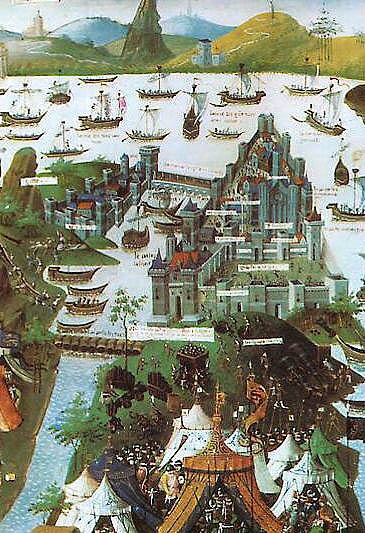
But there are others whom we should be recalling on this May 29: the thousands who died on the walls of Constantinople, 553 years ago on this day, in hopeless defense of their city and their faith against Muslim conquest.

Muslim armies had first tried to storm Constantinople over 800 years earlier, and over the centuries since then, had steadily torn away piece after piece of the Byzantine Empire. The pressure was sometimes greater, sometimes less, but the Religion of Peace never gave up its dream of bringing the great Christian empire to its infidel knees. It knew what it wanted, and it was willing to wait.

By the time Mehmet II brought his Ottoman siege guns up to the walls in spring 1453, everyone knew that even a successful defense could only delay Constantinople's capture by a few years. Too much of the empire had been lost. There weren't enough men, and there wasn't enough money.

But that didn't keep the last emperor, Constantine XI, from doing what he could.

The heroic and tragic story of the siege, and its aftermath for Greek Christians, is well-told in Steven Runciman's The Fall of Constantinople 1453, so if you want to know more about this largely-neglected moment in history, that's a good place to start.

When the walls were breached at last,

Theophilus [another Byzantine leader] shouted that he would rather die than live, and disappeared into the oncoming hordes. Constantine himself knew now that the Empire was lost, and he had no wish to survive it. He flung off his imperial insignia and, with Don Francisco and John Dalmata still at his side, he followed Theophilus. He was never seen again.

If you have a moment, say a prayer for the souls of Constantine and the others who died that day. In their own way, they also gave their lives for us, trying to hold at bay the same threat that looms today. They too deserve to be remembered.

Sunday, May 28, 2006

This Sunday at St. Thomas

Sung by the St. Ann Choir here today:

Jacobus Gallus, Ascendens Christus in Altum
William Byrd, Psallite Domino

Saturday, May 27, 2006

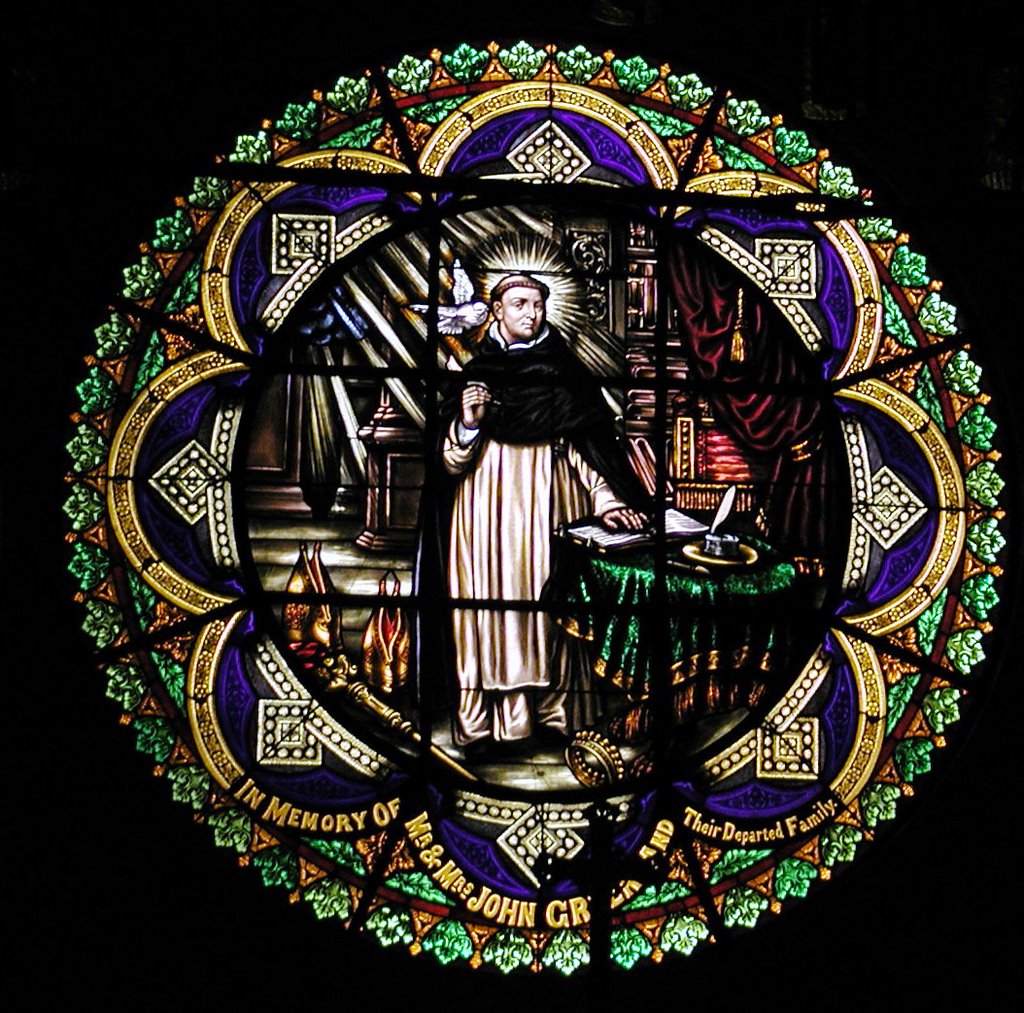
St. Thomas at St. Thomas


This is the window over the altar at St. Thomas Aquinas, my parish church. Of course, it depicts the man himself!

Thursday, May 25, 2006

The High and the Mighty


I happened to catch the 1954 John Wayne movie The High and the Mighty on TV last night. I was intrigued by the portrayal of Catholics in it, especially compared with the current attitudes coming out of Hollywood.

It was the first of the airline disaster films, and there's a long period in which the fate of the airliner and its passengers is in question (at least, as much as it could be with JW on board).

One of the passengers, a poor Italian fisherman from San Francisco, pulls out his rosary and begins to pray, first silently, then quietly aloud; when his seatmate asks him exasperatedly, "Do you have to do that?" he just answers, "Yeah." Later, he greets his family at the gate: six kids, if I recall. He's the only passenger who prays.

And again, as they pass over a ship at sea, the ship's radio operator, who has been helping track them, steps outside to the railing, makes the sign of the cross, and bows his head.

Very positive portrayals of common people with faith. I wish we had more today -- the portrayals, and the people.

One other thing: in the climactic moments, there's a beautiful shot from above, with the plane silhouetted as it flies down the centerline of the approach lights. Along that centerline, a short distance from the runway, there's a transverse bar of lights -- making a cross. I don't think that was accidental.

Three gardens

Was reading a short but wonderful article by a Prof. Rodney Delasanta, called Gardens of Good and Evil, in the May 2005 issue of First Things. (I know, it's May 2006 now, but I'll never catch up with my First Things reading). He looks at the archetypical story of the first Garden -- Eden -- and how the garden's loss has been dealt with.

The Christian view is that Eden, given to us by God, was lost by us through our refusal to live by its rules.

The Enlightenment and modernism, by way of throwing all that old stuff out, gave us Voltaire's maxim in Candide that "we must cultivate our own [man-made] garden." But this, says Delasanta, is "the garden of resignation, of suffering unfulfilled, the garden of disenchantment." Working in this garden is our necessary distraction from the pain of the long slow spiral to death and defeat. It can take your mind off the despair, but nothing more.

Postmodernists have worked out the final implications of Voltaire's vision in literature like Jose Luis Borges' The Garden of Forking Paths, a maze whose lanes lead nowhere and have no meaning. Wandering in that garden serves to pass the time, but you don't have a choice, really, they say. And everything's relative, so don't worry, be happy -- or despair and die, it's all the same.

No, thanks.

Back to the Christian vision.

Our defeat in the first Garden leads downhill to a second Garden, Gethsemane, where a man waits in anguish to sacrifice himself. Here the human race reaches a nadir; of all the human beings who surround Christ that night, one betrays him, others abandon and deny him, and the rest haul him off to be murdered. The Enemy has triumphed, it seems. He has set the stage for the ultimate sacrilege: mankind will murder God's Son. Game over.

Three days later, into a third Garden, Mary Magdalene comes early. But the tomb there is empty, the body gone. Panicked, she looks around, and sees a man; thinking he is the gardener, she begs him to tell her what happened. But he gives no explanation; he simply speaks her name. And she knows him, and knowing him, knows what has happened: the shame of the First Garden and the disaster of the Second have been redeemed utterly by the sacrifice that has just triumphed in the Third.

Thinking he is the gardener... But He is.

I'll take that vision over the other anytime.

Wednesday, May 24, 2006

Stained glass: preserving the faith till better times

One of the great things about stained glass in older churches is that it often preserves an expression of orthodox faith even when the people who now use the building are, well, no longer so orthodox.

This beautiful example, from a church I won't name, carries the motto "Thou art the Christ, the Son of God."

The Episcopalian congregation of this church is, I gather, one of the more "progressive" in California. Which is saying quite a lot. But no matter what moral and theological errors may be preached from the pulpit for a few passing years, this window will still be there, silently insisting through its beauty on the most important Truth of all.

I like that thought.

A new way to provide Da Vinci commentary?

By now, we've probably all watched a DVD that offered, as one of its extended features, running commentary by the actors or director of the movie. Pretty standard.

Yesterday, I got to thinking: what if you could distribute alternative commentary that would play right along with the DVD, perhaps pausing the playback if necessary to let lengthy commentary be heard before going on to the next scene? Wouldn't that be a great service to provide when the DVD of The Da Vinci Code comes out?

Instead of having to watch the movie first, then read a commentary and try to relate it to their recollection of the film, viewers would get the commentary in real time, while the movie was playing (you might have to mute or lower the audio playback from the DVD to let the commentary be heard). Seemed to me that it could be a far more effective way of commenting on a work in which the lies come thick and fast.

Now, here comes a weird coincidence. Today, I was delivering some photos to Stanford Law School, which hires me now and then to shoot their events. My oh-so-brilliant idea of the day before was nowhere on my mind. But being addicted to reading whatever catches my eye, I stopped at a bulletin board outside the office of one of the law profs. And while I was idly skimming a couple of newspaper articles about a copyright case he'd been involved in a couple of years back, I stopped dead at one particular paragraph and said to myself, "Hey! Wait a minute! That's my idea!"

As the article revealed, the concept of marketing supplemental commentary (the article mentioned Roger Ebert as an example) is at least a couple of years old. But it got swept up into a lawsuit from (surprise!) Hollywood, aimed at companies that were marketing versions of movies that had the profanity and smut edited out of them. Those versions were meant to make it possible for families to enjoy popular films without exposing the kids to the full gamut of Tinseltown's depravity.

The directors and studios couldn't object to actual copyright infringement, since no new copy of the material was being made; instead, they were up in arms over the possibility that their artistic integrity (cough, cough) would be compromised if everyone wasn't forced to hear every single f*** and s*** they had gratuitously sprinkled into their scripts, every single time one of their masterworks was seen.

The lawsuit appears to have been enough to kill off some small companies that were trying to get started offering the alternative editions. Others, such as Utah-based ClearPlay, pursuing a different and more sophisticated model, held on.

Then last year, Congress intervened with the Family Entertainment and Copyright Act. (At the Thomas link, scroll down to Title II). Altering the viewing experience of a legitimately-bought copy of a movie became legal, as long as "no fixed copy" of the work was made.

Now, it seems to me that supplemental commentary, synchronized to the playback of a DVD, would easily be covered by the Act. After all, the commentary would be original material, and the original work wouldn't be altered at all. It would be no more a copyright infringement than the common practice of watching a sports event on TV, turning down the volume, and listening to the play-by-play on your favorite radio station.

Ideally, a running Da Vinci Code commentary would be done by some of the prominent experts who have already weighed in with print, audio, and video rebuttals of the book. But if they don't, darn it, I'll do it myself.

Tuesday, May 23, 2006

In for the long haul

The other day, I was listening to a talk about The Da Vinci Code by Fr. Euteneuer of Human Life International. It's good, though a bit over the top at times. It's aimed at committed Catholics who are already convinced of the perversity of radical feminism and the Culture of Death. It won't appeal to many non-Christians.

But it wasn't his comments about DVC that made me sit up. He recalls, at one point, how the Church has faced similar threats from the popular press in the recent past: A Course in Miracles in the 70's, The Celestine Prophecy in the 90's, and so on.

I stopped right there. Yes, those books came out back then -- and they're still on bookshelves everywhere, continuing to deceive and mislead. And where is the Church's response to their lies? Out of print. Scattered here and there on the Web. No longer available.

Oh, the Church may have responded with some vigor when these books were new. But as the buzz died down, so did the Church's countermeasures. And today, those books still sit quietly on home bookshelves, waiting to entice new generations; they show up at used book sales, and get donated to libraries; they're for sale at Amazon. But the opposition -- the truth -- sleeps.

The Church has kept no thorough, devastating responses ready and waiting. The attitude seems to have been: just ignore the books, and they'll go away. Don't draw attention to them. Let them slide slowly toward oblivion.

Fine, as far as it goes. Which is not far enough. Their slide toward oblivion make take decades or centuries, and while they're sliding, they're dragging a lot of souls with them. We can't follow Christ and just let those souls go without a fight.

We need a way to keep the defenses fresh and available -- not just for a few weeks or months while a new pack of lies is on the Times' bestseller list, but for decades to come. Once error is in print, it becomes a permanent enemy, and needs a permanent defense. And we need to do it in a way that doesn't burn out the few who step onto the front lines in the first weeks of battle.

Web, print, and DVD: those are the weapons for the new defenses.

I remember the words of a youth hymn we sang back at my Catholic elementary school in the early 60's:

On earth's battlefield, ne'er a vantage we'll yield...
I'm tired of the long defeat. Anyone else?

Monday, May 22, 2006

Way too soon to relax

The usually ferocious William Donohue of The Catholic League went to see DVC, and had this to say at the end of his dismissive review:

Had the movie been a success, the effect would have been troubling. But because it fails to persuade, this is one movie practicing Christians have nothing to worry about.

I'm not at all convinced. I can well imagine that the movie failed to persuade Bill, since he has taken the trouble to educate himself tirelessly on early Church history, Gnosticism, and the other topics DVC muddies up. But have most practicing Catholics innoculated themselves and their families to a similar degree? I really, really doubt it. It's way too early to relax about DVC, even about its effect on Catholics who attend Mass weekly and do the other things 'practicing' Catholics do.

Yes, critical reaction was largely negative, and reaction of moviegoers in Italy was mixed, but that doesn't mean that the movie can't still deceive. The film grossed $70 million on its opening weekend. It will be seen by hundreds of millions of people before the last DVD spins, decades from now. Few of them will see it with their minds and souls properly equipped with the truth. Many will think it's at least a plausible version of history. And great damage will be done.

This is no time for any of us to breathe a sigh of relief at the movie's imperfections and think "Oh, good, nothing to worry about after all."

The will to unbelief

From a letter from J.R.R. Tolkien to his son Michael, 1963:

It takes a fantastic will to unbelief to suppose that Jesus never really 'happened', and more to suppose that he did not say the things recorded of him -- so incapable of being 'invented' by anyone in the world at that time: such as 'before Abraham came to be I am' (John viii). 'He that hath seen me hath seen the Father' (John ix); or the promulgation of the Blessed Sacrament in John v: 'He that eateth my flesh and drinketh my blood hath eternal life'. We must therefore either believe in Him and in what he said and take the consequences; or reject him and take the consequences.


From the same letter -- written, remember, in '63, just before Vatican II got into gear -- this prescient observation:

I suppose the greatest reform of our time was that carried out by St Pius X: surpassing anything, however needed, that the Council will achieve.


The 'reform' he refers to is not made fully clear in the text, but the editor of the collection of letters notes that, given the context, it was probably Pius X's exhortation to receive the Eucharist daily.

'Surpassing anything ... that the Council will achieve'? How right he was!

Sunday, May 21, 2006

At last, some good da Vinci TV

After shaking my head over the shabby me-too-and-it's-all-true "documentaries" about The daVinci Code on the History Channel and A&E, I was delighted to see something of value on, of all places, the Sci Fi Channel. Good production values, good people, and most importantly, the right attitude. Actually, it's got plenty of attitude.

Called Cracking Da Vinci's Code, it aired May 18, the day before the movie opened, and features such luminaries as the inimitable Amy Welborn; Scott Wenig, Assoc. Prof of Applied Theology at Denver Seminary; Chuck Missler, author of How We Got Our Bible; Jim Garlow, co-author of the book Cracking Da Vinci's Code; Darrell Bock, author of Breaking the da Vinci Code; Erwin Lutzer, author of The da Vinci Deception; Steve Kellmeyer, author of Fact and Fiction in The Da Vinci Code; Sandra Miesel and Carl Olson, authors of The da Vinci Hoax; and Paul Meier, Prof. of Ancient History at Western Michigan University.

Together, they do a fine job of taking Dan Brown's book down hard, exposing the major lies and misrepresentations in authoritative fashion.

Also appearing is an interesting scoundrel named Lewis Perdue, author of The da Vinci Legacy and Daughter of God, two books he penned a decade or more before DVC. Parts of the DVC bear, shall we say, a very, very close resemblance to passages in his books. But of course, Dan Brown says he never read them or heard of them. Never. Nope.

There's also a visit to Rosslyn Chapel, where DVC says a huge Star of David is carved in the floor. A tour guide even pulls up the carpet. No star.

The DVD appears to be available at ShopNetDaily. There, it's confusingly titled Breaking the da Vinci Code, and is billed as an edited version of another production, The da Vinci Code Deception. Amazon has it, too, without the reference to the longer version. Odd. Beware a similarly-titled DVD, Cracking the da Vinci Code; this is different.

Me, I'd rather read the books this production is based on. But a whole lot of people don't read anything serious, so I'm glad this show is out there. I guess things haven't changed much, come to think of it, since Boss Tweed complained about Thomas Nast's political cartoons of him: "I know my constituents can't read. But dammit, they can see pictures!"

This Sunday at St. Thomas

Sung this Sunday at the noon Mass at St. Thomas Aquinas, Palo Alto:

Josquin des Prez, Christe Fili Dei
Hans Leo Hassler, Christe Qui Lux Es et Dies

Thursday, May 18, 2006

No bells at the Consecration? How about trumpets?

From a letter from J.R.R. Tolkien to Christopher and Faith Tolkien, 1955:

I am still staggered by the frescoes at Assisi. You must visit it. We came in for the great feast of Santa Chiara... . High Mass sung by Cardinal Micara with silver trumpets at the elevation!

Silver trumpets! Not just a brief ring of bells, but silver trumpets! Now that made it clear that something big was happening!

Try it at your parish. After all, if you're Catholic, you believe in the Real Presence, don't you? How much more special a thing has to happen, before you let somebody make a really joyful noise about it? There are probably a few young trumpeters in a high school band in your neighborhood, looking to make a few extra bucks. Ask 'em. They probably know a good, solemn fanfare or two. Then get your priest's permission, and do it.

No, I'm not kidding. Do it.

And no, the trumpets don't have to be silver.

Tuesday, May 16, 2006

Laughter at Cannes

Many people have already commented on the derision that The DaVinci Code received at Cannes two days ago. Still, I can't resist noting it here. Someone once said that the thing that stings Satan most is not loathing, but laughter.

The Cannes audience clearly grew restless as the movie dragged on to two and a half hours and spun a long sequence of anticlimactic revelations.

"I kept thinking of the Energizer Bunny, because it kept going and going and going, and not in a good way," said James Rocchi, a film critic for CBS 5 television in San Francisco and the online outlet Cinematical. "Ron Howard makes handsome films. He doesn't make bad ones, but he doesn't make great ones."

One especially melodramatic line uttered by Hanks drew prolonged laughter and some catcalls, and the audience continued to titter for much of the film's remainder.

The Other-cott cometh!

If you haven't heard about the "Other-cott", you haven't heard about absolutely the best idea for striking back against the movie version of Dan Brown's compendium of lies, The DaVinci Code. Go and read all about it, but the basic idea is: this coming weekend, when the DVC movie is opening, go see the only other widely-distributed movie opening the same day: Dreamworks' Over the Hedge. The money that OTH makes -- and more importantly, the money DVC therefore does not make -- will give Sony Pictures fits.

The brilliant Barb Nicolosi is leading the charge. If you're not reading her blog, drop what you are doing and go there now.

Resignations

It seems the Vatican has just accepted the resignations of Cardinal McCarrick of Washington DC, and Bishop Imesch of Joliet, IL. I haven't read enough about Bishop Imesch, or about the replacements that have been announced for both offices, to comment on them. But I'm glad to see
Cardinal McCarrick departing from his very influential diocese. He never would lift a finger to discipline the dozens of Catholic pols who mocked their Church's teachings with their steadfast support for abortion on demand. Instead, he has already received his reward: shmoozing at countless receptions and parties, for a few decades, with the powerful, famous apostates like Kennedy and Kerry.

For handing out free passes to the Communion rail (oh, sorry, those have already been ripped out of most churches, so the reference is probably obscure), he deserved to go -- years earlier.

Friday, May 12, 2006

"This is worse than Mordor!"

Sometimes you glance again at something that you've read a dozen times before, and for the first time, you understand that it expresses and explains feelings you've had on another topic entirely.

In an important chapter of The Lord of the Rings that the movie left out, "The Scouring of the Shire", Frodo and Sam come back to their beloved homeland hoping for rest and solace in the familiar beauty of tree, inn, and hearth, whose memory had kept them going at the grimmest moments of their quest. Instead, they find that the Shire's under dreadful new management. The once lush countryside has been desecrated, trees wantonly chopped down, once-friendly inns turned into cheerless barracks, Frodo's home at Bag End stripped and empty, the hobbit population oppressed by gangs of thugs controlled by the fallen wizard Saruman.
"This is worse than Mordor!" said Sam. 'Much worse in a way. It comes home to you, as they say; because it is home, and you remember it before it was all ruined."
That, I realized today, is an echo of what bothers me, and apparently so many others, as we watch fine old Catholic churches and cathedrals get much of their beauty "renovated" out of them: high altars demolished, altar rails torn out, tabernacles with the Body of Christ within them moved out of sight as if they were something to be ashamed of, statues tossed away, seating rearranged to suit non-Catholic worship theologies, traditional stained glass windows replaced with random arrangements of colored glass such as you might find in any airport.

It comes home to you, because it was home.

It was the place where, perhaps, you grew up in the Faith, and whose every corner you can recall with that intensely detailed memory of early childhood. It looked a certain way when you had your First Communion; when you were confirmed; when you were married; when you buried someone you loved. It looked a certain way when you came for solace or courage, and found it. It looked a certain way when you first really understood, at an unexpected moment in an otherwise ordinary Mass, that you were in the Real Presence of the Son of God.

And it was home because we are flesh as well as spirit. Place matters to us because we live out our lives here and now, in the physical world. Change a place that has been vividly connected to people's spiritual lives, and you run big risks.

Now, a church can be changed in such a way that its older beauty is added to, as when a new statue or a stained glass window is installed, or an unwise remodelling is put right with a faithful restoration. When that happens, people's connection with place and with their past spiritual experiences in it is strengthened, not weakened. The connection we made with God at some past moment is reinforced, and seems all the more beautiful and significant. Not all change is bad.

But what's happening all too often is an arrogant, wanton destruction of the physical forms woven into people's faith experiences. Too often, the message delivered is that the earlier forms were wrong, the earlier spiritual experiences were false or useless, and even that the earlier beliefs are suspect. And too often, the bishops, priests, architects and liturgists who have torn up sacred spaces that the faithful loved deliver that message like this minion of Saruman ('Sharkey' in the patois of his henchmen), spitting scorn at Frodo:

'This country wants waking up and setting to rights,' said the ruffian, 'and Sharkey's going to do it; and make it hard, if you drive him to it. ... Then you'll learn a thing or two, you little rat-folk.'

Our modern minions of Sharkey should remember the message contained in the title of that chapter: the Shire was scoured. The thugs were driven out, and Sharkey was -- well, read it for yourself.

Wednesday, May 10, 2006

Turning wine to water

It's the modern Catholic miracle: take a beautiful church, one that encourages quiet, contemplation, and fervent devotion; and turn its interior into an ugly, pseudo-Protestant concert hall. It's an architectural reversal of the miracle of Cana: the wine of old beauty is turned into the brackish water of faddish awkwardness and sterility.

Karen Hall, at Some Have Hats, has penned a wonderfully passionate rant against the epidemic of radical modifications of traditionally-designed Catholic churches in the U.S. Her focus is on the desecration of St. Charles Borromeo in North Hollywood, California, which is about to begin, but it's happening all over the place, it seems. I share her bitterness over the endless delays and spinelessness exhibited by Rome when parishioners complain that their wishes are being ignored by priests and bishops intent on uglifying everything. She understands that people are not disembodied spirits to whom place is of no importance; they live out their lives of faith in specific places, whose layout and appearance are integral to their experience of God. Tinker with those places, and you risk jarring souls loose from their moorings and losing them forever -- the eternal thing that must never be risked for any temporal reason.

So why does Rome send us the consistent message that an individual soul isn't worth fretting over? Because every day that goes by with our beautiful churches being destroyed, our tabernacles being ripped from our sanctuaries, our liturgy being turned into the Cirque du Soleil, our people receiving communion from "extraordinary" eucharistic ministers 90% of the time, and worst of all, our constantly hearing things from the pulpit that are in direct contradiction to the Magisterium ... every such day that goes by without a word from Rome to stop it, the loud and consistent message is that whatever soul was lost on that day was not worth saving.

Rome needs to understand that it may pride itself in thinking in terms of centuries, but real souls are saved by the minute, the hour, and the day. And in the specific holy places where they have found solace. While the Vatican dithers and does nothing, souls are being lost forever as they are being led astray by the very shepherds who should be protecting them.

The "renovators" are like shepherds who claim to be serving the sheep better by moving the gate of the sheep-pen because they don't like the way it faces. If the sheep get lost because of it, well, too bad, they say; we must keep up with the times. Or the fads.

How long would it take for Pope Benedict to write a one-page directive to all American bishops, advising them to drop all plans for the specific architectural abuses that characterize these pernicious "renovation" campaigns? I could do it in two hours. Make it clear that disobedience of any kind will be grounds for immediate removal from office, and then yank the first bishop who objects, the day after he does so. That would automatically bring most of them into line, weaklings that they are. The number that would actually need to be disciplined would be quite small.

Abortion and the illegals

For weeks, I've been meaning to write about how illegal immigration and this country's 30-year abortion massacre are connected. Quintero over at L.A. Catholic got to it first, but I'm still going to put in my two cents.

Since 1973, American women have killed about 45 million of their children in the womb. The first three million of those children would now be in their early thirties, entering the peak years of income earning and productivity, energizing the economy and helping, through their taxes, to fund services for the growing population of elderly. Another 15 million would be somewhere in their twenties, needing low-level and entry-level jobs. But those millions have disappeared -- and now we're told we must now legalize millions of illegal immigrants to fill those jobs. But we would have no such need if we hadn't killed the very children of our own who could now be doing them.

But do we see that, and stop it? No, we're too attached to sex without the giving of life. The aptly-monikered Culture of Death just rolls on, slowly destroying the country and the culture that has embraced it. No need to invoke divine retribution here. It's just a matter of natural consequences.

Tuesday, May 09, 2006

The problem of bad bishops

Let's be clear about it: the Catholic Church in the United States is plagued with many bishops who are just plain bad. Several have turned out to be sexual offenders. Quite a few have been guilty of shifting pederast priests around so they could offend again in new places. Quite a few have little loyalty to the Magisterium, preferring a more convenient faith of their own invention, instead. Quite a few have done everything they could, seemingly, to kill vocations and drive the most dedicated Catholics out of their dioceses.

Enduring such malfeasance would try the patience of any people in any age, but it is especially galling in the U.S. because of our democratic political heritage, and may be precipitating an eruption of anticlericalism that this country has never seen.

Precisely because they're Americans, American Catholics are used to being able to take action when power is being abused in their secular lives. The right to petition the government for redress of grievances was written into our Constitution from the start. If Americans have a corrupt Congressman, they can work to get him out of office. If their boss is tyrannical, they're often able to express their objections to such behavior to higher-ups. If a co-worker is making unwelcome advances, they can file a complaint. The ability to strike back effectively at bad guys is one of the best safety valves in American public life. People who know can do this are far less likely to explode in disorderly and dangerous resistance.

But American Catholics have no option for such redress when it comes to their bishops. There is no mechanism for effective action against a bishop, except the long and tortuous road of asking Rome to intervene. And Rome has seemed mighty reluctant to intervene. Instead of actively policing the bishops and making them toe the line, Rome appears to sit back and wait for complaints to come in, and then look into it -- after a few more years go by.

And this has its price: the bishops too often act like evil prefects in a really bad boarding school -- secure in their license to bend the rules to their liking and to harrass, intimidate, and bully those who oppose them; and secure in the knowledge that if one of the little people gets uppity enough to complain to the headmaster, then that timid, complacent man will hem and haw and ultimately do nothing except to urge the victims to try to get along better with the bullies.

That approach works badly outside the Church, and it works badly inside it, too. It's terribly demoralizing to anyone who takes the teachings of the Church seriously to see their own bishop flout those teachings, year after year and decade after decade, and insist that everyone else flout them too -- and then to see that the ultimate authority in Rome will take no action to correct the situation. If anyone's still wondering why so many Catholics have left their Church, this is a darn good place to start looking.

When things reach a breaking point (and I think they're very close to it now), American Catholics will demand a voice in selecting their bishops, and an effective means of promptly removing bishops who have gone bad. And if they don't get it, some will take action to seize it -- and things will then get very messy indeed.

It's all very well to say that these men are successors to the Apostles, for so they are, but it is not a sufficient reason to just pray and remain passive. Judas was an Apostle, too, you know. And some of our bishops are his successors.

Sunday, May 07, 2006

This Sunday at St. Thomas Aquinas

From the St. Ann Choir at the noon Mass today at St. Thomas Aquinas, Palo Alto, CA:

Orlando di Lassus, Jubilate Deo
Waclaw z Szamotul, Ego Sum Pastor

Never heard of the second composer? Neither had I, despite years of collecting LP's and CD's of Renaissance music. Turns out he was a Pole, dates c. 1524- c. 1560. The site Completorium says this of him:

The history of Wacław z Szamotuł (W. of Szamotuły) was a history of bad luck for Polish early music. He was a gifted man, a true Renaissance figure. Educated in law, mathematics and philosophy, Wacław of Szamotuły was also a poet writing in Latin as well as in Polish. He died early, about the age of 35. "If the Gods had let him live longer, the Poles would have no need to envy the Italians their Palestrina, Lappi and Vadana" - wrote Szymon Starowolski, author of the first concise biography of Wacław of Szamotuły and one certainly has to agree with him. The second part of bad luck was a fact, that precariously few of his compositions remained to contemporary times.

Thursday, May 04, 2006

Standing up to China

Vatican, May. 04 (CWNews.com) - The Vatican has released a scorching criticism of the illicit ordination of two bishops for the government-approved "official" Church in China.

The statement charges that the government forced other Catholics to participate in the ceremonies, in a "grave violation of religious freedom." And it warned that the bishops ordained without the approval of the Holy See, and those who ordained them, are subject to excommunication.

So reported Catholic World News today.

It's really nice to see the Vatican's fiery response to this latest act of interference with the church. Too often, the attitude in the past has seemed similar to Google's: make the best bargain you can, then swallow your pride and your principles, because China is so big, so vast a market, etc.

The current plight of the Chinese church is a reminder of how past choices can have enormous future consequences. Back in the late 1940's, when part of China was still free but the communists were on the march, all the sophisticated people in the U.S. cautioned against "getting involved in a land war in Asia." Understandable after the sacrifices of the Pacific war, I suppose. And then look what happened: a year after Mao took over, we had our dreaded land war in Asia: Korea.

Imagine the world that might have been, had communism been turned back then. No Korean War. Probably no Vietnam War. No Tienanmen Square. A China prosperous and relatively free, and probably aligned with the West, not cozying up to rogue states like Iran in order to make trouble for us.

Oh -- and a China open to the Gospel, and maybe even now turning to Christ. It may yet happen, but not without terrible suffering on the part of countless Chinese Christians.

Tuesday, May 02, 2006

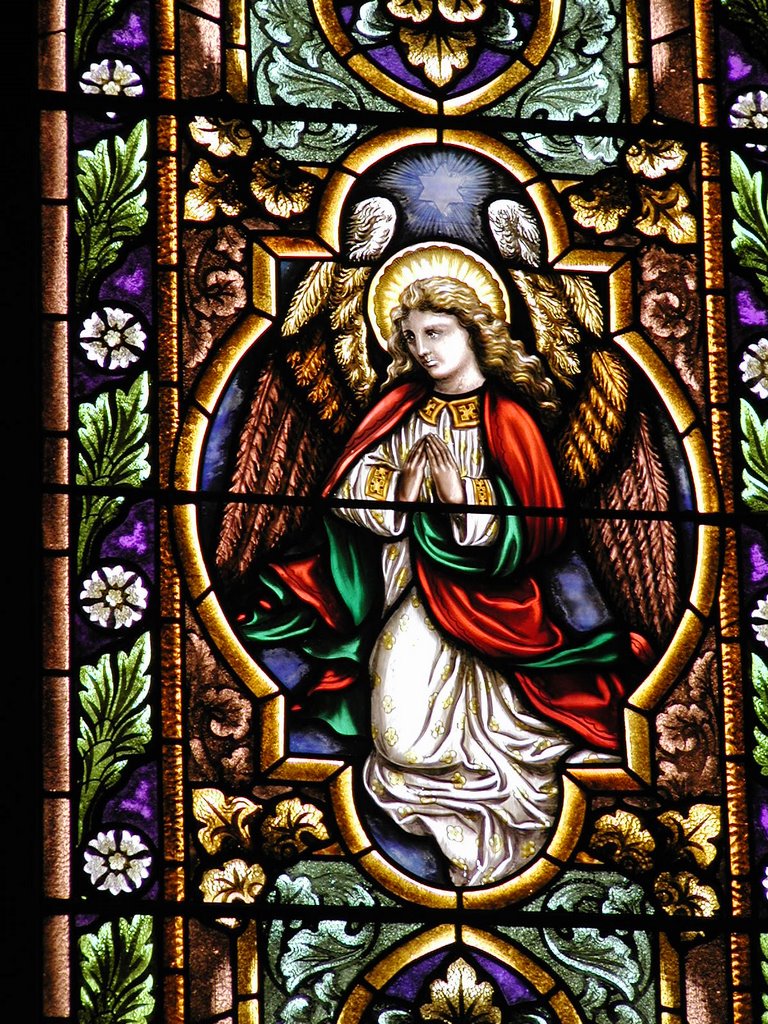
One of St. Thomas' angels


One of the transept angels at my home parish of St. Thomas Aquinas, Palo Alto, California. Don't know the artist, but all the glass dates from the early 1900's.

The reason the universe is so big

You often hear Christians draw a certain conclusion from the vast size of the universe: God surely wouldn't have created a universe so fantastically enormous if the human race were the only intelligent species in it. Sometimes you'll even hear them say that it's arrogant of us to think that He would do so.

On the contrary! I think it's perfectly likely that He would plunk us down in a universe of just the kind we have.

Put yourself in God's place. What kind of universe would you create for a race which would fall because of its prideful desire to "become as gods, knowing good and evil" (that is, everything); whose pride would become central to every one of its vices; which would today become so besotted with its technological and scientific knowledge that it would think there is no more room for God in the intelligent person's worldview? Would you create a little wisp of a thing, a few light-years across, that mankind would comprehend adequately in a few thousand years?

I sure wouldn't. It would only feed into our false pride in our ability to know and control.

Wouldn't you create just what we have: a universe that is not only incomprehensibly large now, but constantly expanding? A universe so constructed that (due to interstellar dark matter) we can't even observe most of it, let alone travel across it? And to complement this vast macro scale, a structure of matter on the micro scale so bizarre that (as Heisenberg proved) you can't even describe the smallest bit of it definitively at any given moment, because the very act of observation gets in the way?

That, I submit, is the perfect universe for mankind. One that puts us permanently in our place, in terms that can't be gainsaid. One that says to mankind, unmistakably and forever, "I am God. You're not." That's the universe we need, and so that's just what he's given us.

Monday, May 01, 2006

St. Anthony of Padua, Menlo Park


I really love traditional stained glass, and am starting to amass a nice library of photos. I'll be sharing a few here now and then.

This magnificent roundel is the handiwork an Carl Huneke, a German immigrant of great talent whose windows grace many a church throughout California. Strangely, it's the only traditional stained glass window in an otherwise nondescript 1950's Catholic church, St. Anthony of Padua.

Sunday, April 30, 2006

Cardinal Mahony and the illegals

I suppose that with his generally sound left-wing credentials, it shouldn't be a surprise that Cardinal Mahony has latched on to the cause of illegal immigrants, too. But I wonder if there isn't something else going on, too.

With his many liturgical abuses duly documented, his support for highly questionable speakers at his recent religious eduation conference, and his possible vulnerability to prosecution now that he has failed to keep records of priestly abuse out of the courts, the Cardinal has to know that he may soon be in the crosshairs for reassignment to some backwater, at best, for the rest of his career.

I wonder if he's thinking: I've paid my dues now to the forces that marshalled those hundreds of thousands of demonstrators in the streets of L.A. recently, in support of illegal immigrants. If Rome tries to move against me, maybe I can call in some favors and get a few hundred thousand of those same people demonstrating in the streets of Los Angeles in my support.

Now, I doubt that such a ploy would have any effect on Benedict, but I can certainly imagine it appealing to the very politically savvy Cardinal.

Just a thought.

Thursday, April 20, 2006

Welcoming everyone, but not every behavior

The United Church of Christ has been patting itself on the back recently with TV commercials praising its own inclusiveness: "No matter who you are, or where you are on life's journey, you are welcome here." The commercials implicitly criticize other churches for what it claims are exclusionary rules that supposedly keep certain groups out.

Fr. Thomas Williams has a fine, succinct article explaining that to welcome a person is not to welcome everything he may do, too. Here's an excerpt:

There is a difference between a church saying “We welcome all persons” and “We welcome all behavior.” After all, two things distinguish Christian belief: a body of doctrine and a moral code. Following Jesus entails both. Jesus welcomed prostitutes, but he never welcomed prostitution. He was soft on adulterers, but unyielding on adultery. After forgiving the adulterous woman, in fact, he adds: “Go and sin no more.” And the tax collector Zacchaeus, on encountering Jesus, promises to pay back all those he has cheated — fourfold. Jesus never welcomed cheating, but he did welcome reformed cheaters. This is not just a matter of semantic hair-splitting. Jesus came to call sinners but to condemn sin, much as a doctor heals sick people but eradicates sickness.

Go and read the whole thing.

Wednesday, April 05, 2006

Offering it up

Recently, when I was talking with my (non-Catholic) wife and daughter, I used the phrase "offering it up" when referring to some sort of discomfort. I think they both thought I was a little nuts, so I thought I'd write a little about the wisdom of the attitude that the phrase expresses.

When I was a boy in Catholic school in Southern California, and we kids were, for example, miserable and complaining in our non-air-conditioned classroom on some torrid September afternoon, the nuns (who, wearing the old black habits, must have been far more uncomfortable than we were) would tell us to take it patiently, and "offer it up." The idea was to take the suffering you were experiencing, large or small, and ask God to accept it along with the sufferings of Christ in recompense for sin. Since we all knew we had sins, and there was plenty of it elsewhere in the world, it made sense, and always quieted things down for a while.

I think there was a great deal of wisdom in that little practice. The problem of suffering is one that has troubled many great thinkers, and disturbs all of us when something bad happens to us, especially if we think we didn't deserve it. And one of the most desolate feelings a human being can have is that his suffering has no meaning. The fact that kids' sufferings are often small by adult standards doesn't mean that they aren't acutely felt. So "offering it up" gave us a way to attach a great -- and real -- significance to whatever we were going through; it allowed us to unite our little hurts, especially the undeserved ones, with the far greater hurts suffered by Him whose suffering was utterly undeserved, and participate a little in the great work of our own redemption.

To those of you who may be saying, "Oh, that evil, guilt-inducing Catholic Church! What kind of sins could you kids possibly have done that could merit feeling spiritually guilty for?", I would ask: do you really remember your own middle-school days? Do you remember the spite and cruelty that made school life a little hell sometimes? Seems to me those were plenty nasty enough to merit a little guilt -- and to motivate us to expiate a bit of it with a little patient "offering up" of the misery of those 100-degree dog days, late in summer.

Sunday, March 26, 2006

Loud. Way too loud.

I was visiting the Montgomery Theater in downtown San Jose, California, yesterday afternoon to deliver some photos for an upcoming production of the Johann Strauss operetta Die Fledermaus. The Montgomery is a venerable old place at the south end of a plaza ringed by big hotels, the Tech Museum, and other spots the city fathers (oops, non-inclusive phrase! sorry!) would like you to visit and spend your money at. It's normally a fairly inviting spot, too, as urban spaces go.

However, it's also frequently used for rallies and outdoor concerts, and yesterday was such a day -- Mexican Heritage Day, I think. Unfortunately, outdoor concerts mean only one thing: loud -- really loud -- music. And loud -- sometimes really loud -- spectators.

The bandstand was almost a quarter of a mile away, but I could barely make a cell phone call outside the theater. I don't want to think what the decibel level was at the other end of the plaza. It wasn't helped by the two cars that were blocking traffic, a fifty feet from me, blowing their horns endlessly while waving huge Mexican flags at each other.

The problem is that popular culture firmly endorses the principle that in order for music to be good, it must be as loud as it's possible to make it. And if you're outside and want to hear your music, it's OK to you force anyone within a mile to listen to it too.

Nor will going inside a building always give you some quiet in which you might do something other than the Officially Sanctioned Loudness. I've been in the Montgomery during performances when a band is playing in the plaza, and whenever it's only dialogue from the stage, you hear, faintly, the whump-whump-BOOM, whump-whump-BOOM and the overamped singers from outside, ruining the effect the actors are trying so hard to achieve, and that the audience paid to experience.

Ah, well. Everything that is not forbidden is compulsory.

Sunday, March 19, 2006

Deception

One thing I've learned about falsehood: it seldom is a complete falsehood. Almost always, it has a good deal of truth mixed in with it, especially in the early going. But that's just the bait; the Deceiver tolerates it, in order to get us to believe that the hook isn't really a hook, the fishline isn't really a fishline -- and the frying pan isn't really a frying pan.

Monday, March 13, 2006

The AP poll on abortion

The new AP poll on abortion attitudes is out, and it's being trumpeted by my local paper (the San Jose Murky News) because it purports to show that the majority of Americans support most abortions for most reasons. Never mind that this result contradicts several other recent polls from CBS, Gallup, and Wirthlin (and that the all-important texts of the questions asked to respondents were "unavailable at press time". But I digress.

The real shocker for me was this:

Looking at other results from the new AP poll, two-thirds of white evangelicals said abortion should be illegal all or most of the time while 54 percent of Protestants agreed. Catholics were evenly split.
That is, the only church with an official worldwide policy against abortion can barely manage to influence the opinion of half its American membership. And who is responsible for seeing to it that the official policy is clearly and frequently explained to rank-and-file Catholics, to counter the daily drumbeat of pro-abortion propaganda they hear from news outlets? American bishops and priests.

Of course, not all are equally guilty. Some, like Vasa in Oregon and Chaput in Denver, are doing great work. Unfortunately, however, some of the worst, like Cardinals Mahony of Los Angeles and McCarrick of DC, are also in control of the largest and most influential dioceses. And too many parish priests, overworked and discouraged, would rather preach another homily on "God is love" than on the greatest social evil of our time.

Tuesday, March 07, 2006

Ten words

I recently encountered a lullaby called "Slumber, My Darling" by Stephen Foster, and these lines struck me:

While others their revels keep,
I will watch over thee.

They struck me because, in ten words, they sum up the things that good parents do, and the sacrifices they make to do them. As they see many of their childless peers spending all their time and money on their own pleasures and advancement -- travel, undistracted education, possessions, careers, promotions, and the rest -- parents choose to conceive and bear children, make good homes for them, play with them, give up career advancement to keep from having to uproot them, worry over them, protect them, teach them, read to them, pour thousands of hours helping them grow up in every way, and then endure the pain of letting them go.

And yes, often, just quietly watch over them as they drift off to sleep.

Sunday, March 05, 2006

This Sunday at St. Thomas

From the St. Ann Choir today during the noon Mass at St. Thomas Aquinas, Palo Alto, CA:

Orlando de Lassus, Ne Reminiscaris and Audi Benigne Conditor
Cristobal de Morales, Inter Vestibulum et Altare

At last, truth in advertising

Remember Jesus talking about not being able to serve both God and Mammon? If Mammon ever did some nice, truthful advertising, it would probably look like this, noted at White Around the Collar (scroll down to the March 1 posting). Very funny, in a sort of whistling-past-Gehenna sort of way...

Friday, March 03, 2006

Getting baptized here? Bring a snorkel!

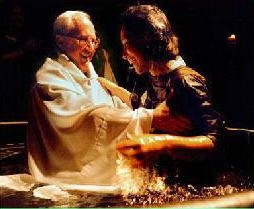
At that church I wrote about in my post about acolyte training, I learned that they have plans to spend as much as $100,000 to install a huge baptistry in their sanctuary. How could you spend that much on a baptismal font, you ask? Ah, but this will be no mere font. It will be a pool, large and deep enough to allow full-immersion baptism -- which, I was told, has been mandated by our bishop. That is, all adult baptisms in our diocese are one day to be performed by submerging the poor catechumens completely, it seems.

I'm sure glad I was baptized in the bad old days, and as a child. A little water, poured with dignity and decorum over the forehead. I won't need to pretend I'm a Southern Baptist, getting dunked in the Chattahoochee.

Talk about an impediment to adult conversions! I don't know about you, but if I was a potential convert and heard that I had to endure this:


... I'd think again about the whole thing.

Staying in the boat

Catholics who prize fidelity to the Church's teachings have a lot to be angry and disappointed about these days, especially those of us who live in the United States. From the cover-up of priestly sexual abuse by some bishops, to the imposition of liturgical abuses by some of the same bishops, to the mandating of highly questionable sex-ed classes for Catholic school children by some of the same bishops again, it seems that there's something outrageous happening almost all the time.

The ever-present temptation is to get out, in one way or another. Get out of the Church and start going to one of those big Protestant churches, where admittedly sometimes you'll hear the Gospel preached far better, and more faithfully, than you did in your Catholic parish. Or get out of the Church and go defiantly Traditionalist with the St. Pius X folks, where at least you'll get the liturgy done reverently and solemnly, as it was before things started rolling downhill -- but not in communion with the rest of the Church.

The common thread, of course, is Getting Out. But I think that's exactly what Old Nick is hoping for: that our legitimate frustration will lead to our breaking away, so that the Body of Christ will be even more broken than it already was.

That's exactly what happened in the early sixteenth century. You think we have abuses now? Read up on it. There was plenty for ardent, sincere Christians to be outraged by back then. But when the Church didn't immediately respond with positive change, Luther and others let their zeal drive them into disastrous impatience: they said, "We won't wait any longer. We're breaking off to set up our own church, which, by the way, is the real Church."

That's not reform; that's rebellion. The Catholic Church used to call it that, too -- the Catholic history texts I read from in seventh and eighth grade did so. We're too polite for that nowadays, of course. But we called a spade a spade not too long ago.

Protestants, don't be insulted. Just accept your origins for what they were. The 'Reformers' had no intention to work humbly and slowly within the Church to effect real reform. That would have taken decades, maybe longer. That would have taken consummate humility and great personal sacrifice. They wanted action, and they wanted it now, in their lifetimes, so they could enjoy its supposed fruits. When they didn't get it, they Got Out.

That's a cautionary recollection for all of us who are discontented now. Let's not follow that terrible example, whose main fruit, five centuries later, is the spectacle of 40,000 denominations who all claim to have the truth.

Instead, let's follow this one from St. Theresa, via Fr. Robert Altier: [Update: this link to the website containing transcriptions of Fr. Altier's homilies no longer works. Fr. Altier has been silenced by his bishop, apparently for opposing too noticeably the very questionable Virtus sex-education program now being forced on Catholic families by the same bishops who betrayed them with thirty years of abuse cover-ups.]

Saint Therese, whose feast we celebrated yesterday, made the point so clearly and so simply when she was talking about the apostles when they were in the boat with Jesus, and Our Lord was sleeping in the bow. The water was sloshing over the top and the boat was being pushed about by the winds and the waves. The apostles, many of whom were fishermen, were afraid that the boat was going to sink. And she said simply, Do you really think the boat is going to sink if Jesus is in it? ... As long as you are in the boat, you have nothing to fear! As long as you are with Jesus, you are just fine. Do not try to showboat it and walk on the water or do something cute because you are going to be in trouble, but stay in the boat with Jesus. Keep your eye on Him. Do not worry about the winds and the waves; let it happen. It is not our problem. Let the Lord take care of that. Our task is to keep our eyes on Him, to pray, to live the life, to keep our focus on what is good and beautiful and excellent – and that is Jesus. If it seems like He is not answering and He is a million miles away when you come to pray then just let Him sleep and keep your eyes on Him.


That's mighty hard advice to follow, especially when the boat appears to be getting steered in the wrong direction by one of the Apostles (i.e., one of their successors). It's hard to trust that Christ will "wake up" (i.e., intervene) at just the right moment to right every wrong and dry every tear with His incomparable power. It's hard not to jump out, to drown in unbelief or to be "rescued" by another boat (but the wrong one).

But staying in the boat -- remaining in the Church and working quietly but ardently for what's right -- is our job. These are the times we we born in, and this is our work. Let's do it.

Thursday, March 02, 2006

Acolyte school, then and now

I happened into a Catholic parish church a few weeks ago after Mass and found a small group of children, mostly girls, attending a class for acolytes, or altar servers, or whatever they call what used to be known as "altar boys."

It was barely controlled chaos. Kids crawling over the pews, talking, laughing, barely paying attention. (Remember, this was going on in the front pews, a few feet from the Real Presence in the Blessed Sacrament). The poor young woman teaching the class wasn't able to convey much because she was constantly interrupting herself to plead with the miscreants to stop, without more than a few seconds success each time. The miscreants were beyond help; the majority looked bored; the few serious ones looked angry and frustrated. The only topic she could cover during my 15 minutes there was how to hold the Bible so the priest could read it during Mass, including reassurances that if they held it upside down, no problem, the priest would turn it over for them.

Roaming down memory lane about 45 years, I recalled my altar boy classes at St. Mary's, a little parish in Fullerton, California. Our little bunch of third and fourth graders were taught our Latin (and the tiny bit of Greek in the Kyrie) outside at the school lunch tables on Saturday morning by the redoubtable Fr. O'Brien, straight from Dublin and strict as all get-out. Did you catch that about Latin? All the responses, including the daunting Confiteor, from memory. Third and fourth graders. And we all got it.

Needless to say, Fr. O'Brien didn't allow even the slightest irreverence while we were finally allowed inside to practice at the altar. After all, Jesus was there. And everyone knew that the sanctuary was only used for worship, and that worship was solemn and reverent.

By the lights of modern liturgists, we kids shouldn't have been able to do it. We shouldn't have had so much demanded from us. We shouldn't have wanted to do it. But we did. And I think we did because it was hard, but it was real; we were being allowed to take part in something big, something adult, something rightly awe-inspiring.

Contrasts: Being taught by a priest who demanded respect and attention, and behaved like he deserved it, vs. being taught by a harried young lay woman who begged for attention and respect and so got neither. Being taught the ancient traditions in the ancient languages, vs. being taught dumbed-down contemporary liturgy in Oprah-speak. Being allowed inside to the sacred space as a privilege, vs. using an already demeaned sanctuary as just another noisy classroom.

This parish church is one of three in a town of 70,000, and they're down to one Mass per Sunday. If they keep it up, they'll get down to zero. Soon.

A hidden treasure: the St. Ann Choir, Palo Alto

Since I often complain here about things that are wrong in the Catholic Church, I'm going to take a break from that and mention a wonderful thing that has been going on here in Palo Alto for many years: the St. Ann Choir.

Every Sunday and on all the major feast days since 1963, the St. Ann Choir -- about a dozen dedicated men and women, with personnel changing over the years -- has provided Gregorian chant and one or two Renaissance motets for a Mass in our town. For many years, that Mass was celebrated at St. Ann's Chapel, a modern but rather attractive church built by Clare Booth Luce for Stanford University students in the 1950s. When St. Ann's closed a few years ago (it was ultimately sold to the Anglican Province of Christ the King -- more about that another time), that Choir moved to St. Thomas Aquinas, a gorgeous 1902 wooden Gothic revival church near downtown.

The Choir probably wouldn't exist without the tireless work of William Mahrt, a professor in the music department at Stanford. He's there almost every Sunday to sing and conduct, and to play the recessional on the little pipe organ in the choir loft -- usually something by Bach, Buxtehude, or one of the other baroque masters.

Not only do we get the Introit, Gradual, and other parts of the Proper sung in Latin, there's a little Mass booklet for the congregation, customized for each week, with the neume notation of the Gloria, Credo, and Agnus Dei, which we're encouraged to join in on. Scripture readings and much of the rest of the Mass are chanted in English.

At the Offertory and Communion, the Choir sings motets from the Renaissance or late Middle Ages -- Dufay, Byrd, Palestrina, di Lasso, and so on. There's another little booklet with the words to their entire repertoire, in Latin and English, so we understand what's being sung.

What a treasure!

It's safe to say that if the St. Ann Choir hadn't been there when I decided to return to the Church, I would have had a much harder time getting as far as I have. Everywhere else in this very politically and religiously liberal area, I would have encountered Masses stripped of all beauty, all good music, not to mention all Latin. I guess I've gotten to share in quite an unusual blessing!

Tuesday, February 28, 2006

The wisdom of Catholic confession

It's part of the wisdom of confessing to a priest that we find it far more embarrassing to reveal our sins to another human being than we do to admit them to God. The sting is far greater! It shouldn't be, of course — obviously we should be far more abashed in front of God, in prayer — but human nature works that way.

Perhaps the lack of confessing to a human being robs Protestants -- and "progressive" Catholics, who scoff at individual confession -- of an important motivator in resisting sin. After all, if you know that if you do the sin, you have to admit it to another person to get right with God, that's uncomfortable, and the thought of having to do that just might provide the strength to resist the temptation.

Saturday, February 25, 2006

Down the memory hole

In 1984, George Orwell's protagonist Winston Smith has a nice job at the Ministry of Truth vaporizing inconvenient documents by shoving them into a receptacle at his desk. The receptacle is called a Memory Hole. Once the documents are ashes, history has changed.

Something similar recently happened in Sweden. It seems that one Swedish schoolbook, a textbook for religious history classes, contained two images of the Prophet Mohammed. In the wake of the torrent of violence and vitriolic hatred pouring out of the Islamic world following the publication of the Danish cartoons, Sweden has decided to pull the textbooks from the classrooms, and the publisher has taken them out of circulation.

A gesture of reasonable conciliation, you might think -- cowardly, but within the bounds of reasonability. Except that the two depictions of Mohammed weren't scurrilous caricatures from the pen of some insensitive Western cartoonist; they were both from Islamic manuscripts of the 13th and 14th centuries. They are a legitimate part of the historical record; when the book was written, the Swedes probably thought they were being sensitive by depicting Mohammed with historical Islamic artwork.

But historical truth doesn't matter to the imams. If you don't like something from the past, suppress it. Just shove it down the Memory Hole, and trust the suicidal West to forget the whole thing ever happened.

Monday, February 20, 2006

Divestment as a tool of jihad

David Horowitz's FrontPage magazine has a very interesting article that describes the left's highly-organized attempt to weaken Israel by getting American and European institutions to get rid of their investments in the Israeli economy. All this is smokescreened with concern over supposedly cruel Israeli treatment of Palestinians, etc., etc.

As I see it, all Israel has done in its brief existence is to build a Western-style democracy in, as Golda Meir famously commented, the one plot of Middle Eastern geography that had absolutely no oil. Palestine was an unproductive backwater until they came; now, their bit of Palestine is a world leader in technology. For this, they've been attacked ruthlessly from the first hour of their existence to the present moment.

Western civilization has already allowed millions of God's chosen people to be murdered in the Holocaust. If it allows the rest to be murdered by militant Islam, I can't help but think that God's retribution on us will swift and hard.

Thursday, February 16, 2006

'Lost': blame U.S. for torture

We're all big fans of the ABC series 'Lost' here, so it was sad to see the plot take a politically correct detour. Last night's episode included more of the backstory of the Iraqi character, Said. He gets captured by U.S. troops during the first Gulf War and finds himself employed as an interpreter during interrogations of other Iraqis. One of these is his former commander, who is believed to know the whereabouts of a downed Amerian pilot. His American handler, a non-uniformed older guy (CIA, I suppose), coerces him into doing something he's never done before: torture a prisoner to extract information. He does it, and then bitterly blames the Americans for forcing this terrible experience into his life.

Never mind, I guess, that Saddam's army had regularly used torture for twenty years before Gulf War I) and taught the finer points of its techniques to thousands of its men, making it by far the more likely place a soldier like Said would learn how to do it. No, let's have him be loyal, good-hearted and decent -- until the evil Americans get hold of him.

I'm not saying Americans have never used torture (and I'm not talking about the Abu Ghraib abuses, which were mainly discomforts and humiliations, but the real thing). But you really have to have a political agenda to have Said be forced into torture by Americans -- the same dreary agenda that all of Hollywood seems to share: Blame America for everything.

The more we let these people control our impression of our country, the more the real bad guys will rejoice.

Saturday, February 11, 2006

What if... ?

What if the early Christians had made a successful effort to convert the Arabs before Mohammed came along? It looks like everyone in the centuries between 300 (when Christianity was legalized) and 600 wrote the Arabs off as a difficult, scattered, and unimportant people. The Christian emperors of the Eastern Roman Empire seem not to have sent missionaries in that direction, preferring to buy off the Arab tribes now and then, to keep their occasional raids from becoming a significant distraction from the empire's struggle with its traditional enemy, the Persians.

What if, in his spiritual misery, Mohammed had been surrounded not by a polyglot paganism, but by a vibrant Christianity that had been going for a century or two?

Yes, things might have happened just as they did; he might still have wandered off to a cave and begun having those visions that have had such fateful and bloody consequences for the world.

But perhaps not. Perhaps there would have been a kindly parish priest to talk to. Perhaps there would have been a monastery nearby, where he could immerse himself in the already formidable Christian intellectual and spiritual heritage, and explore his spiritual yearnings with good guidance. Perhaps, as happened to countless others, he might simply have been helped to Christ by a Christian neighbor.

How many times did Christians think about evangelizing the Arabs during those centuries? How many times did they decide that those motley desert tribes just weren't worth it, that the Great Commandment somehow didn't apply to them?

The price of not spreading the Gospel can have repercussions stretching millennia into the future.

Friday, February 10, 2006

So why are they doing it?

Cliff May has a good article at Townhall.com discussing the reasons why the militant Islamists are doing what they're doing. He argues that those who are orchestrating the violence (and most of it is quite well orchestrated) know quite well that they're doing far more harm to the image of Islam than the cartoons were. But they know their Machiavelli: for those who would rule, "it is better to be feared than loved." For ruling is exactly what they're after: rule over non-Muslims, and even over those Muslims who would like to join the modern world.

As an aside, I think it's great that one key to understanding their behavior is contained not in some bright new analysis from some think tank, but in the writings of one who was observing politics five hundred years ago.

Another key is the long tradition of Muslim aggression against non-Muslims, and of intimidation and threats when their targets were beyond their physical reach. It was that way when Islam first exploded out of the desert in the 640's. It was that way when they started roughing up Christian pilgrims to the Holy Land in the 1000's. It was that way when Islam kept pressing into eastern Europe during the Renaissance, and besieged Vienna in 1529 and again in 1683.

And it's still that way today, when terrorism has provided an effective weapon such as Islam hasn't had since the decline of the Ottoman Empire in the 1800's.

May's article draws parallels between the Islamists and Nazi Germany; the insatiable lust to rule is common to both. I'd draw another parallel. In the mid-1930's, when the Nazis consolidated their hold on German politics, many Germans tried to oppose them, and others, less courageous, despised the Nazis but were too afraid to resist. It's the same with Islamic countries now. We keep hearing that the Islamists are a minority, and that most Muslims don't share their extremism. I'll grant that, for the sake of argument. But that minority has gained control of Iran and Syria, is close to it in Egypt and Turkey, and is flexing its muscles everywhere else. When Europe was overrun in 1939-41, it didn't matter that dedicated Nazis were a political minority in Germany; the overrunning took place anyway. And it won't matter to the rest of us that Islamists are a minority when they hold the reins of national power in a dozen countries and use oil money to buy nuclear weapons and missles.

Tuesday, February 07, 2006

You just gotta love that Religion of Peace...


One of those peace-loving signs at the peaceful demonstration by followers of the Religion of Peace in front of the Danish embassy in London a few days ago.

Being a person who doesn't like confrontation, I have to admit I'm a little uncomfortable with those original Danish cartoons of Mohammed (or is it Muhammad, now? Sorry, don't behead me, peaceful Muslims to whom jihad only denotes an internal struggle against one's own sins!). Still less comfortable with some of the truly vitriolic follow-on cartoons from Europeans that are popping up on the net.

With that said, none of it justifies rioting, burning down buildings, and suggesting beheadings. One gets the impression that when the chips are down, this is what the Q'uran really teaches people: spite, revenge, murder, destruction. I sure don't hear many Muslim voices speaking up and denouncing this latest round of violence as a perversion of Islam -- the excuse we heard after 9/11.

No, I'd put up this plaque on the burned-out shell of the Danish embassy in Syria: "Sacred to the memory of the Religion of Peace. Si monumentum requiris, circumspice."

Wednesday, February 01, 2006

Chant and praise music

The music minister at a large Presbyterian church once told me that modern "praise songs" were like Gregorian chant because they were repetitious (e.g., "Worthy, worthy, worthy, worthy, is the Lord, Oh, he's so worthy, worthy, worthy...").

This amiable fellow had had a long and pretty distinguished career as a classical vocal soloist, but I guess he had never spent any time carefully listening to, or better yet, singing chant. If he had, he would have known that although chant will sometimes spread a single syllable over several notes, it never repeats itself gratuitously the way praise music habitually does. When chant does repeat a phrase or sentence, it's part of a verse-and-response structure that makes contextual sense. The longest sections of chant in the Ordinary -- the Gloria, Credo, and Pater Noster -- have no repetition at all.

Chant does deliver the words more slowly than we would normally speak them, and maybe that's where some of the confusion comes in. But that's part of its effectiveness: it gives us time to slow down, quiet down, and really let the meaning of the words we're singing soak in.

That democracy of the dead

Chesterton's remark about a "democracy of the dead" is hardly news, but since this is a journal of thoughts I've found it interesting to encounter, here it is again:

Tradition means giving votes to the most obscure of all classes, our ancestors. It is the democracy of the dead. Tradition refuses to submit to the small and arrogant oligarchy of those who merely happen to be walking about.

I love this, because it's a slap in the face to the pride that's peculiar to our times: that the people of the past were ignorant loons because they didn't know certain things (usually technological) discovered in our lifetime. Why study Socrates or Aquinas, we say. Why read Utopia or The Consolation of Philosophy? So boring! After all, Boethius and More and all those other dead people had no computers, no internet! They never downloaded anything! They didn't know about DNA or even electricity! How could they have anything useful to say to us, who are so much better informed?

As if, after sixteen years of oh-so-modern schooling, the average college graduate today could put together two coherent sentences about any of those technological developments.

Sunday, January 29, 2006

Burdens

I was at Borders a few days ago, and a book called A Calendar of Saints: Lives of the Principal Saints of the Christian Year was on the remaindered rack. Quite a nice book for eight bucks. I was paging through it tonight and found this, by Bernard of Clairvaux:

The character of God's eternal and just law is this: that those refusing to be ruled by God's gentleness will have the misfortune of being ruled by their own selves; that whoever voluntarily throws off the gentle yoke and light burden of charity will be obliged to carry the unbearable burden of their own will.

It had occurred to me before this that Christ said "My yoke is easy and my burden is light." He didn't say, "I have no yoke or burden to give you." Just that His was the lightest one you could pick up. A heck of a lot lighter than the one you'll end up making for yourself, otherwise.

Saturday, January 28, 2006

It's trivial (not)

In the Middle Ages, education preserved and developed one of the gems of understanding of the ancient Roman world: the concept of a foundation of three subjects -- Grammar, Logic, and Rhetoric. Whatever speciality each educated person might eventually take up, he would start with those things, and not go on to specialization until he had learned them.

Together, these three subjects gave a student the chief things he would need to use that unique gift to human beings: the ability to understand and articulate thoughts and emotions through words, and thus to come closer to Truth.

It seems to me that there's a close analogy in that choice of subjects to teaching how to build a beautiful building (at which the the Roman and Medieval worlds were masterful).

Grammar taught about the bricks of language and how to mortar them together.

Logic taught how to take the pieces that one could make with bricks and mortar -- walls, pillars, and so on -- and engineer a building that would stand up to wind and weather.

Rhetoric taught how to make that building beautiful. And beauty has great power to convince.

These three foundational subjects were known as the trivium, or the three paths. It's a reflection of how far the modern world has fallen in understanding that the only derived word people now know is "trivial," meaning unimportant.

I'm not saying that grammar, logic, and rhetoric should be taught to the exclusion of the other subjects we've come to expect in university curricula. I'm only saying that they're the foundation, and without the foundation, the rest of what we try to build will always be shaky, and will often be ugly.

Friday, January 27, 2006

St. Mary's School RIP

A few weeks ago, I was trying to find some pictures online of my old parish church and school, St. Mary's in Fullerton, CA. I didn't find any photos, but I did see an announcement that after 80-some years, the parish school had closed in May of 2005, supposedly due to declining enrollment. There was also a strong hint in the newspaper story, however, that the closing may also have been related to the huge payouts the Orange County diocese has had to make as a result of the clerical abuse scandal.

Whatever the reason, it's sad. Only forty years ago, the classrooms of St. Mary's were bursting with 55 children each! And each class in my years there (1956-64) was taught by a habited nun -- the only exception being the kindly Mrs. Clark in third grade. (In case you've heard today's teachers complain about the noisy chaos in their classrooms of 25, let me assure you that our classrooms were always quiet and orderly -- and I never saw a nun hit anyone, with anything, to keep it that way). I saw from the privateschool.org website that class sizes had dwindled to between 15 and 20 before the end. And this despite the influx of Hispanic families to Fullerton, which should have resulted in a steady supply of new Catholic children to be educated.

It's sometimes difficult to grasp the enormous changes I've seen.

Thursday, January 26, 2006

Tough topic

Pope Benedict has just published his first encyclical letter, Deus Caritas Est. No beating around the bush with this guy -- he goes right to the topic of love, the utter distortion of which has been the trademark error of the modern world. If you want to know in what sense God really is Love (hint: it's not the way it has been defined by the Kumbaya generation) and what implications that holds for every expression of every type of human love, this is a great place to start.

Wednesday, January 25, 2006

Last weekend's West Coast Walk for Life

I had thought about going up for last Saturday's Walk for Life in San Francisco, but after listening to an organizer's warnings about the vicious reception the march would probably get in that bastion of tolerance and openness to ideas, I distrusted my ability to stay cool in the face of it. Today I found this site (h/t: The Cafeteria is Closed) with plenty of photos and even some video. In retrospect, I wish I had taken part. The march discipline appears to have been great, the opposition mostly just nasty and ridiculous, and the police out in force and determined to protect the marchers' safety and the right of the march to go forward without being blocked or interfered with.

Wednesday, January 04, 2006

Unnatural death

I needed some light reading a few days ago, and pulled Dorothy Sayers' Unnatural Death off the shelf. It's one of the delightful series of mysteries she wrote around the character of Lord Peter Wimsey. And it was a very good read, another great romp through the vanished England of nearly a century ago. But it also contained a sentence that carried an unsettling resonance with today's world.

At the very end, when the murderer has been identified, Wimsey's friend Inspector Parker is musing on the case, and says:

She probably really thought that anyone who inconvenienced her had no right to exist.
When Unnatural Death was published in 1927, the murderess' point of view was enough to startle even a police inspector. Eighty years later, we accept her attitude 3,000 times a day. According to Planned Parenthood's Alan Guttmacher Institute, it's the chief reason given by women in the US for having an abortion: the child in the womb would be an inconvenience if it were allowed to develop. No matter that everything we've learned about life in womb since 1973 has tended to reinforce the humanity of the unborn child. The pregnancy, let alone bringing up the child afterwards, would upset plans for school, social life, travel, career advancement, etc., etc. So terribly inconvenient to the pursuit of happiness.

And our enlightened age applauds. We are, after all, so much more sophisticated than Inspector Parker in that primitive year of 1927.